

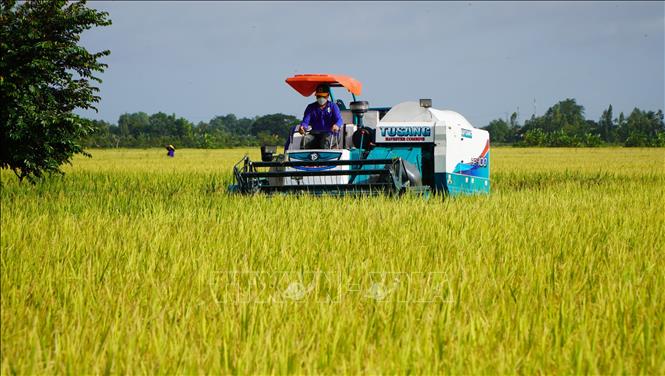
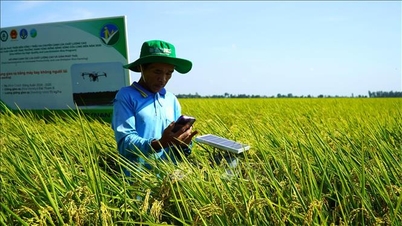
According to the Ministry of Agriculture and Environment , the total area covered by the project has reached 312,734 hectares, exceeding the target by more than 132,700 hectares. In particular, the seven pilot models implemented in Can Tho, Vinh Long, Dong Thap, and An Giang have clearly demonstrated the economic and environmental effectiveness of the new production approach. On the same unit area, production costs decreased by 8.2-24.2%; seed quantity decreased by 30-50%; chemical fertilizer use decreased by 30-70 kg/ha; the number of pesticide applications decreased by 1-4 times; and irrigation water usage decreased by 30-40%. Meanwhile, productivity increased by 2.4-7%, and farmers' income increased by 12-50%, equivalent to a profit increase of 4-7.6 million VND/ha compared to traditional farming.
In addition to economic benefits, the project also creates a significant environmental impact. Greenhouse gas emissions are reduced by an average of 2-12 tons of CO₂ equivalent per hectare, and the practice of burning straw after harvest is significantly improved, contributing to reduced air pollution and secondary emissions.
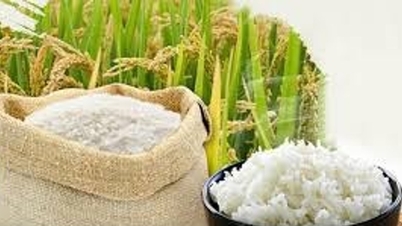
Building upon that production foundation, the Vietnam Rice Industry Association (VIETRISA) has developed and launched the "Green Vietnamese Rice with Low Emissions" brand, considered a new "passport" for Vietnamese rice in the integration process. Recently, VIETRISA certified over 71,400 tons of rice meeting the standards. Notably, in May 2025, Vietnam became the first country to successfully export 500 tons of low-emission rice to the Japanese market. Although this figure is still modest compared to the total amount of rice exported, it is considered a milestone signifying confidence and affirming Vietnam's ability to practice sustainable agriculture on a large scale.
According to National Assembly Vice Chairman Le Minh Hoan, the greatest value of the 1 million hectare rice project lies not in the area or yield, but in the change in farmers' behavior. From a mindset of "doing a lot" to "doing it right," from chasing quantity to focusing on quality, efficiency, and environmental responsibility. Vietnamese rice is not just a commodity, but also a commitment to consumers and future generations regarding a path to sustainable development, however difficult and slower.
Former Minister of Agriculture and Rural Development (now the Ministry of Agriculture and Environment), and Chairman of the Board of Directors of the International Rice Research Institute (IRRI), Cao Duc Phat, assessed that the project has created three major breakthroughs. Firstly, a breakthrough in awareness, affirming that this is the correct and almost only path for the sustainable development of Vietnam's rice industry, increasing farmers' income and addressing environmental and climate change issues.
Secondly, there is a breakthrough in production efficiency. If the project is implemented correctly, Vietnam could achieve the lowest cost per kilogram of rice among rice-producing countries, while simultaneously generating the highest profits for farmers. Thirdly, there is a breakthrough in market access, as rice will compete not only on price but also on green standards and low emissions.
Building on those achievements, Mr. Cao Duc Phat suggested that the project needs three new breakthroughs: a surge in market opening to create momentum for expanding cultivated areas; perfecting the coordination mechanism and effectively utilizing resources to support farmers, businesses, and scientists; and especially unlocking and concentrating financial and credit resources, including international funding for green agriculture.
At the local level, An Giang – the largest rice granary in the Mekong Delta – is also one of the localities that implemented the project early and systematically. According to Mr. Tran Thanh Hiep, Deputy Director of the Department of Agriculture and Environment of An Giang province, by 2025 the area of high-quality rice will account for 59% of the total production area of the province, striving to reach nearly 70% by 2026. The entire province has established 375 high-quality rice growing areas, with nearly 700 cooperatives and about 46,000 members, and is continuing to improve their quality.
Mr. Hiep believes that in the future, the project will have more advantages as businesses play a leading role, along with a strong reorganization of community agricultural extension forces down to the commune level. This is an important foundation for expanding the recognition of the "Green Vietnamese Rice with Low Emissions" brand and encouraging businesses to participate more deeply in the supply chain.
However, the implementation of the project also faces many challenges, such as the lack of synchronized irrigation and rural transportation infrastructure in some areas; limited market linkage capacity of cooperatives; the straw value chain not yet clearly formed; and the fact that the measurement, reporting, and emission assessment (MRV) work is new and lacks specialized personnel.
Aiming to sustainably develop over 351,000 hectares of high-quality, low-emission rice by 2030, An Giang will focus on implementing the MRV system; boosting investment in irrigation and logistics infrastructure; promoting digital transformation in growing area management and traceability; and simultaneously implementing preferential credit packages for farmers and cooperatives, and attracting businesses to invest in processing linked to raw material areas.
From a business perspective, Mr. Huynh Van Thon, Chairman of the Board of Directors of Loc Troi Group, believes that for the project to succeed, the key factor remains the market outlet. Lessons from the large-scale model farm implemented since 2011 show that if the market problem is not solved, it is impossible to organize large-scale raw material areas, and even less possible to ensure long-term benefits for farmers.
To address each "bottleneck," the Ministry of Agriculture and Environment has issued the Measurement, Reporting, and Verification (MRV) procedure for greenhouse gas emissions and the procedure for producing high-quality, low-emission rice in the Mekong Delta. According to Deputy Minister of Agriculture and Environment Tran Thanh Nam, this is not just a technical requirement, but the starting point for transforming Vietnam's rice production methods towards a green, smart, circular, and low-emission approach. The Ministry hopes that localities, businesses, cooperatives, and farmers will cooperate synchronously to make these procedures the new standard in rice production in the Mekong Delta from the 2025-2026 Winter-Spring crop season.
Source: https://baotintuc.vn/kinh-te/lan-toa-san-xuat-lua-chat-luong-cao-gan-voi-giam-phat-thai-20260115190838822.htm



![[Image] Hanoi's urban life under the challenge of a "scorching hot" environment](https://vphoto.vietnam.vn/thumb/1200x675/vietnam/resource/IMAGE/2026/05/25/1779706979265_nang-nong-t5-2026-minh-duy-7-4636-jpg.webp)





















































Comment (0)