


According to the General Statistics Office's press release on the labor and employment situation in the first quarter of 2025, 1.35 million young people (aged 15-24) are unemployed and not participating in education or training, accounting for 10.4% of the total youth population. Specifically, the rate of unemployed and not participating in education or training among young people is 8.2% in urban areas and 11.7% in rural areas; the rate of unemployed and not participating in education or training among young women is 11.5%; and among young men it is 9.3%.
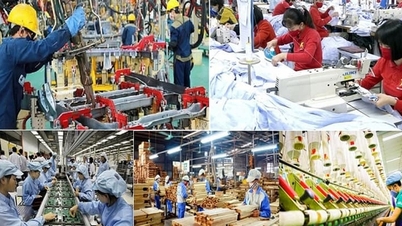
Meanwhile, hundreds of thousands of university and college graduates enter the labor market each year, increasing competitive pressure while the number of jobs tends to shrink. This reveals an increasingly evident paradox: an abundant supply of young labor but a lack of stable employment.
One of the key reasons is the rapid development of science and technology, especially artificial intelligence (AI), automation, and digital transformation. These advancements are replacing many traditional jobs, while new positions require high-level professional skills, adaptability, and creative thinking—qualities that not all young people are adequately equipped with.
Many businesses today tend to prioritize high-quality personnel over mass recruitment, leading to job shortages for workers. Furthermore, fierce competition in the labor market comes not only from domestic workers but also from international talent. Vietnam's deep integration into the global economy opens up many opportunities but also brings intense competitive pressure. Young people, in addition to competing with their peers, must also face experienced candidates from other countries with strong foreign language skills, technological expertise, and professional work ethics. On the other hand, there remains an imbalance between training and the actual needs of businesses. Many graduates lack practical skills and fail to meet job requirements, forcing businesses to retrain them from scratch or prioritize hiring experienced individuals. Meanwhile, some young people tend to choose "easy jobs with high salaries," lacking the drive and willingness to gain experience from low-level entry-level positions.
Ms. Luu Kim Loan, a graduate in Public Relations from Van Lang University ( Ho Chi Minh City), shared with students at Thu Dau Mot University who are looking for part-time jobs: “I graduated almost 3 years ago, and currently I'm helping with my family's business while also searching for a suitable job. Since graduating, I've tried and worked full-time at two companies, but I didn't feel they were a good fit. It's not just me; many of my classmates are also having difficulty finding jobs. Some can't find work at all, while others find jobs with very low incomes or jobs that are unrelated to their field of study.”
It is evident that, despite graduating from prestigious universities and majoring in "hot" fields, young people do not automatically have an easy time developing their careers. This reality demands that educational institutions improve their training programs to align with practical applications, and strengthen cooperation with businesses so that students have opportunities for internships and exposure to real-world work environments.
Young people need to proactively equip themselves not only with professional knowledge but also with soft skills, technological proficiency, foreign languages, and especially a lifelong learning mindset to adapt to the ever-changing labor market.
Simultaneously, social organizations need to continue improving policies to support entrepreneurship, career guidance, and the connection between labor supply and demand, especially in rural and remote areas where job opportunities remain limited.
In the digital age, employment is not simply a fixed position but a continuous journey of learning and adaptation. For young workers, challenges are also opportunities if they know how to seize them, innovate their thinking, and prepare thoroughly for life. Only then will the dream of stable employment and sustainable development truly be within reach for the younger generation.
According to the General Statistics Office's press release on the labor and employment situation in the first quarter of 2025, 1.35 million young people (aged 15-24) are unemployed and not participating in education or training, accounting for 10.4% of the total youth population. Specifically, the rate of unemployed and not participating in education or training among young people is 8.2% in urban areas and 11.7% in rural areas; the rate of unemployed and not participating in education or training among young women is 11.5%; and among young men it is 9.3%. |
QUYNH NHU
Source: https://baobinhduong.vn/lao-dong-tre-va-thach-thuc-trong-ky-nguyen-so-a349108.html
























![[Photo] Reception to welcome General Secretary and President To Lam and his wife on their State visit to the Philippines](https://vphoto.vietnam.vn/thumb/1200x675/vietnam/resource/IMAGE/2026/06/01/1780295488620_vna-potal-chieu-dai-chao-mung-tong-bi-thu-chu-tich-nuoc-to-lam-va-phu-nhan-tham-cap-nha-nuoc-toi-philippines-8798060-7855-jpg.webp)

































































Comment (0)