

The underground parking lot has become a wasteland.
The corner of Nguyen Dinh Chieu and Tran Nhan Tong streets, where a four-story smart parking facility was planned many years ago, remains just a temporary parking lot on the sidewalk, primarily serving restaurants and offices. In other words, the smart parking facility still exists only on paper.
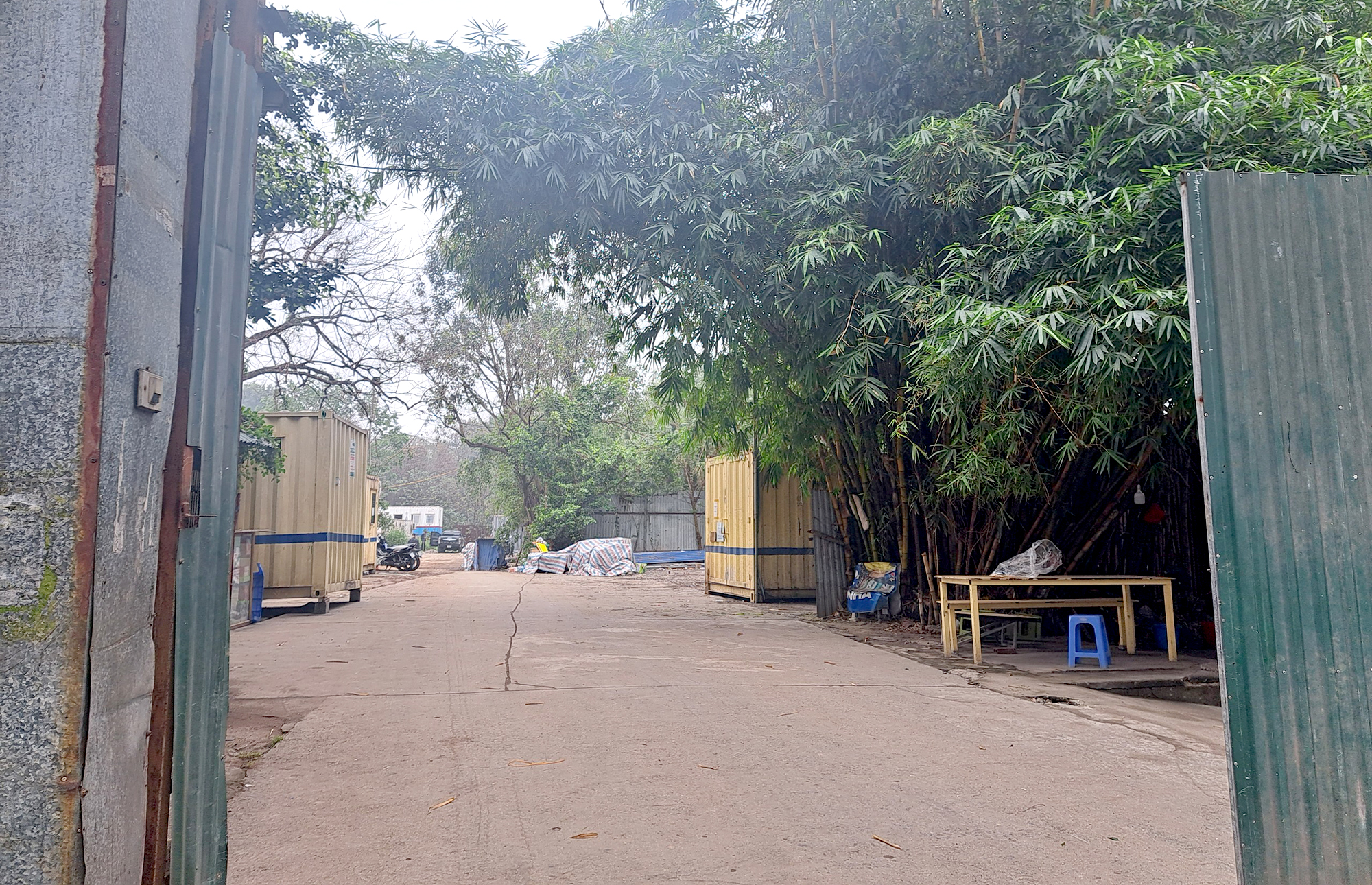
The underground parking project at 295 Le Duan Street remains an abandoned plot of land after 16 years.
Not far from there, at 295 Le Duan Street, the planned three-story underground parking lot project is just a large plot of land enclosed by corrugated iron, overgrown with weeds and littered with trash.
Ms. Nguyen Thi Phuong, a resident nearby, shared: "In the city center, there are no houses to live in, land is worth hundreds of millions of dong per square meter, but a vast strip of land, thousands of square meters, is lying idle. It's such a waste."
Similarly, the area of gardens next to the Temple of Literature, which was planned to be used as an underground parking lot, is also at a standstill, becoming an abandoned vacant plot of land.
In the core district of Hoan Kiem, the planned parking spaces included six underground parking lots, totaling approximately 5 hectares, located in the Dong Xuan Market area, Phung Hung - Bat Dan flower garden, the Nhan Dan Newspaper printing house site, Dong Kinh Nghia Thuc Square, 19-8 Square and adjacent flower gardens, and the courtyard of the Vietnam-Soviet Friendship Cultural Palace. However, to date, there has been no indication that these parking lots will be constructed.
Because designated parking areas were not implemented as planned, city authorities were forced to adopt a temporary solution: granting permits for parking along streets, on part or all of the sidewalk. However, even utilizing the road and sidewalks only meets a small fraction of the public's needs.
According to research by the Institute of Transport Strategy and Development, Ministry of Transport , the total area of static traffic in Hanoi is over 90 hectares, only meeting 8-10% of the parking demand.
This has led to a proliferation of illegal, improperly planned, and poorly located parking spaces.
Businesses are not enthusiastic.
Explaining the delays in constructing underground parking lots, the Hanoi Department of Planning and Architecture stated that the legal framework related to investment and construction has undergone many changes, leading to prolonged time for the preparation, appraisal, approval, and implementation of investment projects.
According to the plan for bus stations and parking lots in Hanoi until 2030, with a vision to 2050, by 2050 Hanoi will have 1,620 public parking lots, including 73 underground ones.
According to statistics from the Hanoi Department of Transport in December 2023, the city was currently investing in 96 parking lot projects.
Of these, 18 projects have completed investment and construction, 12 projects have received approval/decision to terminate investment, and 66 projects are currently under investment.
The number of parking lots that have been or are being invested in is only equivalent to about 5% of the set target; about 1% of the parking lots have been completed.
Meanwhile, a representative from the Hanoi People's Committee stated that the city annually organizes investment promotion conferences to attract investors for land-use projects, including projects to build parking lots and terminals.
However, due to the unattractive location and site for attracting investment in public parking lots and terminals, the results have been very limited.
Furthermore, the initial investment costs for public parking projects are quite high, and the time and feasibility of recouping the investment are questionable, making businesses hesitant to invest.
Mr. Nguyen Xuan Luu, Director of the Department of Finance, shared: " The government stipulates that the land lease fee for underground parking lots will be subsidized at 10% of the surface land lease fee."
While the investment capital for above-ground parking lots is very low, the investment capital for underground parking lots is very high, and parking fees are regulated.
To attract investment, we need mechanisms in place, including interest rate subsidies."
Mr. Vo Thanh Tung, Head of the Urban Management Department of Tay Ho District, argued that, given the current mechanisms not being truly attractive for the socialization of parking lots, some key projects should be invested in by the state.
Untangling the mechanism
According to information from the Traffic Newspaper, the Hanoi City People's Council has just issued Resolution 07, approving a number of specific policies on investment in the construction of underground parking projects such as: 100% support for land lease fees for the first 10 years, starting from the date the obligation to pay land lease fees for parking lots arises;
100% of import taxes payable on equipment and technology lines imported directly for the parking lot construction project will be subsidized.
Investors are permitted to utilize up to 30% of the total underground floor area of the project as per the planning regulations for the investment and operation of commercial and other services.
In addition, the Hanoi Department of Transport also advised the Hanoi People's Committee to issue some specific mechanisms such as: Allowing investors to sell some underground parking spaces after the investment is completed;
Within a radius of approximately 500m around the planned parking areas, temporary parking on the road or sidewalk is not permitted;
Establish a separate pricing mechanism for parking fees at privatized parking lots, in order to facilitate investors' quick return on investment…
A representative from a large parking management company stated: "Previously, our company was assigned by the city to research several underground parking lots in the area. However, in reality, the cost of building underground parking lots is very high, hundreds of billions of dong, and the long-term return on investment makes it difficult to see profitability."
"In recent years, although the city has opened up its mechanisms more, the reality is still not commensurate with the capital invested by investors."
For example, the investment cost for an underground parking lot at 295 Le Duan Street amounts to several hundred billion VND. So how many years would it take to recover the capital? Instead of thinking like that, business people would use that money to buy dozens of houses to rent out and see the profit," this representative emphasized, adding that having traveled to many countries around the world, he found that the fastest way to build underground parking lots is for the State to invest the money and then hold a bidding process.
Currently, many countries are doing this to serve the needs of their citizens. Without a truly "flexible" mechanism, it would be difficult to attract investors to underground parking facilities.
Source
![[Image] Close-up view of the interchange connecting the two expressways and Long Thanh Airport.](https://vphoto.vietnam.vn/thumb/1200x675/vietnam/resource/IMAGE/2026/05/25/1779703378210_ndo_br_z7863716673926-224453a31600126cce10622af6290afd-4549-jpg.webp)

![[Image] Hanoi's urban life under the challenge of a "scorching hot" environment](https://vphoto.vietnam.vn/thumb/1200x675/vietnam/resource/IMAGE/2026/05/25/1779706979265_nang-nong-t5-2026-minh-duy-7-4636-jpg.webp)


































































































Comment (0)