

According to the latest announcement from FIFA, 170 referees have been selected for the biggest World Cup in history, including 52 main referees, 88 assistant referees, and 30 VAR referees. Of these, Asia has 25 representatives, with 8 main referees from Qatar, Saudi Arabia, Japan, Australia, China, Jordan, UAE, and Uzbekistan.
There's no shortage of people, but a shortage of… "standards".
As mentioned above, Southeast Asia and South Asia are two regions of Asia without referee representatives. This is nothing new. It has happened so many times at the World Cup that it has almost become an unofficial rule. Each World Cup, a few names from Southeast Asia are included in the watchlist, creating a glimmer of hope. Then, in the final list, everything returns to the familiar state: Southeast Asia continues to be left out of the competition.
There will be some regrets for candidates like Nazmi Nasaruddin (Malaysia) or Sivakorn Pu-udom (Thailand). However, World Cup referees are not selected simply to have enough representatives, but rather must meet the highest standards. These standards are not built on a few good matches or a few FIFA training courses, but on a consistent performance at the highest level.

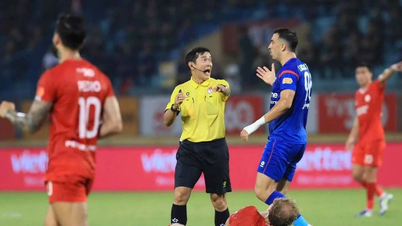
The tournament needs to be upgraded soon, so that one day Vietnam will have referees officiating at the FIFA World Cup. (Image for illustrative purposes only). Photo: QUANG LIÊM
Southeast Asia has no shortage of referees. However, it lacks a crucial element: a standardized system for referees to mature. Regional tournaments remain vibrant, attracting spectators, generating excitement, and sparking controversy. In some rounds, the debate over refereeing even outweighs the debate over the referees' performance. In such an environment, referees sometimes only have to learn how to… “survive.” And “survival” is vastly different from “meeting World Cup standards.”
The belief isn't strong enough yet.
A good referee needs not only to follow the rules but also to have sufficient credibility to control the game. However, credibility cannot exist in an environment where every decision is habitually questioned. When trust is insufficient, every decision is easily drawn into controversy. When controversy becomes commonplace, the standards gradually descend to acceptable levels.
From a certain perspective, Southeast Asia isn't exactly lacking in potential. However, it's also a place where many things are just right: the tournaments are just watchable, the pressure is just bearable, and the standards are just high enough to avoid collapse. When everything is just right, the fact that there will be no representatives at the FIFA World Cup 2026 also becomes… "just right".
Meanwhile, in stronger football leagues within the AFC, referees are assigned to matches where errors are virtually nonexistent. The pressure there is immense. Therefore, the absence of referees from Southeast Asia at the 2026 World Cup is an inevitable consequence.
FIFA is not obligated to favor one region over another. They simply select those who meet the highest standards. Southeast Asia doesn't lack talent. But it lacks the system to produce truly top-tier players. The gap isn't in a single selection or exclusion decision, but in a preparation process that has never truly reached its full potential.
If the aforementioned issues are not changed soon, the absence of Southeast Asian referees will not stop at the 2026 FIFA World Cup.
FIFA doesn't "lack" referee slots for the Southeast Asian region; they just lack reasons to choose them.
When the tournament doesn't meet the standards, and trust isn't strong enough, referees can't reach the level required for the FIFA World Cup 2026.

Source: https://nld.com.vn/loi-giai-chuan-trong-tai-196260413210621253.htm
![[Photo] The General Secretary, President and his wife begin their state visit to the Philippines.](https://vphoto.vietnam.vn/thumb/1200x675/vietnam/resource/IMAGE/2026/05/31/1780230559452_anh-man-hinh-2026-05-31-luc-19-28-11.png)

![[Image] Hanoi Police officially crowned champions of V-League 2025/2026](https://vphoto.vietnam.vn/thumb/1200x675/vietnam/resource/IMAGE/2026/05/31/1780244769054_ndo_br_039d561b692be875b13a-jpg.webp)




















![[Video] Sunset at Lap An Lagoon – Where the sun sets over the fishing nets](https://vphoto.vietnam.vn/thumb/340x192/vietnam/resource/IMAGE/2026/05/31/1780192137701_beach-landscape-sea-water-nature-grass-745871-pxhere-com.jpeg)



![[Photo] Solemn bathing ceremony and Buddha procession in Hue](https://vphoto.vietnam.vn/thumb/1200x675/vietnam/resource/IMAGE/2026/05/31/1780228263543_1-jpg.webp)
![[Photo] Admire the coral "masterpiece" amidst the million-year-old heritage of Dak Lak province.](https://vphoto.vietnam.vn/thumb/1200x675/vietnam/resource/IMAGE/2026/05/31/1780221235105_anh-man-hinh-2026-05-31-luc-16-53-27.png)

























































Comment (0)