

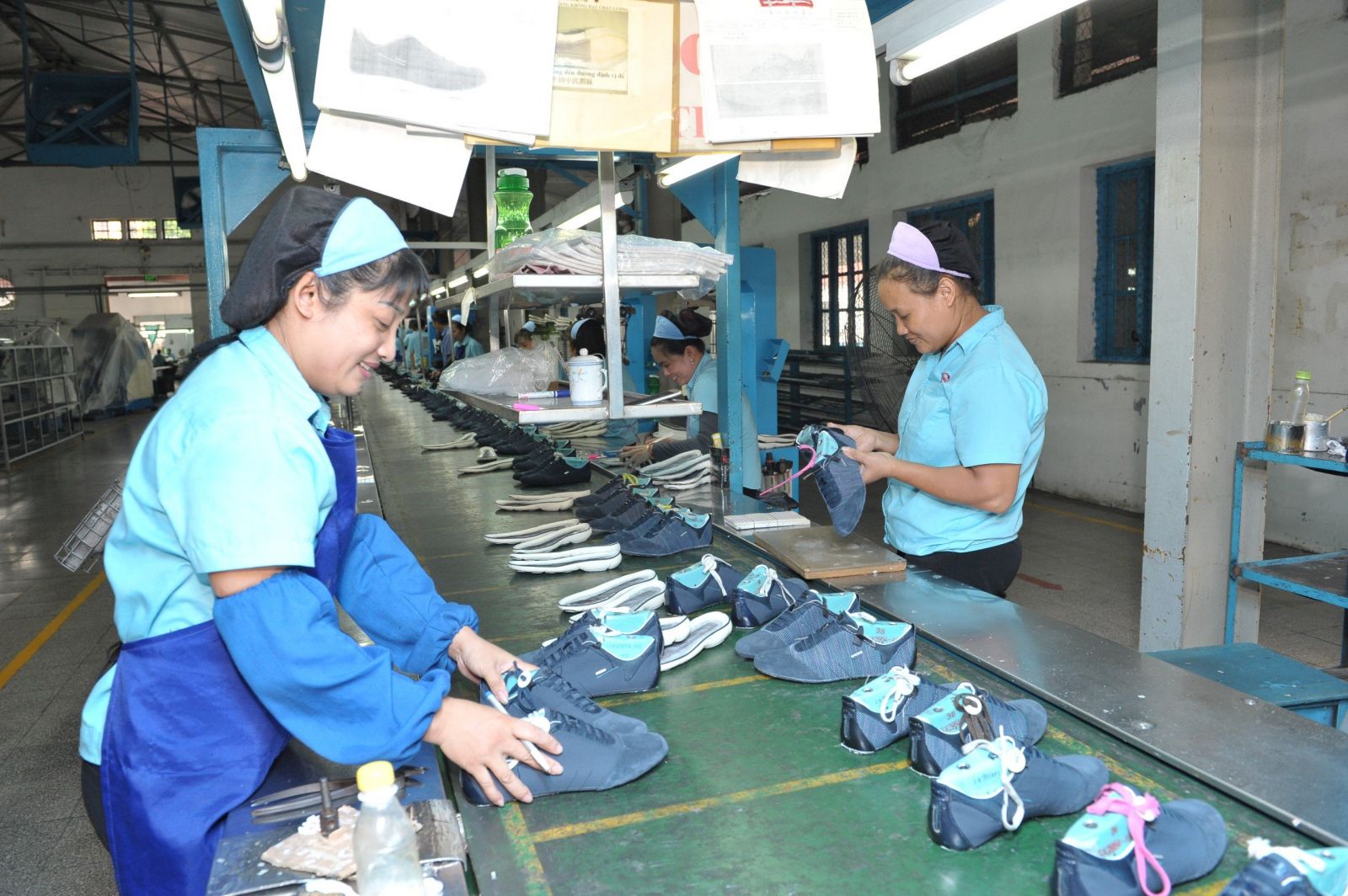
Raw materials and components still have to be imported.
According to the Vietnam Leather and Footwear Association (LEFASO), 10 years ago, the localization rate of leather and footwear products was only 40%, but now the average has increased to 55%. In some cases, such as sports shoes, the localization rate can reach 70-80%, and canvas shoes can have almost 100% of their raw materials and components sourced domestically.
In fact, the entire industry has 129 enterprises investing in the production of raw materials and components, but only about 20 domestic enterprises are capable of supplying high-quality raw materials, making it difficult for leather and footwear manufacturers to secure orders and raw materials.
With competitive pricing, convenient transportation, diverse product types, and high quality, China remains the largest supplier of raw materials and components for Vietnam's footwear industry, accounting for approximately 35%; followed by Thailand with 11.8%; Italy with 10.3%, and so on. In addition, domestic footwear businesses also import leather from the US, South Korea, and other markets, although the proportion from each market is not significant.
Regarding the above issue, Mr. Nguyen Van Khanh - Permanent Vice Chairman of the Ho Chi Minh City Leather and Footwear Association - said that the supporting industry for the leather and footwear sector has been discussed for many years but has not yet met the expectations of the State, businesses, manufacturers, etc., and requires a longer-term roadmap.
Many experts believe that Vietnam's footwear industry is facing great opportunities from free trade agreements, but whether or not these opportunities can be taken advantage of depends on the development of supporting industries and domestic raw materials.
Currently, a large amount of raw materials for the footwear industry still have to be imported. Notably, footwear raw materials are only concentrated for mid-range and upper-mid-range products, while the rest still have to be imported, resulting in low added value for the industry. Every year, some businesses still have to import materials such as: leather, technical fabrics, molding accessories, soles, plastics, adhesives, chemicals, etc.
Focus on long-term solutions.
LEFASO points out that, in the near future, the Vietnamese footwear industry will participate in the production of more high-end shoe lines. Therefore, domestic businesses need to focus on developing new technologies and high-quality raw materials and components. To meet these conditions, businesses must improve and innovate the quality of their workforce as well as their production facilities, especially by using clean energy and green technologies to meet EU standards.
For the footwear industry, the shift is from producing traditional products to manufacturing mid-range and high-end products, including common and fashionable leather shoes and handbags. For products serving the domestic market, there is a stronger focus on developing fashionable designs, researching and applying new materials, and paying attention to market demand research.
At numerous industry-related events, LEFASO has proposed that the State support the formation of specialized industrial zones for the leather and footwear industry, focusing on the production of tanned leather, technical fabrics, molding accessories, soles, etc., in a way that facilitates environmental protection and centralized production, developing the supporting industry with appropriate mechanisms and policies. Furthermore, the starting point for enterprises producing supporting products is still low, their capacity is weak, and they are almost unable to meet excessively large orders…
Facing the goal of developing raw materials and auxiliary materials for the footwear industry, Vietnam needs a synchronized mechanism, policies, and solutions to attract investment from multinational corporations; and to connect domestic enterprises to participate in the supply chain of raw materials and auxiliary materials for foreign-invested enterprises. The footwear industry is currently following constantly changing fashion trends, therefore, the footwear supporting industry needs to be developed in line with these trends.
Some experts suggest that the State needs to support the formation of specialized industrial zones for the footwear industry, focusing on the production of leather, technical fabrics, molding accessories, soles, etc., in a way that facilitates environmental protection and organized production, developing supporting industries with appropriate mechanisms and policies. Furthermore, the starting point for businesses producing supporting products is still low, their capacity is weak, and they are almost unable to meet excessively large orders…
The issuance of policies to develop footwear industrial clusters in each region is a new, highly effective and feasible development direction. Simultaneously, there needs to be a synchronized mechanism, policies, and solutions to attract investment from multinational corporations; and to connect domestic businesses to participate in the supply chain of raw materials and components for foreign-invested enterprises.
However, to build a closed production chain for the industry, solutions for developing supporting industries need to prioritize domestic enterprises, helping them withstand fluctuations in the global market and preventing foreign investors from exploiting rules of origin to gain advantages in exports. Increasing the localization rate or developing supporting industries remains a difficult challenge for many sectors, not just the footwear industry. However, with sufficient determination and early preparation, we still have the opportunity to achieve rapid progress in the future.
Furthermore, to promote the development of supporting industries, it is necessary to build, refine, and effectively and synchronously implement specific mechanisms and policies for the development of priority supporting industries; and continue to implement preferential interest rate policies for supporting industry enterprises... On that basis, focus on developing domestic value chains through attracting effective investment and promoting business connections and linkages between Vietnamese enterprises and multinational corporations, domestic and foreign manufacturing companies.
Based on that, it is necessary to focus on promoting the development of supporting industries for the leather and footwear sector, synchronizing mechanisms, policies, and solutions to attract investment from multinational corporations; and connecting domestic enterprises to participate in the supply chain of raw materials and components for foreign-invested enterprises.
Source: https://moit.gov.vn/tin-tuc/phat-trien-cong-nghiep/cong-nghiep-ho-tro-nganh-da-giay-loi-giai-nao-cho-bai-toan-thieu-nguyen-lieu-.html


![[Image] Central Party Office summarizes work in 2025](/_next/image?url=https%3A%2F%2Fvphoto.vietnam.vn%2Fthumb%2F1200x675%2Fvietnam%2Fresource%2FIMAGE%2F2025%2F12%2F18%2F1766065572073_vptw-hoi-nghi-tong-ket-89-1204-jpg.webp&w=3840&q=75)































































Comment (0)