

President Ho Chi Minh once taught about self-study: "In learning, self-study is the essence." Similarly, the renowned scientist Albert Einstein famously said: "Knowledge is only acquired through human thought." And to develop the thinking skills necessary to acquire knowledge, the best way is through self-study.
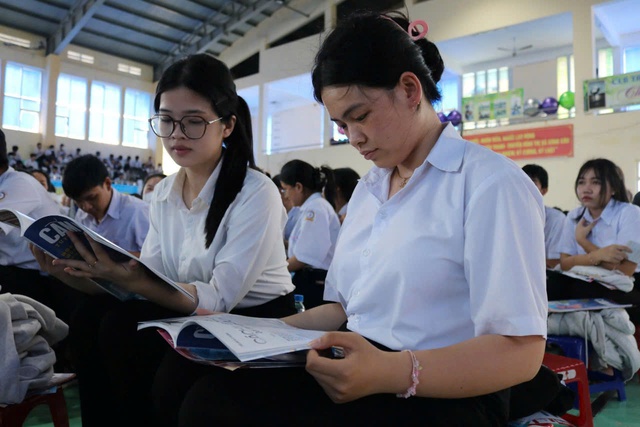
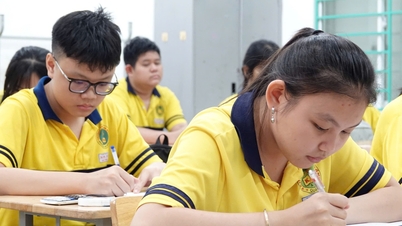
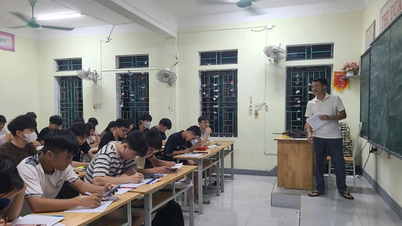
Students in Phu Yen province learned about admissions, career paths, and effective study methods during the 2025 Exam Season Counseling program organized by Thanh Nien Newspaper in the province last weekend.
Photo: Tran Bich Ngan
Why is self-learning skill important?
Returning to the quote by physicist Albert Einstein, the reason we must self-study to acquire lasting knowledge is that only when we actively seek out and explore information ourselves can we best retain it. If we only passively listen to teachers' lectures, solve problems, or spend all our time on extra classes, we have fewer opportunities to discover and master knowledge on our own.
For example, in mathematics, if students are in class or attending extra classes, they have very little time to think and find solutions to problems because they are pressed for time. However, with self-study, students have the freedom to ponder, research materials, and find solutions. And when they solve a problem, they will remember the solution very well and for a long time.
Similarly, in social science subjects, online interaction helps students engage in multi-dimensional interactions, view issues objectively, and make informed choices about right and wrong, good and bad, rather than being limited by a single subjective perspective.
Tips on self-learning
Previously, scholar Nguyen Hien Le (1912-1984) also advised students on self-study. In his book "A Guide for Students ," Nguyen Hien Le discussed the necessity of students knowing how to organize their self-study at home. This included focusing on creating a reasonable study schedule, choosing a suitable study space (paying attention to noise and lighting), forming study groups, selecting books, and developing effective self-study methods for each subject.
Nowadays, students need to pay extra attention to selecting and using learning materials effectively when self-studying; how to combine classroom lessons/lectures with self-reference materials; and how to interact on social media... these are all important requirements.
Scholar Nguyen Hien Le also advised students to maintain hygiene, eat a balanced and scientific diet, and exercise regularly to improve their studies, because according to him, "a healthy body leads to a clear mind."
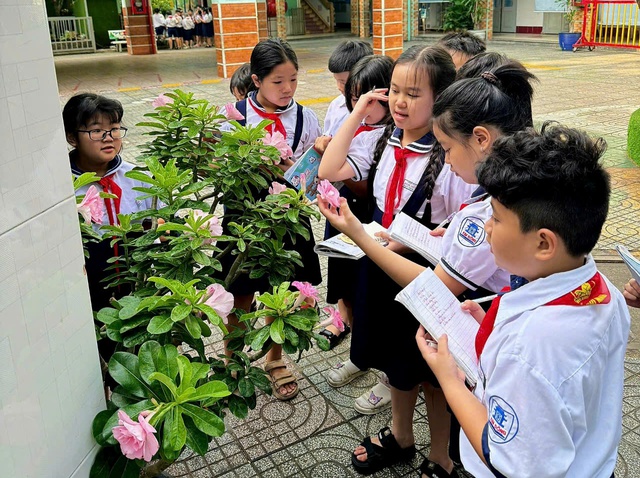
The writing lesson was held outdoors in the school garden for the teacher and students of class 4/8 at Kim Dong Primary School, Go Vap District, Ho Chi Minh City.
PHOTO: HN
Professor Tran Van Khe (1921-2015), a renowned researcher of traditional Vietnamese culture and music, also outlined effective self-learning methods for long-term retention. In his book, *Stories from the Heart* , In a 2010 article published by NXB Trẻ (Youth Publishing House), Professor Tran Van Khe shared his insights on how to learn quickly and retain information for a long time. He mentioned that during his high school years at Petrus Ky High School (now Le Hong Phong Specialized High School in Ho Chi Minh City), he devised many effective learning methods. These included utilizing everything that helped him remember to retain information accurately and for a long time; simplifying complex knowledge; and incorporating poetry and acting to make learning more enjoyable.
For example, to remember important historical events, Professor Tran Van Khe often looked for significant events along with their corresponding timeframes. For instance, to remember the French Revolution of 1789, he would look in Vietnamese history for the event of King Quang Trung's victory at the Battle of Dong Da, driving the Qing army out of the country. Similarly, when studying Chinese history and the Tang, Song, Yuan, Ming, and Qing dynasties, where remembering the exact years was difficult, Professor Tran Van Khe simplified it by rounding: the Tang dynasty spanned three centuries (7th, 8th, and 9th); the Song dynasty spanned three centuries (10th, 11th, and 12th); the Yuan dynasty spanned one century (13th); the Ming dynasty spanned three centuries (14th, 15th, and 16th); and the Qing dynasty spanned three centuries (17th, 18th, and 19th). While this method wasn't precise in terms of years, it made remembering the centuries easier.
At the age of 90, Professor Tran Van Khe continued to innovate in his memorization skills. Professor Tran Van Khe shared that to remember a 10-digit phone number, he broke it down into groups of numbers and linked them to other things like his date of birth, the floor number he lived on, etc.
Clearly, for effective and lasting learning, each student needs to develop self-learning skills.
Source: https://archive.vietnam.vn/loi-khuyen-cua-nguoi-noi-tieng-ve-tu-hoc/
![[Photo] Secretary of the National Assembly Party Committee, Chairman of the National Assembly presides over the meeting of the Standing Committee and Executive Committee of the National Assembly Party Committee.](https://vphoto.vietnam.vn/thumb/1200x675/vietnam/resource/IMAGE/2026/06/03/1780480353201_ndo_br_bnd-2585-jpg.webp)

![[Photo] General Secretary and President To Lam presides over a meeting with the Central Organizing Committee.](https://vphoto.vietnam.vn/thumb/1200x675/vietnam/resource/IMAGE/2026/06/03/1780482764658_a1-bnd-4741-3342-jpg.webp)















![[Photo] First session of the 14th Congress of the Vietnam Trade Union](https://vphoto.vietnam.vn/thumb/1200x675/vietnam/resource/IMAGE/2026/06/03/1780465947883_ndo_br_img-3852-jpg.webp)





















![[Video] Sunset at Lap An Lagoon – Where the sun sets over the fishing nets](https://vphoto.vietnam.vn/thumb/1200x675/vietnam/resource/IMAGE/2026/05/31/1780192137701_beach-landscape-sea-water-nature-grass-745871-pxhere-com.jpeg)































Comment (0)