

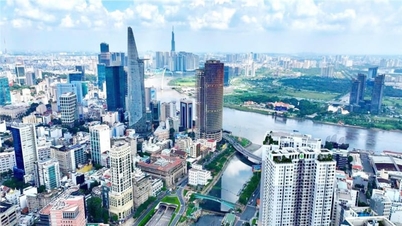
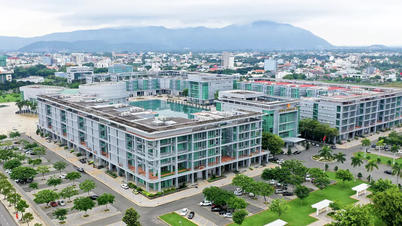
Resolution 09-NQ/TW of the Politburo positioned Ho Chi Minh City as a national growth pole, an international financial center, an innovation hub, and a regional linkage nucleus. The message was clear: the city could no longer be managed as a conventional administrative unit.
Ho Chi Minh City's socio -economic activities have now transcended administrative boundaries, forming a closely interconnected development space. Management methods can no longer follow the old mindset: fragmentation based on geographical boundaries, heavy bureaucracy, and a slow response to the evolving development.
At the same time, Vietnam's logistics costs remain among the highest in the region. Traffic pressure at Ho Chi Minh City's gateways is increasing. Issues such as flood control, environmental protection, connectivity infrastructure, and public transportation are no longer within the purview of individual localities. As development space operates according to the demands of a modern city, governance thinking must change.
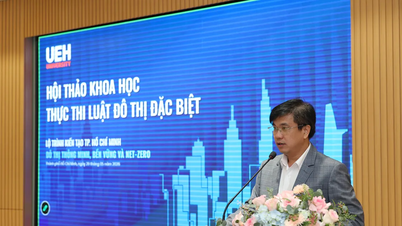
Therefore, the Law on Special Urban Areas should not merely grant more administrative authority, but must create a genuine regional governance mechanism. What Ho Chi Minh City needs is not just more power, but sufficient legal capacity to coordinate interconnected issues related to infrastructure, logistics, data, environment, and shared development space.
The law needs to create a regional coordination mechanism with sufficient authority, a robust interconnected financial mechanism, and a transparent, data-driven monitoring system. This is the fundamental difference between a large city and a modern city with international competitiveness. A modern city does not compete based on its size or building density, but on the quality of its governance and operational efficiency.
In the digital age, paper-based governance and decentralized administrative processes are no longer suitable for the fast-paced nature of a large city. Modern cities need to manage traffic, planning, logistics, and public services in real time, based on transparent data and integrated digital platforms.
Institutional reform today cannot simply stop at cutting a few administrative procedures; it must shift to a flexible, transparent, and data-driven governance model. The spirit of a controlled testing (sandbox) mechanism in the draft law is therefore the right direction. But the issue is not whether or not to open up, but how to open up in a way that both promotes innovation and controls institutional risks.
Resolution 09 is not just about economic growth or large-scale projects. Issues such as quality of life, public transportation, flood control, the environment, green development, and building a "civilized, modern, and compassionate" city are clearly emphasized. A city may have more skyscrapers, more projects, and a higher GDP, but if its residents still have to live with prolonged traffic congestion, increasing pollution, and ever-growing living costs, then that is not sustainable development.
The measure of success for the Law on Special Urban Areas lies not in the number of special mechanisms enacted, but in whether we can thoroughly change the mindset of urban governance. This is not just a story for Ho Chi Minh City, but also a challenge regarding the urban development model of Vietnam for many decades to come.
Source: https://www.sggp.org.vn/luat-do-thi-dac-biet-can-tu-duy-quan-tri-post855668.html

![[Photo] First session of the 14th Congress of the Vietnam Trade Union](https://vphoto.vietnam.vn/thumb/1200x675/vietnam/resource/IMAGE/2026/06/03/1780465947883_ndo_br_img-3852-jpg.webp)






















![[Photo] Delegation attending the 14th Congress of the Vietnam Trade Union visits the Mausoleum of President Ho Chi Minh.](https://vphoto.vietnam.vn/thumb/1200x675/vietnam/resource/IMAGE/2026/06/03/1780451842301_ndo_br_img-3824-jpg.webp)






















































Comment (0)