Taxpayer segmentation management
The amended Law on Tax Administration comprises 9 Chapters and 53 Articles, in line with the principle of "legalizing major principles and policies; assigning detailed regulations to the Government" as per Conclusion 119-KL/TW dated January 20, 2025. The Law fully stipulates the rights, obligations, responsibilities, and principles of tax administration under the authority of the National Assembly; at the same time, it assigns the Government and the Ministry of Finance to provide detailed regulations on frequently changing technical and operational aspects, in accordance with the spirit of Resolution 66-NQ/TW, to ensure flexibility and improve the efficiency of administrative procedures.
One of the important new provisions of the Law is the addition of regulations on classifying taxpayers into groups, and the addition of principles for tax authorities. Deputy Minister of Finance Do Thanh Trung said that this is an important legal basis for tax authorities to shift from the previous functional-based tax management method to a management method based on taxpayers combined with functions.
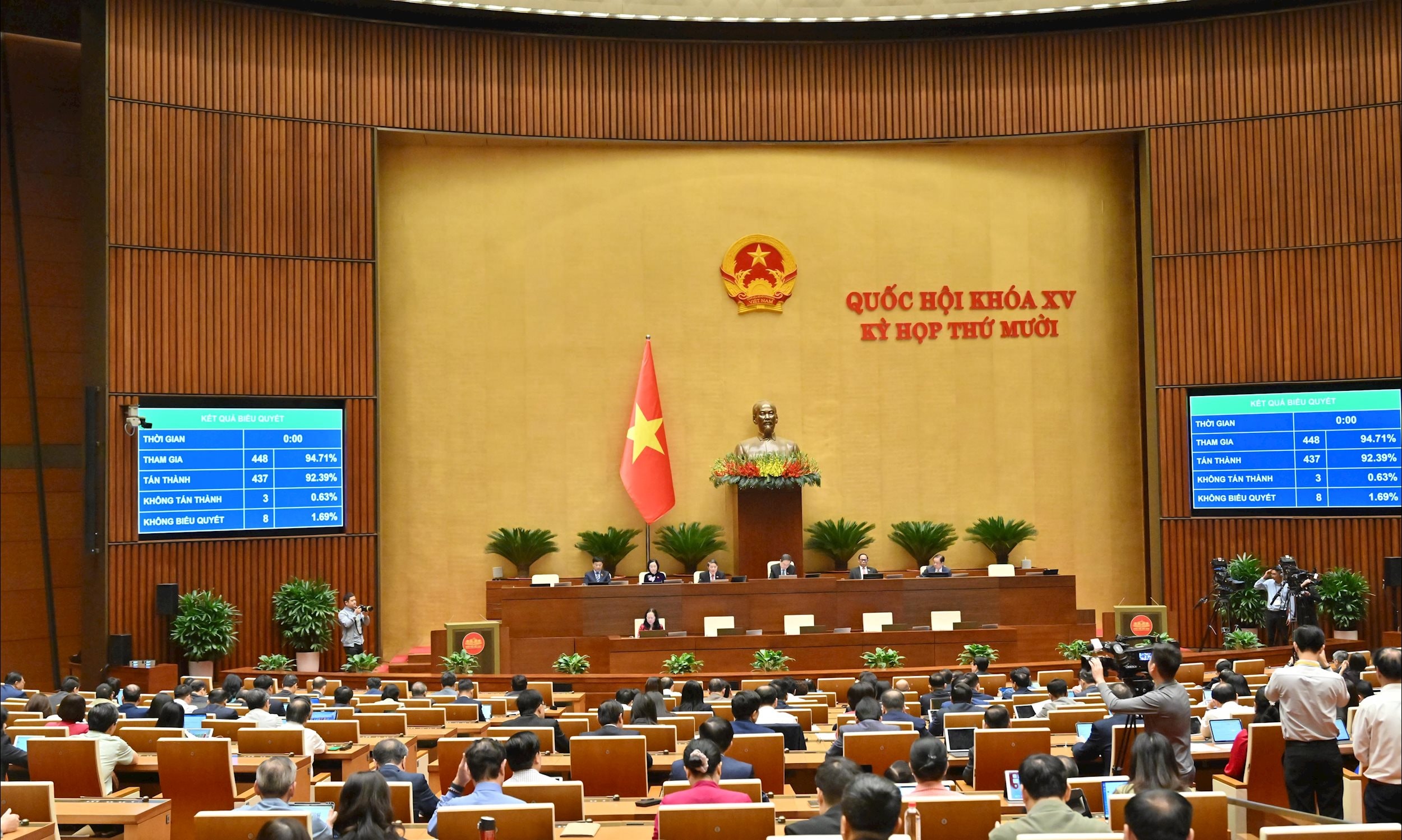
The National Assembly voted to pass the amended Law on Tax Administration on December 10, 2025. Photo: Quang Khánh
In addition, the Law has added provisions stipulating that business households and individual businesses declare and calculate taxes based on a percentage of revenue, with tax rates and calculation methods prescribed by tax laws, and are supported by the tax authorities in filing tax returns based on the tax authority's database and information provided by the taxpayer.
The law also adds provisions on the principles of international cooperation and international tax administration to meet the requirements of international cooperation and protect Vietnam's legitimate tax rights. It includes provisions on compliance management with a preferential regime for taxpayers with good compliance; an integrated information system providing full-process online public services, connecting to the national database; tax authorities being allowed to purchase commercial databases; ensuring information security; and taxpayers not being penalized when system failures lead to the failure to fulfill obligations on time.
Another notable change is the amended law regulating complaints, denunciations, and dispute resolution regarding taxes; it also includes provisions for resolving tax disputes with foreign elements.
Specifically, Article 41 of Chapter VIII of the Law stipulates the following regarding complaints, denunciations, and dispute resolution concerning taxes:
Taxpayers, organizations, and individuals have the right to file complaints with competent authorities regarding administrative decisions and actions of tax authorities or authorized personnel within tax authorities when there are grounds to believe that such decisions or actions are unlawful and directly infringe upon their legitimate rights and interests. Complainants are informed of the complaint resolution process and procedures through the Tax Management Information System as prescribed by law.
Individuals have the right to report violations of tax laws by taxpayers, tax officials, or other organizations or individuals.
The authority, procedures, and processes for resolving complaints and denunciations shall be carried out in accordance with the provisions of the law on complaints and denunciations.
Tax disputes with a foreign element between taxpayers who are foreign or Vietnamese organizations or individuals and Vietnamese tax authorities, relating to tax obligations arising in Vietnam or abroad, may be resolved through: Complaint procedures as prescribed by law on complaints; Litigation procedures as prescribed by law on administrative litigation; Dispute resolution mechanisms as stipulated in international tax treaties; contracts, agreements and government guarantees and other international treaties to which the Socialist Republic of Vietnam is a member or signatory (if any).
In addition, Article 42 also stipulates the responsibilities and powers of tax authorities in resolving tax-related complaints.
Specifically, tax authorities that receive complaints regarding the implementation of tax laws have the right to request the complainant to provide relevant documents and records; if the complainant refuses to provide the documents and records, the tax authority has the right to refuse to consider and resolve the complaint.
The tax authorities must refund the incorrectly collected tax, other charges, late payment penalties, and fines to taxpayers and third parties within 15 days of receiving the decision from the competent authority.
For complex complaints, the head of the tax administration agency, as the person handling the complaint, shall consult with relevant agencies and organizations, including those involved in the initial complaint. When conducting this consultation, the head of the tax administration agency must issue a decision establishing a Consultation Council. The Consultation Council operates on the principle of majority voting. The voting results serve as the basis for the head of the tax administration agency to consider when making a decision on handling the complaint. The head of the tax administration agency is the person who makes the decision and is responsible for that decision.
Comprehensive digital transformation in tax administration.
According to Deputy Minister of Finance Do Thanh Trung, a key focus of the amended Law on Tax Administration is the comprehensive digital transformation of tax administration (in all aspects, from management methods, organizational structure, and human resources to the way administrative procedures are carried out, ensuring information security in the digital environment). This includes comprehensively reforming administrative procedures, implementing full-process online public services, building an e-tax agency based on a centralized integration of taxpayer data, automating tax administration processes and functions, and applying AI to support compliance, operational processing, inspection, penalties, enforcement, and automatic tax refunds. It also involves connecting national databases and sharing information with relevant agencies and organizations. Furthermore, it includes provisions on the legal validity of electronic administrative decisions and the automatic issuance of decisions from system applications (to implement Resolution No. 57-NQ/TW and Project 06).

Deputy Minister of Finance Do Thanh Trung introduced the basic contents of the amended Law on Tax Administration.
In addition, the Law has amended and improved several provisions to ensure clarity, consistent application of the law, and protection of taxpayers' rights. This includes focusing on improving regulations regarding the rights and responsibilities of taxpayers and tax authorities in tax administration; the principles of tax administration; the confidentiality and disclosure of taxpayer information; and prohibited acts in tax administration.
The law has also amended and supplemented regulations to improve the effectiveness, efficiency, and simplification of administrative procedures in tax management, focusing on perfecting regulations on building the tax management force; on tax registration and tax identification numbers; on tax declaration and tax calculation; on handling overpaid taxes; on handling late payment penalties; on tax refunds; on tax exemptions and reductions; on debt restructuring and debt write-offs; on tax audits and measures applied in tax audits; on collecting information and temporarily seizing related documents in cases of suspected tax evasion; on tax assessment; on electronic invoices; and electronic documents.
In addition, the new Law delegates authority to the Government in 32 articles and to the Ministry of Finance in 24 articles, in accordance with the policy outlined in Resolution No. 66-NQ/TW. "The amendments and additions in the draft Law ensure that no new administrative procedures are created, and guarantee seamless, complete processes in an electronic environment," the Deputy Minister of Finance affirmed.
The law takes effect from July 1, 2026. However, the provisions in Article 13 and the use of electronic invoices by household businesses and individual businesses in Article 26 of this Law take effect from January 1, 2026, in accordance with the policy of abolishing lump-sum tax as stipulated in Resolution No. 68-NQ/TW and Resolution No. 198/2025/QH15.
Source: https://daibieunhandan.vn/luat-quan-ly-thue-sua-doi-doi-moi-phuong-thuc-quan-ly-thue-10410788.html



![[Image] Close-up view of the interchange connecting the two expressways and Long Thanh Airport.](https://vphoto.vietnam.vn/thumb/1200x675/vietnam/resource/IMAGE/2026/05/25/1779703378210_ndo_br_z7863716673926-224453a31600126cce10622af6290afd-4549-jpg.webp)
![[Image] Hanoi's urban life under the challenge of a "scorching hot" environment](https://vphoto.vietnam.vn/thumb/1200x675/vietnam/resource/IMAGE/2026/05/25/1779706979265_nang-nong-t5-2026-minh-duy-7-4636-jpg.webp)








































































































Comment (0)