

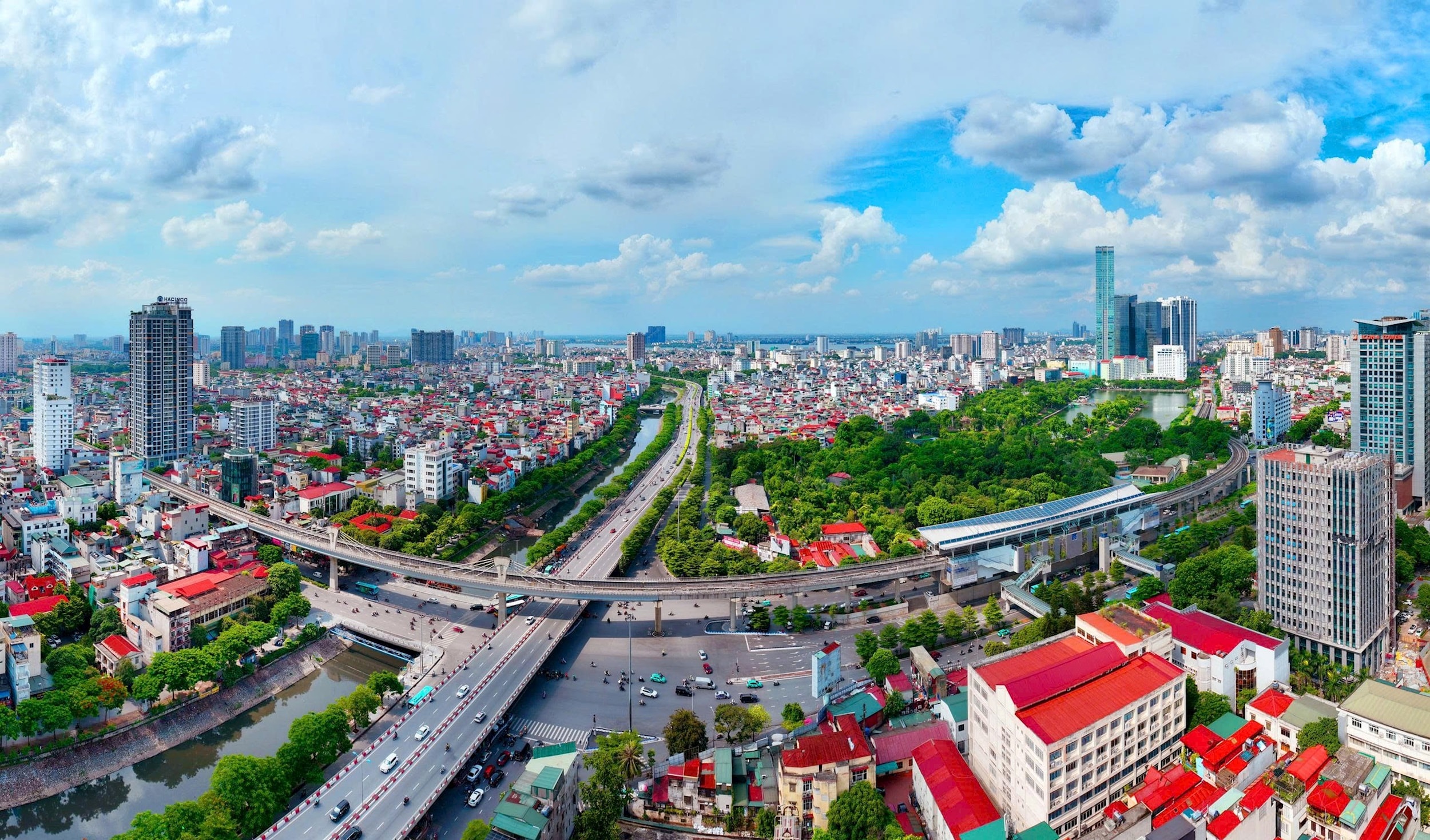
This is not just a legal adjustment, but also opens up opportunities for the capital city to play its role as the leading force, center of innovation, and driving engine of national growth.
From a "give and take" approach to proactive decision-making and taking responsibility.
For many years, one of the biggest bottlenecks to Hanoi 's development has been the gap between the governance requirements of a special megacity and the still uniform legal framework applied to all localities. As urbanization accelerates, population growth increases, infrastructure investment demands, digital transformation, and the resolution of urban problems become increasingly complex, the old management mechanisms gradually reveal their limitations.

In reality, many policies necessary for urban development require lengthy consultations with ministries and agencies, or guidance from the central government. This often prevents Hanoi from responding quickly enough to the urgent demands of the situation.
In this context, the Capital City Law of 2026 is seen as an institutional breakthrough, focusing on the substantive and comprehensive decentralization of power to the city government.
Article 4 of the Law affirms that the principle of decentralization must be thoroughly implemented, clearly defining the authority of the People's Council, the People's Committee, and the Chairman of the People's Committee of the city. Beyond simply delegating power, the Law also opens up mechanisms for the city government to further decentralize authority to lower levels, ensuring continuous, flexible, and practical operation.
A notable point is the spirit of "empowerment coupled with responsibility." The law requires all decentralization activities to ensure openness, transparency, accountability, control of power, and prevention and combating corruption and negative practices. At the same time, a monitoring and evaluation mechanism is designed to allow for timely adjustments if implementation is ineffective.
According to experts, this represents a major shift in governance thinking. Previously, local authorities often operated with a mindset of "requesting special mechanisms," but now Hanoi is given the opportunity to proactively decide on many important issues, while also bearing greater responsibility for governance outcomes.
The 2026 Law on the Capital City represents a major breakthrough by granting Hanoi nearly 200 powers, many of which are entirely new and unprecedented in the current legal system. This significant decentralization of power to the capital, including the authority to issue legal regulations and pilot special mechanisms, demonstrates the National Assembly 's confidence in Hanoi's leading role. However, alongside this expansion of power, there must be mechanisms to control that power, strengthen supervision, ensure accountability, and improve the quality of the officials implementing the policies.
National Assembly representative Ta Van Ha ( Da Nang City delegation)
Speaking to the press at the time the National Assembly was considering the amendment to the Capital City Law, many National Assembly deputies argued that Hanoi needed to be granted "stronger autonomy" due to its scale, role, and unique challenges that few other localities face. Accordingly, the special mechanism is not a privilege but a necessary condition for the capital city to operate effectively and create a ripple effect of development for the region and the entire country.
One of the notable points is the provision on the application of law in Article 5. Accordingly, in case of a difference between the Law on the Capital City and other laws or resolutions of the National Assembly on the same issue, the Law on the Capital City shall take precedence. This is considered a "special legal framework" for Hanoi to proactively resolve long-standing bottlenecks.
Furthermore, if the central government later issues new mechanisms that are more favorable or advantageous to other localities, the City People's Council has the right to decide which ones to apply to ensure the development interests of the capital city. This regulation helps Hanoi avoid "institutional backwardness" in development competition, while also creating the necessary flexibility for modern urban governance.
Creating new institutional spaces for innovation and creativity.
Another notable breakthrough of the 2026 Capital City Law is the expansion of Hanoi's powers in organizing its administrative structure, civil service system, and developing its own policies.
According to Article 7, the City People's Council is granted broad authority in deciding on the organizational structure, the structure of specialized agencies, the number of People's Council representatives at the commune level, the staffing and job positions of civil servants and public employees. In particular, Hanoi is allowed to develop income policies for its staff, civil servants, public employees, and workers receiving salaries from the city's budget.
This is considered a significant breakthrough in the context of increasingly fierce competition for high-quality human resources. A special urban area that wants to be effectively governed needs a highly skilled and capable civil service to meet the requirements of smart city management, digital government, and new development models.
The argument is that, without sufficiently strong mechanisms to retain talented individuals, the public sector will struggle to compete with private and international businesses.
Another notable new feature is that the City People's Committee has the right to regulate policies and measures for organizing the implementation of digital administration and digital public services; promoting grassroots democracy and mobilizing citizens to participate in local governance.
This shows that the Law not only expands the powers of the government but also aims for a more modern model of governance, in which citizens become active participants rather than merely beneficiaries of policies.
In addition, Article 8 grants Hanoi the authority to issue legal documents with various contents or those not yet regulated by the central government, in order to meet the development requirements of the capital city.
In other words, Hanoi is no longer passively waiting for guidance documents in every case, but can proactively design governance tools that suit practical requirements, as long as they comply with the Constitution, do not violate international treaties, and adhere to the principles of transparency and full impact assessment.
This is considered a major step forward in public administration, because for a special urban area like Hanoi, the speed of policy response is crucial to development effectiveness.
Previously, many new models faced difficulties due to a lack of legal basis, but now, the Law on the Capital City opens up a broader institutional space for innovation, administrative reform, and digital transformation.
Breakthroughs must go hand in hand with checks and balances.
One provision highly praised by many experts is Article 9, which regulates the piloting of new mechanisms and policies. According to this provision, Hanoi is authorized to pilot mechanisms and policies that differ from laws and resolutions of the National Assembly, or address issues not yet regulated by law, in order to meet practical development needs.
The pilot program has a very broad scope, ranging from organizational models, public service, science and technology, education, healthcare, digital transformation to urban management, high-tech agriculture, resource mobilization, and addressing issues that directly affect people's quality of life.
This means Hanoi could become the country's "institutional laboratory," where new models are tested before being replicated.
However, the Law also sets very strict "technical barriers." The pilot program must not restrict human rights or civil rights, nor harm national defense, security, social order, or the investment and business environment.
Each pilot mechanism must clearly define its objectives, scope, timeframe, risk management measures, monitoring mechanisms, and accountability.
Experts believe this is a progressive approach, creating room for controlled experimentation and ensuring both innovation and system security.
It can be seen that the core of the 2026 Capital City Law lies not only in the number of new mechanisms and policies, but more importantly in the change in governance thinking: from model-based management to practice-based governance; from a "request-and-grant" mechanism to decentralization with accountability; and from administrative management to development-oriented management.
With greater empowerment, Hanoi also faces higher demands for governance efficiency, transparency, and accountability to the people.
But it is precisely within this pressure that opportunities for breakthroughs also arise. Because if the superior mechanisms of the Capital City Law are effectively utilized, Hanoi can not only solve the internal problems of a special urban area but also become a model of modern governance, contributing institutional experience to the whole country in the new development phase.
The Capital City Law of 2026 can be considered a very important milestone, creating a unique legal foundation for Hanoi to develop faster and more sustainably in the new phase. The law stands out with three major breakthroughs: breakthroughs in institutions, breakthroughs in development thinking, and breakthroughs in development space.
Firstly, a breakthrough in institutional reform: The Capital City Law grants greater autonomy and responsibility to the Hanoi city government in developing and implementing mechanisms and policies appropriate to the capital's specific characteristics. Hanoi has been granted increased decentralization and delegation of power in state management, particularly in organizational structure, personnel management, and socio-economic development.
Secondly, a breakthrough in development thinking: The law guides the construction of a new development model for the capital city based on innovation, digital transformation, green economy, circular economy, and new economic models. This is the foundation for Hanoi to develop rapidly but sustainably, improving the quality of life for its people.
Thirdly, a breakthrough in development space: The law expands the mechanism for regional linkages between Hanoi and localities within and outside the Capital Region; at the same time, it creates a mechanism for developing urban space in depth, such as underground space, low-level space, and provides direction for exploiting high-level space in the future.Lawyer Nguyen Ngoc Hung, Head of Connect Law Office (Hanoi Bar Association)
Source: https://hanoimoi.vn/luat-thu-do-nam-2026-ha-noi-but-pha-tu-co-che-dac-thu-757745.html

![[Image] Hanoi's urban life under the challenge of a "scorching hot" environment](https://vphoto.vietnam.vn/thumb/1200x675/vietnam/resource/IMAGE/2026/05/25/1779706979265_nang-nong-t5-2026-minh-duy-7-4636-jpg.webp)


![[Image] Close-up view of the interchange connecting the two expressways and Long Thanh Airport.](https://vphoto.vietnam.vn/thumb/1200x675/vietnam/resource/IMAGE/2026/05/25/1779703378210_ndo_br_z7863716673926-224453a31600126cce10622af6290afd-4549-jpg.webp)
























































































Comment (0)