

Claudine Gay faced intense criticism in the US for her ambiguous stance on antisemitism, accusations of plagiarism, and a decline in credibility with donors, before ultimately resigning.
Claudine Gay announced her resignation as president of Harvard University on January 2nd, returning to teaching and research on African Americans at the university. Gay said it was a difficult decision, but in the best interests of the school.
The Harvard University Board of Governors accepted Gay's resignation and appointed Alan M. Garber, an economist and academic director, as interim president.
Claudine Gay only took office last July. She is the shortest-serving president in Harvard University's nearly 390-year history, since its founding in 1636.
Analysts believe Gay faced heavy criticism for failing to adequately respond to calls for the genocide of Jews on campus. She was also suspected of plagiarism and was the reason some donors considered ceasing their support for Harvard.
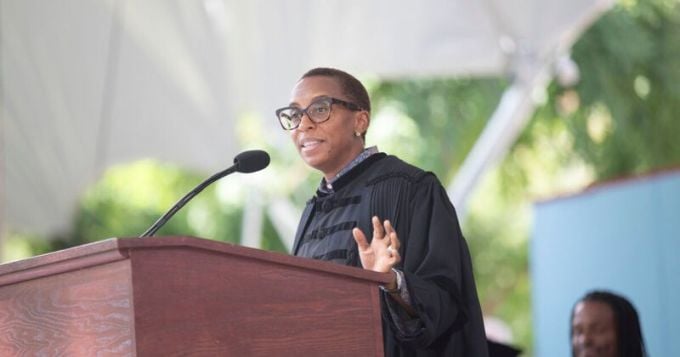
Claudine Gay four months ago, when she welcomed the Class of 2027. Photo: Harvard University
The Israel-Hamas conflict, which began on October 7th, has led to debates and protests against Jews, or antisemitism, in American schools.
Thirty Harvard student groups sent an open letter asserting that "Israel is entirely responsible for all the violence taking place" and calling for "action to stop the ongoing destruction of the Palestinians." The letter sparked outrage, while Gay and the school board were also criticized for not publicly condemning the Hamas attack.
Three days later, under pressure from donors and alumni, Gay issued a statement condemning Hamas and asserting that "no student group speaks on behalf of Harvard University."
Amid escalating tensions, and to ensure a safe and inclusive educational environment, the U.S. Department of Education launched several investigations in late November into anti-Semitic practices at the university. Claudine Gay and two other presidents were summoned to testify before the U.S. Congress on December 5th. There, Gay declined to directly answer questions about how the school handled the tensions, stating that a balance had to be struck between protecting freedom of speech and ensuring student safety.
When asked whether calling for the genocide of Jews would violate Harvard's anti-bullying policy and asked to answer yes or no, Claudine replied: "Possibly, depending on the circumstances. When words turn into action, we will get involved."
Claudine's ambiguous stance has angered many Harvard alumni and donors, who are calling for her resignation. Seventy U.S. lawmakers also signed a letter requesting that the boards of directors of three universities participate in a hearing to remove the president from office.
Trouble continued for Gay when The Washington Free Beacon published 39 allegations of plagiarism in her research. The publication focused its analysis on her 1993 essay in the history journal Origins, her doctoral dissertation at Harvard, and two articles from 2012 and 2017.
In particular, the 1997 doctoral dissertation titled "Taking Power: Black Elections and the Redefining of American Politics " was accused of incompletely citing large sections from a 1996 work by Bradley Palmquist and Stephen Voss, which had previously been awarded for its excellence.
This violates Harvard's citation rules, which state that "taking any idea or language from another person without citing the source in your writing constitutes plagiarism."
However, the school board denied the allegations, stating that they had noticed flaws in her research beforehand, but that they did not violate research principles and showed no signs of plagiarism.
Following these controversies, Claudine Gay is believed to have lost credibility with Harvard's donors. For the past three years, the university has consistently received over $50 billion in donations, largely from alumni. In 2023, donations accounted for approximately 45% of Harvard's budget. However, some alumni are planning to withdraw their donations.
Bill Ackman, the billionaire and CEO of Pershing Square, strongly criticized Gay and announced he would withdraw his multi-billion dollar donation to the school, according to The Guardian. The Len Blavatnik family, who had previously contributed over $200 million to Harvard, also stopped donating.
Alumni are also upset that the number of early applications for Harvard's 2024 admissions season is only about 7,900, a 17% decrease from last year and the lowest in four years.
"Many alumni are very upset about how the university handled the crisis," said Sam Lessin, a technology investor and Harvard alumnus.
While many were pleased by Ms. Gay's resignation, a number of people expressed concern about the potential divisions within society. They argued that the criticism directed at her stemmed from racist sentiments, according to The Guardian. Some said Gay was chosen as headmistress not for her qualifications, but because of the school's goal of promoting diversity.
The Harvard University Board, while thanking Gay for her contributions as president, also condemned some of the "racist" remarks directed at her. Amidst the criticism last December, 700 Harvard faculty members still petitioned to keep Gay as president.
Ms. Gay said she experienced racist personal attacks after her testimony at the hearing.
"It is heartbreaking that my commitments to eliminating hostility and maintaining academic discipline have been questioned. I have been subjected to personal attacks and racial threats," Gay wrote in the letter on Tuesday.
Claudine Gay, 53, is the first Black president in Harvard University's history. Born to a family of Haitian immigrants in New York, she is an expert on politics and African Americans in the United States. Last year, she took office after the U.S. Supreme Court rejected the use of race as a criterion for university admissions, a move seen as a breakthrough for universities.
Doan Hung ( According to The Guardian, AP )
Source link


![[Photo] Prime Minister Pham Minh Chinh attends the Conference on the Implementation of Tasks for 2026 of the Industry and Trade Sector](/_next/image?url=https%3A%2F%2Fvphoto.vietnam.vn%2Fthumb%2F1200x675%2Fvietnam%2Fresource%2FIMAGE%2F2025%2F12%2F19%2F1766159500458_ndo_br_shared31-jpg.webp&w=3840&q=75)


















































































Comment (0)