

(NLĐO) - What scientists have always hoped for in distant extraterrestrial worlds may exist right here on the Moon, the very place that led them astray.
For a long time, most astronomers believed that Earth's only natural satellite – the ancient celestial body known as the Moon – was nothing more than a dormant mass of rock.
Evidence from the "lunar seas"—a long-standing misnomer for dark, flat volcanic basins filled with solidified lava—suggests that the celestial body was once significantly compressed in the distant past.
In particular, the large, curved ridges on the near side of the Moon, the side visible to Earth, were formed by contraction that occurred billions of years ago.
This leads to the argument that the Moon has long since ceased geological activity.
However, a new study reveals that what lies beneath the surface of the Moon may be more dynamic than we previously thought, according to Sci-News.
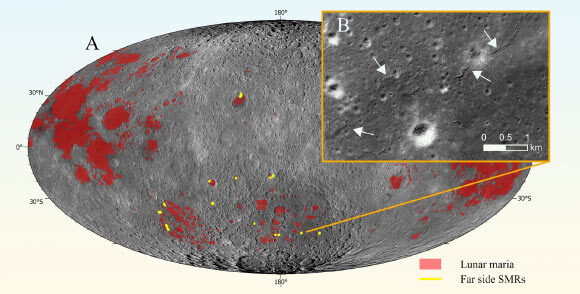
New evidence from the far side of the Moon suggests that this celestial body is not yet "dead" - Photo: Smithsonian Institute
A research team led by Dr. Jaclyn Clark from the University of Maryland has discovered 266 previously unknown mountain ranges on the far side of the Moon.
Interestingly, they are significantly younger than the previously studied ridges on the near face.
Thus, the belief that the Moon became dormant 2.5-3 billion years ago may have been "misguided".
"We found that these tectonic landforms have been active for the past billion years and may still be active today," Dr. Clark stated.
These small mountain ranges appear to have formed within the last 200 million years, a relatively recent period geologically speaking, given the comparison of the ridges they create with other surrounding topographic features.
This is reflected in the fact that very few impact craters exist in these "young" regions, because they haven't existed long enough to be heavily riddled with holes from space bombardment.
The authors also note that the ridges on the far side have a similar structure to those on the near side of the Moon, suggesting that both were created by the same force, possibly a combination of the Moon's contraction and the shifting of its orbit.
"We hope future missions to the Moon will include tools like ground-penetrating radar so researchers can better understand the structures beneath the Moon's surface," said Dr. Clark.
According to him, knowing that the Moon has been experiencing significant geological activity in the near future and may still be active is of great importance for future plans to explore this celestial body.
It is still too early to conclude what the possibility of geological activity on the Moon might hold.
However, on Earth, geological activity is one of the essential factors for stabilizing the planet's environment, enabling life to be born and survive for a long time. Therefore, scientists are always hoping to find evidence of geological activity on other celestial bodies.
Source: https://nld.com.vn/mat-trang-cua-trai-dat-song-day-gan-day-196250204094152625.htm
![[Photo] Prime Minister Pham Minh Chinh attends the Conference on the Implementation of Tasks for 2026 of the Industry and Trade Sector](/_next/image?url=https%3A%2F%2Fvphoto.vietnam.vn%2Fthumb%2F1200x675%2Fvietnam%2Fresource%2FIMAGE%2F2025%2F12%2F19%2F1766159500458_ndo_br_shared31-jpg.webp&w=3840&q=75)





























































































Comment (0)