

China's Jiuzhang quantum computer takes less than a second to process a task that the world's most powerful supercomputer currently takes nearly five years to complete.
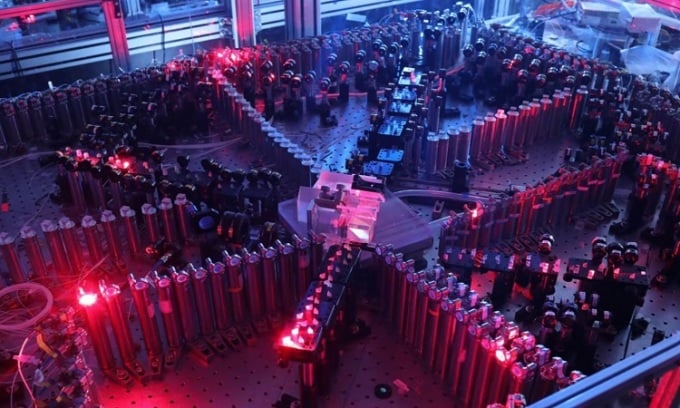
The Jiuzhang quantum computer was developed by the University of Science and Technology of China. Photo: SCMP
Chinese scientists say they have achieved a new milestone in the field of quantum computing, with their Jiuzhang device capable of performing tasks commonly used in artificial intelligence (AI) 180 million times faster than the world's most powerful supercomputer. The problems their quantum computer solves could be applied to data mining, bioinformatics, network analysis, and chemical modeling research. The research team published their experimental results in the journal Physical Review, the South China Morning Post reported on June 8th.
"Our work brings us closer to testing the problem in practice using current medium-scale quantum computers," said research team leader Pan Jianwei, a physicist at the University of Science and Technology of China.
In the study, Pan's team used Jiuzhang to solve a problem that challenges conventional computing. The machine used over 200,000 samples in the process. For the first time, researchers used a quantum computer to implement and advance two algorithms—random search and metallurgical simulation—commonly used in the field of AI.
The world's fastest supercomputer needs 700 seconds per sample, meaning it would take nearly five years to process the same number of samples. But Jiuzhang takes less than a second. This more extensive list of tasks gives quantum computers an advantage over conventional computers.
In traditional computers, bits are the basic units of information representing 0 or 1. Qubits go further, capable of representing 0, 1, or both states simultaneously. This is one of the simplest examples of the specificity of quantum mechanics. Because the basic information of a quantum computer can represent all possibilities simultaneously, theoretically, they are much faster and more powerful than the conventional computers we use in everyday life.
However, the subatomic particles at the heart of this technology are fragile, short-lived, and prone to failure if exposed to even a slight disturbance from the surrounding environment. Most quantum computers operate in extremely cold and isolated environments to avoid disruption. Jiuzhang uses light as the physical medium for computation. Unlike other quantum computers, it does not need to operate at extremely low temperatures in a sealed environment and operates stably for longer periods.
An Khang (According to SCMP )
Source link

![[Image] Nearly 125,000 Hanoi students completed the Literature exam for the 10th grade entrance exam.](https://vphoto.vietnam.vn/thumb/1200x675/vietnam/resource/IMAGE/2026/05/30/1780117233041_ndo_br_thiet-ke-chua-co-ten-2-png.webp)




































































































Comment (0)