

Ho Chi Minh City's logistics system is facing extremely serious overload pressure, especially at Cat Lai port - which handles nearly half of the country's import and export goods.
A situation that warrants attention.
Cat Lai Port is consistently operating far beyond its designed capacity, with loading levels frequently reaching 115% - 120%. The consequence is prolonged congestion; ships waiting to dock spend from 48 hours, and in some cases up to 6 days, disrupting the supply chain, significantly increasing logistics costs, and directly impacting economic efficiency.
Furthermore, major routes leading to the port, such as Nguyen Thi Dinh Street, Cat Lai Bridge, and Nguyen Huu Tho Street, are constantly congested. The massive influx of container trucks causes the average turnaround time for trucks to extend from 4 to 8 hours. This stagnation not only damages the environment with enormous emissions but also reduces the transportation efficiency of businesses.
At the same time, the development of strategic inter-regional routes remains very slow due to cumbersome legal procedures and a lack of coordination in planning. If these obstacles are not soon removed through multi-modal solutions, these vital routes will quickly become permanent bottlenecks. Inter-regional supply chains will face the risk of paralysis, preventing Ho Chi Minh City from fully realizing its enormous economic potential.
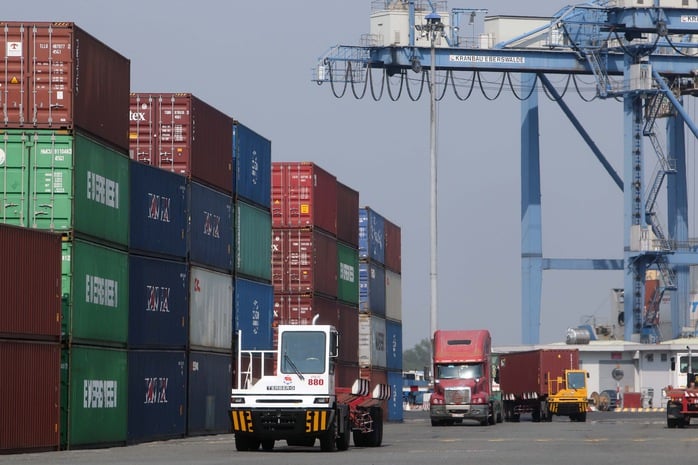
Cat Lai Port (Ho Chi Minh City) is continuously operating far beyond its designed capacity. (Photo: HOANG TRIEU)
Escape from the air
To break through current logistics bottlenecks, cable car systems (TUVs) have emerged as a revolutionary solution. TUVs operate via suspended cargo compartments, running along a robust cable network on strategic routes, connecting industrial zones and seaports to distribution centers.
The outstanding advantage of TUV is that it frees up the flow of goods from road transport. Instead of being crammed together on the ground, cargo compartments with a capacity of 30 tons – equivalent to a container truck – will move smoothly in a separate space. Traffic congestion caused by trucks will be completely eliminated. Every cargo compartment is equipped with automated technology that automatically calculates speed and direction. This allows for the application of "just-in-time" distribution methods, shortening warehousing time and providing a significant competitive advantage for businesses.
From an economic standpoint, the cost of building a TUV system is only about one-tenth of the cost of investing in a metro system. Construction speed has reached record levels, averaging 1 km completed per month, thanks to the absence of complex land acquisition or the need for large land plots. Most of the equipment and machinery can be manufactured and assembled domestically. This allows the city to proactively manage resources, significantly saving on import costs and providing a strong impetus for the development of the domestic supporting industries.
Affordable for the economy, clean for the environment.
Integrating TUV technology into regional logistics planning maps is not a distant prospect but has vivid practical evidence. In Colombia, cities like Medellín and Bogotá have successfully operated urban cable cars in complex mountainous terrain, serving tens of millions of passengers. In Japan, the 500-kilometer "Autoflow Road" mega-project connecting Tokyo and Osaka is also pioneering the trend of automated freight transport to reduce congestion. These models clearly demonstrate the feasibility of elevated transport technology.
Applied to the practical context of Ho Chi Minh City, the TUV system demonstrates perfect adaptability. The city is characterized by its high population density, intricate network of canals, and narrow inner-city roads. The TUV concrete pillars can be easily constructed across the riverine terrain, directly connecting logistics centers in Binh Duong and Dong Nai with Cat Lai Port and Long Thanh Airport without disrupting the existing urban landscape.
Furthermore, TUVs are a crucial piece in realizing the vision of a green megacity. By operating entirely on electricity and incorporating a solar panel system, TUVs ensure zero direct emissions. If they can replace 50% of the volume of goods transported by road, CO2, NOx, and PM2.5 emissions could be drastically reduced by 30% - 40%. The air quality will be significantly improved, vehicle noise will be minimized, and this will contribute to an enhanced quality of life in a civilized and modern way.
Transporting people by day, transporting goods by night.
To optimize the value delivered, the TUV system in Ho Chi Minh City can be designed as a multi-tasking model, serving both freight and passenger transport needs simultaneously. This flexible combination offers the following outstanding core benefits:
Firstly, space optimization and cost savings: Instead of investing in two separate systems, the integrated TUV system makes full use of elevated space, saving 60% - 70% of the total transportation infrastructure investment cost for the entire region.
Secondly, flexible real-time operational coordination: The system automatically prioritizes passenger compartments during peak hours to minimize traffic congestion, while maximizing cargo flow at night, fully utilizing 100% of the network capacity.
Thirdly, adaptability to regional expansion: TUV's flexible modular structure allows for easy expansion and extension of routes to keep pace with the rapid urbanization as Ho Chi Minh City connects with neighboring economic regions in its future development orientation.

Source: https://nld.com.vn/mo-loi-giam-un-tac-quanh-cang-tu-tren-cao-196260520201235408.htm
![[Photo] Ba Lang An Lighthouse - the "eye of the sea" amidst the "rock museum" of Quang Ngai province.](https://vphoto.vietnam.vn/thumb/1200x675/vietnam/resource/IMAGE/2026/05/29/1780038698840_anh-man-hinh-2026-05-29-luc-14-10-42.png)


![[Image] Pleasant weather helps students enter the 10th grade entrance exam with confidence.](https://vphoto.vietnam.vn/thumb/1200x675/vietnam/resource/IMAGE/2026/05/29/1780034401612_ngay-1-thi-lop-10-minh-duy-8-5009-jpg.webp)

































































Comment (0)