The first thing to do is to erect a fence made of sharpened bamboo sticks around the hut.
For the first few nights, we had to keep the fire burning all night. No one slept well because of the tigers' roars, sometimes near, sometimes far; it was terrifying. One night, we huddled together, holding our breath, looking out at the moonlit forest. About ten meters from the hut, two huge tigers were sitting together, mating. Every morning, the dusty red road was covered with thick tiger footprints.

|
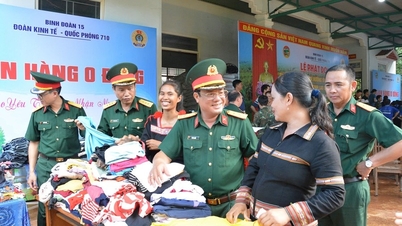
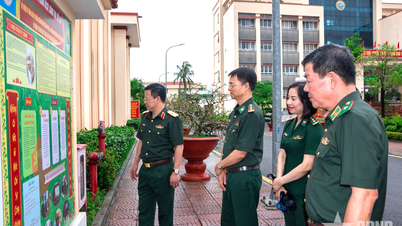
Officers from the 78th Economic -Defense Brigade, along with the author (far left), visit Le village. |
One afternoon, we were startled awake by a bloodcurdling scream. Grabbing our guns and jumping up, we caught a glimpse of a striped figure darting into the forest. On the dirt road leading to the Mo Rai Commune People's Committee, the postman, his face pale with fear, sat slumped beside his bicycle, his pith helmet bearing five tiger claw marks. The helmet had saved his life from a sudden pounce from above.
Seeing that scene, Captain Nguyen Quang Thao, the company commander, shook his head: "There are more tigers than people in this land." The statement was somewhat exaggerated, but it accurately reflected the situation. At that time, Mo Rai commune covered an area of approximately 1,580 km² ( in 2013, Mo Rai commune was divided into four communes belonging to Sa Thay district, with an area of 585 km² . From July 1, 2025, Mo Rai commune belongs to Quang Ngai province), larger than some provinces in the Northern Delta at that time, while the population was only a little over 1,000 people wandering in the forest. The villages were inhabited only by the elderly and pregnant women awaiting childbirth.
After the first few weeks of hesitation, the soldiers gradually became bolder and ventured into the villages to explore. And we witnessed some strange things.
The first strange thing is that on the roof of the communal house in Le village hangs a rattan basket containing a piece of driftwood with a tusk in its mouth and a sharp stone, which the villagers call Yang. Interestingly, Yang in Le village... can lay eggs. Round, white stones, like pigeon eggs, appear in the basket from nowhere. Every year during the festival, the villagers hold a ceremony to bathe Yang and count the eggs. According to the village elders, the more Yang lays eggs in a given year, the more bountiful the harvest will be. This is truly a mystery without an explanation.
The second strange thing is the custom of giving birth in the forest. Rơ Măm and Gia Rai women in Mô Rai, when the time comes to give birth, go to a pre-built house by the stream, give birth alone, bite the umbilical cord, take the baby down to the stream to bathe, and then chew a handful of glang leaves to regain strength. Because of this birthing custom, the maternal mortality rate is very high. When the mother dies, the newborn is buried with her. Not just the mother and child, but buried together in the same coffin as those who died before. Then, buffalo and pigs are slaughtered to offer to the spirits, and they eat, drink, cry, and laugh at the grave.
In 2003, the Border Guard Command, in coordination with the Army Literature and Arts Magazine, organized a writing contest on the theme of border defense. At that time, I was studying at the Nguyen Du School of Creative Writing and decided to return to Mo Rai. When I arrived at Le village, I was overjoyed to learn that Y Duc, the child who was buried with his mother in 1998 but rescued by the Border Guard, still had his maternal uncle, A Nul, and his older brother, A Ngan. These people didn't believe Y Duc was still alive. Seeing this, I had the idea of bringing Y Duc back to the village from the Kon Tum Provincial Social Welfare Center. My request was approved. When the UAZ vehicle of the Kon Tum Provincial Border Guard Command brought Y Duc back, the whole village of Le was shaken. The sound of gongs suddenly erupted, along with shouts, cries, and laughter. I was horrified to witness Y Duc's fear at the awkward welcome from the community that had once rejected him. Through the tearful, mournful stories of old man A Nul, I understood that the Rơ Măm people buried the baby with its mother not out of love, but out of helplessness due to circumstances. In the midst of the green forest and red mountains, without milk or medicine, the child would die anyway, so the family reluctantly buried it with its mother to avoid the need for another funeral... These details provided me with enough material and emotion to write my memoir "In the Deep Forest," the first prize winner of the competition.
Returning to Mo Rai this year, I was amazed. The concrete roads were wide and spacious. The rubber forests stretched endlessly. But what astonished me most were the people here. In the past, they lived surrounded by forests and mountains, their faces always gloomy and stagnant. Now, they are vibrant in a fresh, new environment. The Rơ Măm people, in particular, once lived in isolation, facing the threat of extinction from disease and wild animals. In 2003, only 120 people remained, but now their numbers have increased to 500. Thanks to the development of electricity, roads, schools, and health stations, and internet access reaching their homes, Rơ Măm youth have "break free" and integrated into the wider society. From a community with 100% illiteracy, the village of Le now has hundreds of children graduating from high school, and dozens graduating from college and university. Most young people in the village have become workers for the 78th Economic-Defense Brigade (15th Army Corps) with an average salary of 10 million dong per month.

|
The villagers welcomed Y Duc in 2003. |
Observing the Rơ Măm and Gia Rai workers, I clearly see a significant physical transformation. In the past, when I visited Le village, I saw that the average height of adult Rơ Măm people was only "about the height of a wine jar," but now their average height is 1.60 meters.
When visiting boarding schools in the area, I was amazed to see the Rơ Măm children. Their skin was fair, their eyes bright, and they were innocent and confident in interacting with friends and visitors. This is due not only to good nutrition but also to the fact that the Rơ Măm people have intermarried with the Kinh, Gia Rai, and Xơ Đăng people, creating healthy and intelligent generations.
During my stay in Mo Rai, I had the opportunity to attend a delightful "solidarity meal" for the workers of the 78th Economic-Defense Brigade. The breakfast was lavish, like a village feast in the Northern Delta, with fragrant ST25 rice, crispy fried pork, bone broth with potatoes... and especially two plates of pork head and offal. These ingredients were sourced from a unique livestock production area.
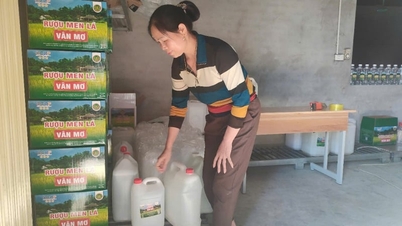
The production area is located next to the Ia Grai River, near the Mo Rai dam. A modern distillery with large stainless steel stills and a closed-loop fermentation and distillation system. Hundreds of pigs, weighing 100 kilograms each, sway intoxication from the rice wine lees in their pens. Thousands of laying ducks swim freely in large ponds... Taking advantage of the terrain, the unit has created five ponds stocked with various types of fish such as grass carp, silver carp, catfish, and common carp... The benefits of this model are not only providing clean food and drinks at lower prices than the market for workers and villagers but also creating a sustainable ecosystem. The trees are healthy, the fish are abundant, and endemic bird species such as the Kơ tia and Chơ rao have returned to Mo Rai. On nights accompanying the workers tapping rubber, in the border area between the rubber plots, I encountered herds of monkeys, deer, and wild boars...
Watching the crimson sun slowly set behind the mountains and the birds fluttering back to the forest, a strange feeling welled up inside me. From a wild land resembling a primitive society with hunting, gathering, slash-and-burn farming, and inbreeding, life in Mo Rai has now taken on the appearance of an increasingly civilized rural society, with increasingly modern agriculture .
This transformation is thanks to the Ministry of National Defense's "border green belt" strategy. Nearly 30 years of persistent implementation of this policy, the blood, sweat, and tears of generations of officers and soldiers of the Central Highlands Army Corps (3rd Army Corps), the 15th Army Corps, and the Border Guard have sown seeds in this land, resulting in sweet fruits.
Following the principle of "good land attracts good people," not only the Rơ Măm people have found peace in their land and village, but people from many ethnic groups and regions have also come to Mô Rai to settle, forming a multi-ethnic community united and closely connected in building and protecting the border. In Mô Rai, there is absolutely no illegal proselytization or opposition to the government. I met a retired teacher from Thanh Hóa. She confided that when she sent her children here to work as laborers, she thought they would have to return home after only a few months to a year. But reality has proven otherwise. She herself had to pack her bags and move to Mô Rai with her children because "life here is far better than back home."
I returned to visit the communal house where the mysterious Yang spirit resides. A Thai, a young intellectual, the village head of Le village, and a representative of the Kon Tum Provincial People's Council, said, "Yang still gives birth." Every year, the village still holds the Yang bathing ceremony, counts the eggs, and performs traditional rituals such as buffalo sacrifice, Xoang dance, gong performances, and brocade weaving... I blurted out, "What about the barbaric custom of burying children with their mothers?" Not only A Thai, but all the Rơ Măm youths standing around us were bewildered. Their bewilderment was understandable, because at their age, around 20, they had never seen such a gruesome sight before. Only the elders looked pensive, reminiscing about the distant, impoverished, and dark past.
DO TIEN THUY
Source: https://www.qdnd.vn/80-nam-cach-mang-thang-tam-va-quoc-khanh-2-9/mo-rai-rung-da-chuyen-minh-843992

















































































Comment (0)