


Too many people registered for the theater tour in Hanoi.
Writer Nguyen Truong Quy has chosen theaters and cinemas from the 1950s to tell the story of Hanoi's urban culture for a "theater tour" - " Hanoi Sings in the Past ". According to Mr. Quy, this tour will showcase the flourishing of the theater system, the spread of popular new songs, and films whose popularity still resonates today.
One example Mr. Quy gave was a tour that passed through Hanoi's first three theaters: San Nhien Dai or Lac Viet (associated with Cheo opera), Quang Lac (Tuong opera), and Chuong Vang (Cai Luong opera). "These three places are only about 150 meters apart, located in the heart of the Old Quarter. Then there's the Tri Tri Meeting Hall on Hang Quat Street, where a presentation of modern music took place on June 9, 1938, a significant milestone for a modern art form in the modernization of Vietnamese life," Mr. Quy said. Besides these, there are other theaters that hold memories for many generations, such as: Olympia (Hong Ha), Cinema Tonkinois (Thu Do), Porte d'Or (Kim Mon), Eden (Cong Nhan)…
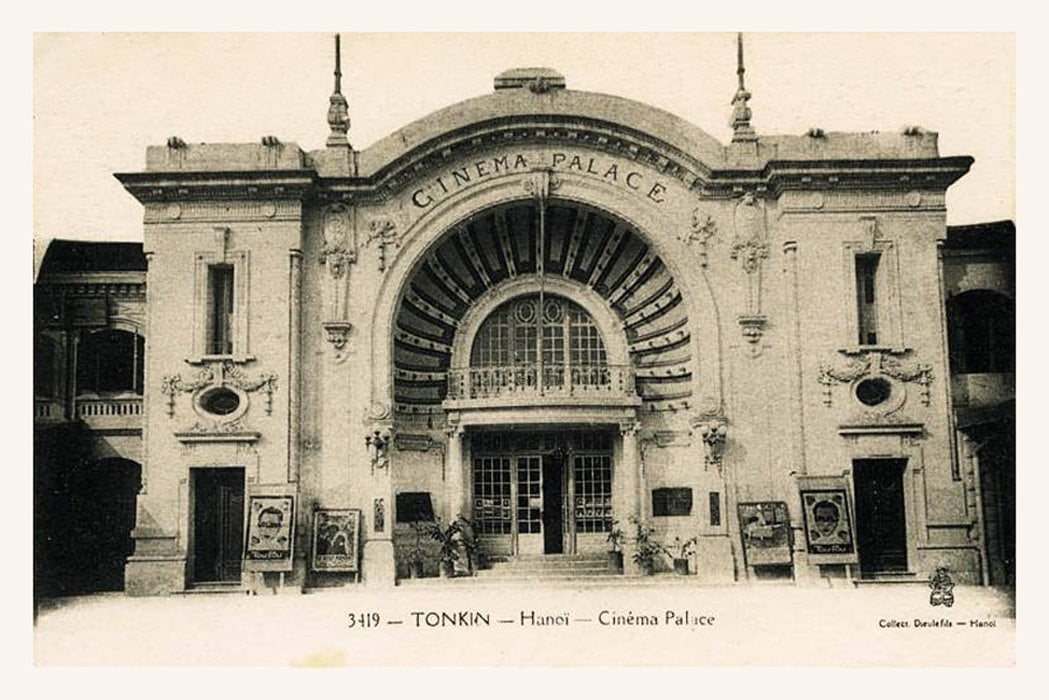
The Cinema Palace in the early 20th century, later renamed Eden and now Công Nhân, the headquarters of the Hanoi Drama Theatre, was located on Tràng Tiền Street.
PHOTO: ARCHIVE
In 2018, Mr. Truong Quy and his friends revived the theater atmosphere at Dai Dong Theater by organizing a concert by Doan Chuan and Tu Linh. At that time, Dai Dong Theater had ceased to function as a theater and had become a dance school. According to director Nguyen Hoang Diep, the preparations for that concert were therefore more challenging. The video screened that day allowed the public to see the number one singer of Dai Dong Theater – singer Thanh Hang.
The experiential tours led by writer Truong Quy are not tourist tours but rather knowledge-sharing tours. However, they are very popular. "After completing the theater tour, I was constantly asked to organize other tours. That tour was initially limited to 25 people, but it ended up with 40, and I had to turn away many late registrants. During the exchange, I also received many questions from the participants, proving that there is a great demand for experiencing Hanoi's cultural spaces among the residents themselves," Mr. Quy said.
Mr. Quy took many friends on tours inside several theaters and temples, such as Kim Ngan, which used to be venues for Ca Tru performances. Their reactions to some performances were quite positive. However, while some theaters displayed images and artifacts, the explanations were rather rudimentary. This was the perfect opportunity to fill in the gaps in their understanding of Hanoi's theaters. After about an hour, the group would gather at a cafe, where the speaker would summarize the content, answer questions, and share their feelings with the group.
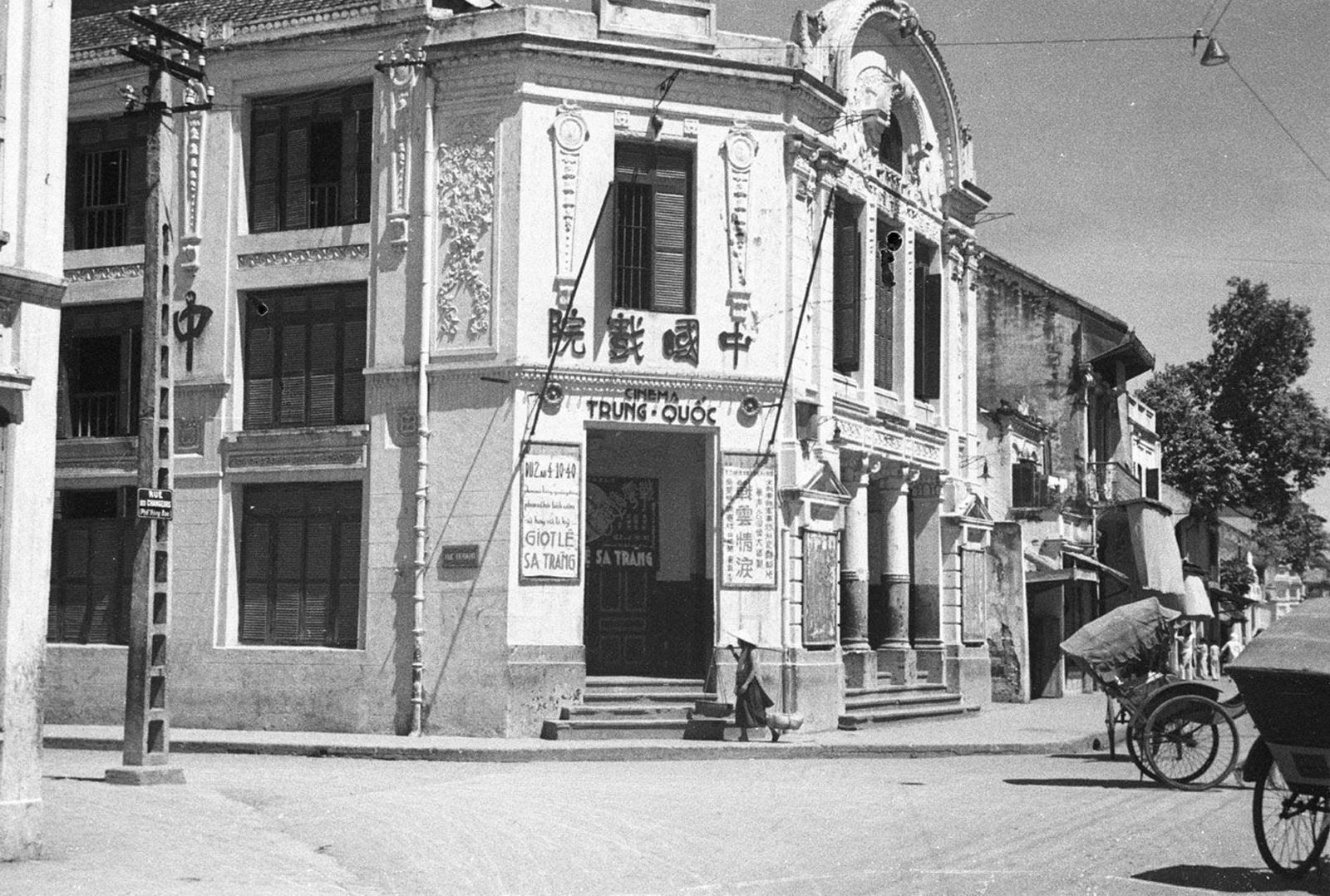
The Chinese cinema around 1940, named To Nhu in 1946, was the venue for the departure ceremony of the Self-Defense Force of Zone I on the National Resistance Day. Later, it became the Kim Chung and Chuong Vang cinemas, bought by impresario Long for the Kim Chung theater troupe, named after his wife.
PHOTO: ARCHIVE
Following the failure of the Grand Theatre tour.
I recall that in 2017, the Ministry of Culture, Sports and Tourism developed a theater-museum tour with prestigious destinations including the Hanoi Opera House and the National Museum of History. These are both architectural landmarks, not to mention places steeped in history and culture. At the Hanoi Opera House, visitors are welcomed in the Mirror Room, learning about important events that took place in the August Revolution Square (in front of the theater) from the beginning of the 20th century to the present, and experiencing the VIP seating reserved for heads of state when watching performances… Finally, the public enjoys the comprehensive art performance "Vietnamese Soul ," which includes light music, traditional opera, folk singing, flute, zither, and puppetry.
However, the Hanoi Opera House tour quickly disappeared. At 400,000 VND for regular visitors, halved for students, the tour was even criticized as being too expensive. To date, there is no sign that the Hanoi Opera House tour will be restarted. Meanwhile, the Hanoi Opera House sightseeing tour in the Old Quarter continues to attract visitors whenever it is offered.
Writer Truong Quy believes that visiting these theaters has great potential, but requires a suitable storytelling approach. Visitors themselves must have a need to understand the past and be willing to "taste" it. When the storyteller and the visitor meet on that need, the remaining narrative is the infrastructure.
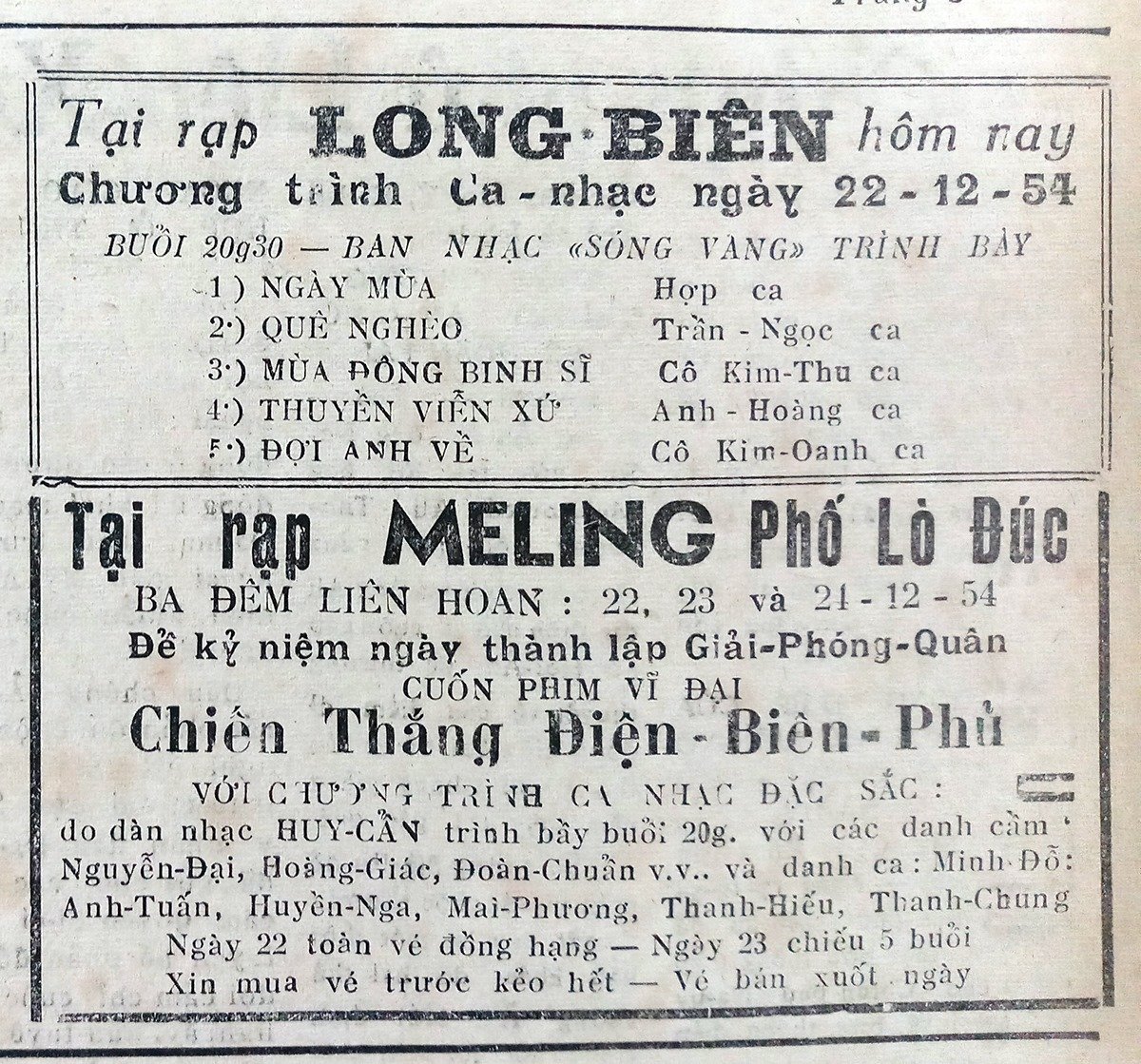
Advertising for music and film screenings at Long Bien and Me Linh theaters on the occasion of the founding day of the People's Liberation Army (People's Army) on December 22, 1954.
PHOTO: ARCHIVE
"If it's to be commercialized for the general tourist market, it certainly needs careful 'tailoring' and flexibility," Mr. Quy said. According to Mr. Quy, a decade ago, when he took several guests (including an American professor of Vietnamese studies and a translator) to a traditional opera theater, they quickly became bored due to the shoddy artistic quality and rather dilapidated setting.
After Mr. Quy redirected them to Kim Ngan Temple and they were treated to a couple of Ca Tru performances by artist Bach Van, "the guests were truly moved by that dedication," Mr. Quy shared, expressing: "I think the most important thing is that the content must achieve perfection, like a complete dish, even if it's just presenting pure information. Doing it superficially won't easily fool anyone."
According to Mr. Quy: "In my opinion, theater tours would be more attractive if they had means to recreate 'vintage' imagery: large-format promotional posters from the past, images of artists or major events related to significant changes, and unique artifacts that would create the identity of that theater. For example, a collection of costumes from the famous Cai Luong play 'Kieu ' that has been popular for several decades from the 20th century to the present day would certainly be a hallmark of the Kim Chung, Chuong Vang, and now the Hanoi Cai Luong Theater."
Source: https://thanhnien.vn/mo-tour-nha-hat-o-ha-noi-185250504225638405.htm
































![[Photo gallery] The apricot blossom garden in the Dong Nai Provincial Party Committee compound is resplendent on the 5th day of Tet.](https://vphoto.vietnam.vn/thumb/402x226/vietnam/resource/IMAGE/2026/02/21/1771662697530_a3_20260221112347_20260221144613.jpeg)








Comment (0)