

(NLĐO) - The strange circumstances of Earth and the Moon more than half a billion years ago have contributed significantly to our existence today.
According to a study recently published in the journal PNAS, a day on Earth about half a billion years ago was 2.2 hours longer than it is today, while the Moon also drifted 20,000 km farther away than it does now.
That was a period lasting from 650 to 500 million years ago, making up what is known as the "Cambrian biological explosion".
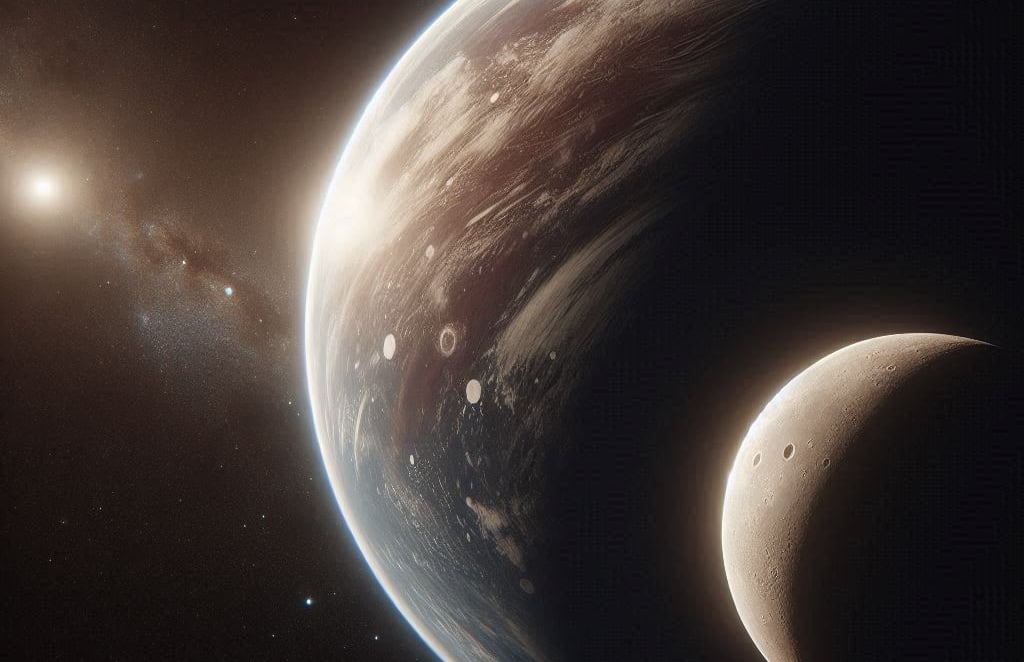
The Earth and the Moon underwent periods of great upheaval hundreds of millions of years ago - Photo by AI: Anh Thu
According to Live Science, a research team led by geologist He Huang from Chengdu University of Technology (China) attempted to clarify the Earth's rotation history by examining data collected from rock layers in marine environments dating back 700-200 million years.
These slabs of rock help to recreate how tides have changed on the planet's surface, partly because they reveal the thickness of the oceans.
The team combined this data with models of tidal forces acting between the Moon and Earth to map the speed at which Earth rotates on its axis over the half-billion-year study period.
Ultimately, they discovered a "staircase" pattern in the Earth's rotation, with two phases where the planet's rotation changes rapidly and dramatically, alternating with periods of stability.
The first period of upheaval was 650-500 million years ago, encompassing the "Cambrian Explosion," the planet's most explosive period of biological activity, when simple organisms suddenly evolved into complex, multicellular animals, diversifying into new ecological niches.
The second phase occurred approximately 340-280 million years ago, corresponding to the period when massive glaciers covered the planet.
During both periods, the days were 2.2 hours longer and the Moon was also 20,000 km farther away than average.
In the first phase, days as long as 26.2 hours increased the number of hours the world received sunlight, boosting photosynthesis and leading to major oxidation events, causing life to flourish.
This is because, over time, the Moon pulls our planet in a gravitational pull.
As a result, there are times when it drifts away from us, draining the Earth's kinetic energy, slowing down our planet's rotation, and thus making the day longer.
Secondly, the appearance of glaciers quickly transformed the Earth into a freezing snowball, leading to mass extinctions.
However, every mass extinction is always followed by other biological explosions, as new species emerge and fill the ecological niches left by the extinct species.
Therefore, it can be said that both events have had a profound impact on our existence today.
Source: https://nld.com.vn/mot-ngay-trai-dat-tung-dai-262-gio-mat-trang-troi-xa-196240818082256203.htm





























![[Photo] Reception to welcome General Secretary and President To Lam and his wife on their State visit to the Philippines](https://vphoto.vietnam.vn/thumb/1200x675/vietnam/resource/IMAGE/2026/06/01/1780295488620_vna-potal-chieu-dai-chao-mung-tong-bi-thu-chu-tich-nuoc-to-lam-va-phu-nhan-tham-cap-nha-nuoc-toi-philippines-8798060-7855-jpg.webp)





































































Comment (0)