After a week of release, "Red Rain," a film by the People's Army Film Studio and directed by Dang Thai Huyen, surpassed 200 billion VND, becoming the highest-grossing revolutionary war film in Vietnamese cinematic history. More than just a box office phenomenon, "Red Rain" is also a tragic ballad, evoking patriotism and national pride.
An epic song from the Quang Tri battlefield.
When discussing the war against the US, the Quang Tri Citadel in 1972 is a particularly significant location. That 81-day and 81-night battle became a symbol of courage, where thousands of soldiers perished along the Thach Han River.
That heroic and tragic historical context is recreated through the language of cinema in "Red Rain," with a script rich in epic qualities and many emotionally moving details.
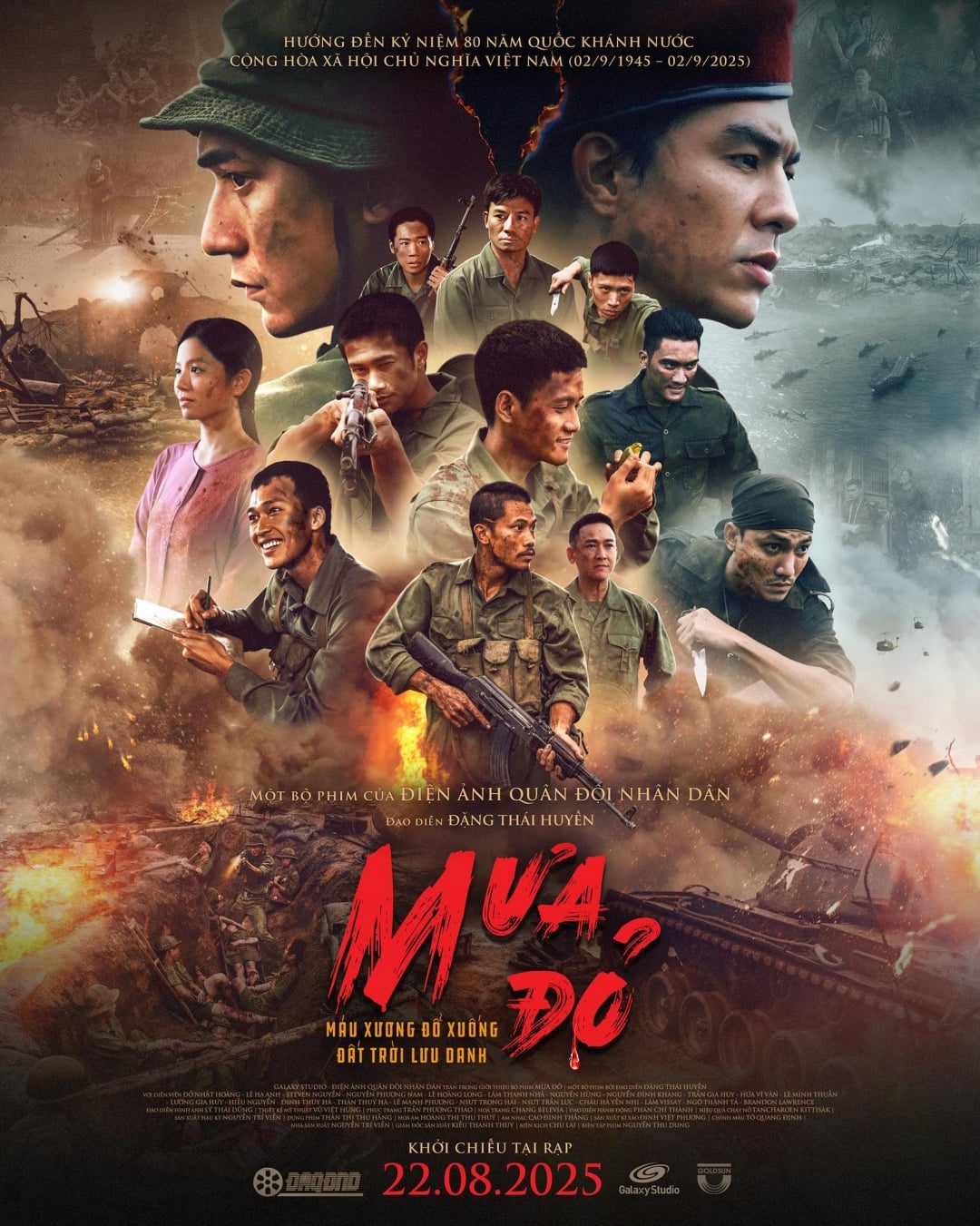
|
Movie poster for "Red Rain". |
The film's script was written by author Chu Lai, a former soldier with direct battlefield experience. The story revolves around Squad 1, a group of young soldiers in their twenties, most of whom are handling weapons for the first time. They include Cuong (Do Nhat Hoang), a music conservatory student who gave up his study abroad opportunity to enlist; Ta (Phuong Nam), a straightforward and courageous squad leader; Binh (Lam Thanh Nha), a romantic art student; Tu (Dinh Khang), a high school student who wrote his enlistment application in blood; Hai (Nguyen Hung), a simple electrician; and Sen (Le Hoang Long), a seasoned special forces soldier.
They came from different rural areas, with diverse backgrounds, yet shared a common ideal: fighting to restore peace to their country. During rare moments of respite amidst the bombing, they talked about family, love, and future dreams, even joking about death to reassure themselves. This is how director Dang Thai Huyen created a distinctly soldierly atmosphere – simple, sincere, often humorous, but also full of humanistic emotion.
The highlight of "Red Rain" lies in its contrasting narrative. On one side is the South Vietnamese army, backed by the US, using modern weaponry: B-52 bombers carpet-bombing, targeted bombing, and artillery barrages that devastated the Citadel. On the other side is the liberation army with rudimentary equipment and cut off from aid. In this lopsided battle, the spirit of "fighting to the death for the Fatherland" helped them hold their ground. Wide-angle shots show the extent of the destruction of war, while simultaneously celebrating the indomitable spirit of the young soldiers.
"Red Rain" has ended, but its impact still resonates. More than just a work of art, the film is a tribute to previous generations and a message to today's generation: cherish peace, for behind it lies the sweat, tears, and blood of countless people. |
Beyond depicting the brutality of the trenches, the film also brings to life the atmosphere of diplomatic negotiations . The character of the Deputy Minister of Foreign Affairs (Dinh Thuy Ha) – Cuong's mother – appears as a symbolic counterpoint: behind the soldier is his family, a mother anxiously waiting for her son, and simultaneously representing a resilient and resolute diplomacy for the benefit of the nation.
The emotional climax of the film is the scene where the soldiers cross the Thach Han River amidst a hail of bombs and bullets. They fall to the ground as soon as they reach the other side, struck by artillery fire, but before dying they manage to cry out: "Mother!" That cry pierces the hearts of the viewers, reminding us that today's peace was not achieved by chance, but was bought with the youth, blood, and bones of an entire generation.
Why did "Red Rain" become a box office phenomenon?
The resounding success of "Red Rain" stems not only from its sacred historical significance or tragic script, but also from many positive aspects of its cinematic artistry.
First and foremost, there was the meticulous investment in setting and technology. The film crew built a 50-hectare film set, recreating trenches, battlefields, and surgical and medical areas, with every detail carefully considered: from the moss on the walls and the overgrown tree roots in the bunkers, to the stretchers and rudimentary bandaging tools. The explosion scenes with combat vehicles and weapons were modeled after real prototypes. The result was spectacular, realistic footage that was indistinguishable from a historical documentary.
In addition, the film scores points thanks to the immersive performances of its young cast. Although there are no "box office stars," new faces like Do Nhat Hoang (Cuong), Phuong Nam (Ta), Steven Nguyen (Quang), and Ha Anh (Hong) all leave a lasting impression with their expressions, gestures, and dialogue.

|
Young people check in with the Red Rain movie poster at CGV Vincom Phu Yen cinema. |
Another crucial element is the humanistic message that transcends hatred. The film doesn't portray the enemy as inhuman, but rather opens up a humane perspective: they are also sons, fathers, husbands, with their own anxieties and pains. This portrayal allows "Red Rain" to transcend the boundaries of propaganda, touching upon the universality of war: on either side, people suffer loss.
From a market perspective, "Red Rain" was released at the perfect time – the season commemorating the August Revolution and National Day on September 2nd. This is a time when Vietnamese audiences tend to seek out historical content, and the film perfectly met that demand. Furthermore, a strong social media marketing campaign kept the keyword "Red Rain" consistently in the top Google Trends.
According to Box Office Vietnam, in just the first three days, the film surpassed 100 billion VND – a pace comparable to Ly Hai's "Face Off 7: One Wish" or Tran Thanh's "The Four Contresses". As of the afternoon of August 29th, the film had grossed over 230 billion VND, with more than 4,000 screenings per day, many times more than other films currently in theaters.
However, Red Rain is not without its shortcomings. Some viewers felt that the love triangle between Cuong, Quang, and Hong was weak and unconvincing. Some dialogues still felt propagandistic and unnatural. But compared to the overall picture, these are only minor flaws that do not overshadow the artistic and emotional value the film offers.
Source: https://baodaklak.vn/van-hoa-du-lich-van-hoc-nghe-thuat/202508/mua-do-va-gia-tri-cua-hoa-binh-766195c/






![[Image] Nearly 125,000 Hanoi students completed the Literature exam for the 10th grade entrance exam.](https://vphoto.vietnam.vn/thumb/1200x675/vietnam/resource/IMAGE/2026/05/30/1780117233041_ndo_br_thiet-ke-chua-co-ten-2-png.webp)





















































































Comment (0)