


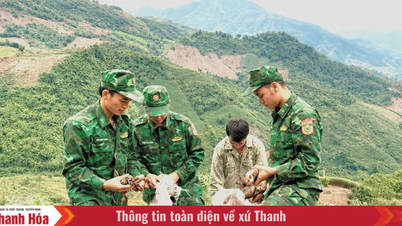
Officers from Trung Ly Border Guard Station patrol the border, ensuring border security. Photo: PV
From a new roof to dreams
The first summer rain had just stopped, and the road to Tao village in Trung Ly commune was still muddy. Following border guards along the misty mountain slopes, we encountered many new, sturdy houses gradually replacing the dilapidated thatched roofs of years past. Major Quan Dinh Thao, Deputy Political Officer of the Trung Ly Border Guard Post, recounted: "At the time of implementing Directive No. 22-CT/TU of the Provincial Party Committee on supporting the elimination of temporary and dilapidated houses, many highland villages in the border commune of Trung Ly were almost completely isolated due to difficult roads. Some households received financial assistance, but it was still not enough to build houses because the transportation costs were too high. Without the soldiers coming down to help with labor, it would have been difficult for the villagers to build new houses."
And then, the border guards went down to the village to level the ground, carry sand, and haul bags of cement across the stream. Some days, it rained so heavily that the mud reached their ankles, but the soldiers stayed until late at night before returning to the outpost. Over 1.3 billion VND was contributed by border guards; thousands of man-days were mobilized; and hundreds of tons of materials were brought to the remote villages. But what the people remember most is perhaps not the numbers, but the image of the soldiers, covered in mud, diligently building houses for the villagers before the rainy season. In the new house, still smelling of lime and mortar in Tao village, Mr. Loc Van Thoai looked at his two children playing on the porch and couldn't hide his joy. His family of seven had lived crammed together in a dilapidated stilt house for many years. Every rainy season, the whole family was anxious, fearing the wind and the roof would be blown off. "Now that we have a new house, we can rest assured that our children can go to school and focus on farming. We will escape poverty eventually," Mr. Thoai said.
Late in the afternoon in Trung Ly, we met Giang A Phanh, who had just returned from school. In the small, brightly lit room, the Hmong boy sat on the porch, clutching his notebooks, his face shining amidst the hazy mountain mist. A few years ago, Phanh's childhood was filled with tears. His father died when he was only four years old, and his mother remarried and then disappeared. The three siblings relied on their uncle, who worked year-round cultivating corn and cassava. On cold, rainy days, the old house was drafty, and the siblings huddled together to sleep by the fire.
In August 2023, the boy's life took a different turn when he was adopted by the Trung Ly Border Guard Post. From that day on, Phanh had fathers in military uniforms. They took him to school, taught him to read and write, and reminded him to eat his meals on time. In the small room at the post, the boy had his own study corner for the first time, with a desk and a bright white lamp. Major Nguyen Van Thien, Political Officer of the Trung Ly Border Guard Post, recounted: "When Phanh first arrived at the post, he was quiet and always hid behind the door. But then he gradually became more sociable, showing off his good grades and running out to greet the officers when they returned from their assignments. He said that he wanted to be a teacher to teach the children in the village in the future."
That dream sounds simple. But in a place where many children once had to drop out of school due to lack of books and food, the fact that a boy dared to think about his future is truly precious. Giàng A Phành is not alone; for many years, the "Helping Children Go to School" and "Adopted Children of Border Guard Posts" programs have become a pillar of support for many students in border areas. From 2015 to the present, the Thanh Hóa Provincial Border Guard has supported hundreds of disadvantaged students, including many from neighboring Laos. Many have passed university and college entrance exams, and some have become students at military and police academies.
Firmly holding the "support of the people"
The changes in the border region today are not only reflected in new houses or bright lights in the villages. More significantly, it's a shift in mindset, in how people view life and work together to maintain peace in their communities. For there was a time when, behind those tranquil mountain slopes, lay the haunting specter of drugs, poverty, and insecurity that lasted for many years.
Mr. Thào A Sự, the head of Tà Cóm village, recalls a time when the village had dozens of drug addicts, with many going to prison for drug-related offenses. Young people were lured into drug use, and the villagers' lives were miserable.
The border trails were once used as drug smuggling routes. Poverty, lack of legal knowledge, and long-standing outdated customs trapped many families in a vicious cycle. But step by step, things began to change thanks to the persistent efforts of the border guards. They not only fought and cracked down on crime, but also won the hearts of the people through small acts: visiting individual homes to spread awareness, holding village meetings, persuading people to quit drugs, and having entire clans sign pledges not to abet drug trafficking. Many self-governing models such as "Self-governing villages for drug prevention," "Areas free from drug-related crime and vice," and "Self-governing clans for drug prevention" were formed, helping border villages become increasingly united.
This is the result of the entire political system – from the policies of the Party and State to the synchronized involvement of Party committees, governments, and mass organizations at all levels, creating a foundation for the gradual transformation of the border region. In this shared journey, border guards contribute their part through their persistent presence on the borderland: working with the people to build roads, construct cultural centers, patrol the border and boundary markers, and even going down to the corn and cassava fields to guide production. From this reality, the "Bright Village in the Border Region" model is implemented as a way to continue the journey of protecting the people and villages through the long-term companionship of the entire political system, in which the border guards are the force directly stationed at the border.
In Ta Com today, morning broadcasts in the Hmong language resound. More children attend school. Outdated customs in weddings and funerals are gradually being eliminated. Young people are beginning to learn about economic activities, raising chickens and cows, growing corn and cassava to escape poverty. Major Quan Dinh Thao said: "The most valuable thing is not the newly built infrastructure, but the fact that the people understand that they are also the keepers of peace in their village. When the people trust the Party, the government, and the soldiers, everything becomes easier. That is the most solid foundation for protecting the border."
Evening descended quickly over the border mountains. We left Ta Com as the streetlights lined the small road. The community center was switched on. In the distance, the sounds of children reciting their lessons echoed from the windows. On the way down the mountain, we suddenly remembered a question a colleague had asked many years ago: "Will people live like this forever?" And today, the answer came from the village head, Thao A Su – a man who had witnessed the transformation of an entire village since the border guards chose to stay: "Now the village can light itself; no one needs to light it anymore."
That was perhaps the shortest statement, but it was the greatest achievement of ten years of "igniting the flame" on the border of Thanh Hoa province.
Speaking at the Conference summarizing and honoring models, programs, and movements of the Border Guard participating in socio-economic development in border areas from 2015-2025 (March 2, 2026), the Standing Deputy Secretary of the Provincial Party Committee, Nguyen Hong Phong, affirmed: "Through models and programs accompanying the people, the Thanh Hoa Provincial Border Guard has contributed to consolidating the political foundation, strictly managing the border and boundary markers, and building a solid all-people border defense posture. Thanh Hoa has become a shining example in the border region, preventing illegal migration and the emergence of illegal religious activities; the crime situation, especially drug trafficking along the border, is strictly controlled and managed." |
Milky Way - Dinh Giang
Source: https://baothanhhoa.vn/muoi-nam-thap-lua-bien-cuong-bai-cuoi-ban-sang-dan-an-289524.htm

















![[Infographics] Criteria and procedures for evaluating and classifying OCOP products](https://vphoto.vietnam.vn/thumb/402x226/vietnam/resource/IMAGE/2026/06/01/1780307493571_infographics-bo-w1200t0-di2622d199d1164352t11358l1-ocop-023.webp)
![[Photo] Reception to welcome General Secretary and President To Lam and his wife on their State visit to the Philippines](https://vphoto.vietnam.vn/thumb/1200x675/vietnam/resource/IMAGE/2026/06/01/1780295488620_vna-potal-chieu-dai-chao-mung-tong-bi-thu-chu-tich-nuoc-to-lam-va-phu-nhan-tham-cap-nha-nuoc-toi-philippines-8798060-7855-jpg.webp)
















































Comment (0)