

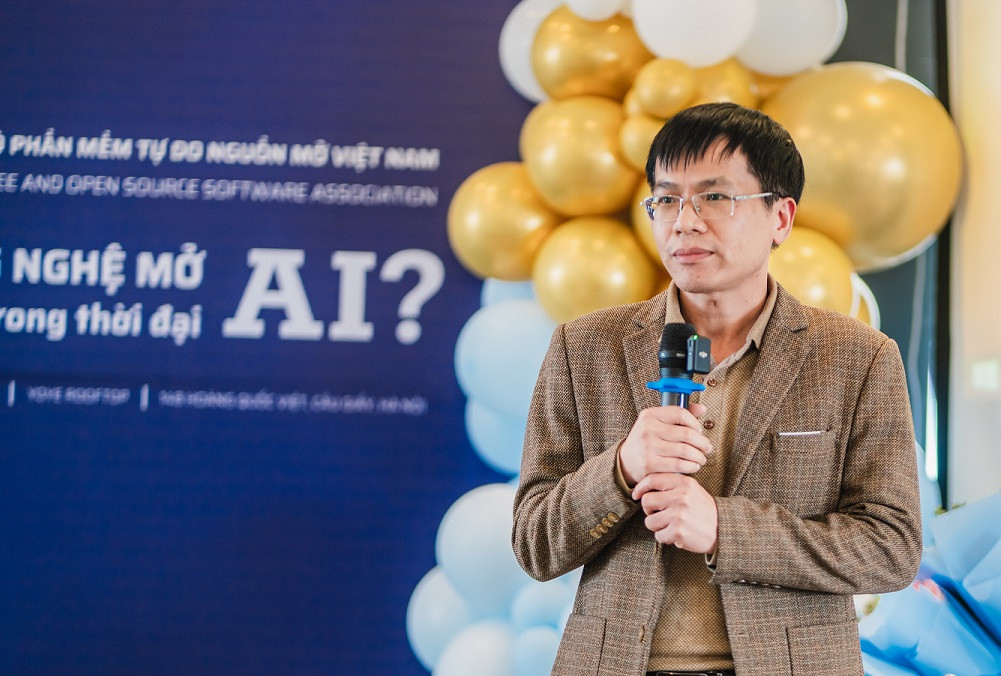
Mr. Ngo Hong Son, Chairman of the Vietnam Free and Open Source Software Club (VFOSSA), shared with VietNamNet newspaper about the current state and aspirations for the development of open technology in Vietnam.
A groundbreaking choice in the age of AI.
- Why is open technology the groundbreaking choice in the age of AI, sir?
Mr. Ngo Hong Son: According to statistics, in 2024 there were more than 70,000 new publicly available open-source AI projects, accounting for about 60% of the total number of AI projects. More than 100 countries prioritize the application of open-source software in government agencies, and 69% of technologists in the public sector want to increase their use of open-source software.
To master a technology, one needs a deep understanding of it. Inheriting and developing open platforms, then releasing them "open" for the community to evaluate and further develop, is an effective way to master technology. If you buy closed technology or develop it from scratch, it's very difficult to quickly catch up with the world .
- What has Vietnam done in its journey to apply open technology in AI projects?
Vietnam quickly embraced the open technology trend from the 2000s and has recently also rapidly "caught the trend" of AI.
Vietnamese people possess a strong advantage in highly skilled human resources with in-depth research capabilities and the ability to access new technologies. Many Vietnamese AI research groups have published high-quality scientific research papers at leading global AI conferences.
Several large companies have invested in infrastructure to train AI models, supporting product development and global service delivery.
- To what extent is the Vietnamese business community seizing opportunities from open technology?
Taking the development of Cloud Computing as an example, large Vietnamese businesses have a significant market share using open platforms.
The application of open technology and AI offers numerous opportunities for businesses of all sizes. The key is whether businesses can seize these opportunities at the right time to increase their competitive advantage.
Looking at the world, many large businesses have invested heavily in open technology, giving them a higher level of technological initiative compared to Vietnamese businesses. For example, Chinese businesses have invested heavily in open technology to master it.
Vietnam has also shown early interest, but progress has been slow due to a lack of sharing. Many businesses, after developing products using open-source technology, close down and do not support the community in further development, thus weakening the open-source community.
We need policies that prioritize open technology.
- Has Vietnam already issued numerous documents and policies addressing open technology?
VFOSSA has contributed opinions and persuaded policymakers to incorporate open technology into many legal documents. At the Vietnam Open Technology Forum 2020, Minister of Information and Communications Nguyen Manh Hung affirmed: "Open technology is the choice to master technology." The national strategy on research, development, and application of AI until 2030 also prioritizes open technology.
However, recently, public interest in open technology has not been as high as expected. Resolution No. 57-NQ/TW dated December 22, 2024, of the Politburo on breakthroughs in national science, technology, innovation, and digital transformation affirms the determination that "Vietnam must master technology." This should be understood as meaning that mastering technology requires selecting solutions, prioritizing open technology.
VFOSSA will continue to persistently contribute policy suggestions to ensure that open technologies are more widely applied in all aspects of social life, especially in the AI era.
- What is your biggest aspiration when it comes to policies related to open technology?
VFOSSA hopes that all public investment projects or science and technology research topics, funded by the state budget, will develop on an open technology platform to enhance transparency.
Looking to the world, Switzerland has required all public investment projects to disclose their source code and use open technology to monitor transparency.
In 2024, VFOSSA advised Vietsens Technology Group on the implementation of open-source code in the OpenHIS project, which is now used in many facilities such as Bach Mai Hospital, Ha Nam Provincial General Hospital, etc. This is a contribution to the open-source community from a business enterprise.
If more Vietnamese businesses also have open-source software projects, especially in public services, it will benefit Vietnam in the long run.
- What are your predictions regarding Vietnam's position in the region in terms of open technology development by 2030?
If Vietnam has specific priority policies, it will promote the development of open technology, thereby enhancing technological mastery, fostering innovation, and promoting sustainable development.
To date, the number of open-source projects from Vietnam that have reached the global market remains relatively small.
Hopefully, by 2030, with the collective efforts of the community and supportive government policies, Vietnam will have open-source projects of significant caliber, making positive contributions to the global community.
Mr. Bui Quoc Huy, Founder & CEO of Edtech Cole Co., Ltd.: 5 levels of AI development + Level 1: AI operates according to rules (1950-1980), based on programming commands set by humans. Many Vietnamese businesses are at Level 1, applying AI in manufacturing plants, in IoT devices and machinery, or in activities related to programming based on principles. + Level 2: AI related to machine learning (1980 - 2010), capable of self-learning based on predefined and labeled input data. Level 1 AI applications are very common in customer data analysis, risk management, and automated investment (such as stock market investment bots)... + Level 3: Deep learning-related AI (2010-2020), which is becoming very popular worldwide, especially after the advent of Chat GPT, improving the efficiency of natural language and image processing. This level uses AI based on models simulating the human brain, capable of providing suggestions or solving problems that closely match human predictions. + Level 4: General AI (2028-2029). AI applications will be able to simulate the human brain more intelligently and accurately than at Level 3. + Level 5: Superintelligent AI (by 2045). AI will replace humans in tasks such as programming, building robots, and designing input-output problems without human intervention. |
Source: https://vietnamnet.vn/muon-nhanh-lam-chu-cong-nghe-hay-chon-cong-nghe-mo-2363990.html

![[Image] Pleasant weather helps students enter the 10th grade entrance exam with confidence.](https://vphoto.vietnam.vn/thumb/1200x675/vietnam/resource/IMAGE/2026/05/29/1780034401612_ngay-1-thi-lop-10-minh-duy-8-5009-jpg.webp)
![[Photo] Ba Lang An Lighthouse - the "eye of the sea" amidst the "rock museum" of Quang Ngai province.](https://vphoto.vietnam.vn/thumb/1200x675/vietnam/resource/IMAGE/2026/05/29/1780038698840_anh-man-hinh-2026-05-29-luc-14-10-42.png)








































































Comment (0)