

Lesson 1: Muong Phang - The Heart of the Dien Bien Phu Campaign
When mentioning the victory at Dien Bien Phu, besides famous landmarks like Muong Thanh, Hong Cum, Him Lam, and Hill A1, one cannot fail to mention Muong Phang. This was the location of the Command Headquarters – the nerve center of the Dien Bien Phu campaign for 105 days (from January 31 to May 15, 1954). Prior to that, the first location of the Command Headquarters was in Tham Pua cave (Chieng Sinh commune, Tuan Giao district) for 32 days, and the second location was in Huoi He village (Na Tau commune) for 13 days.
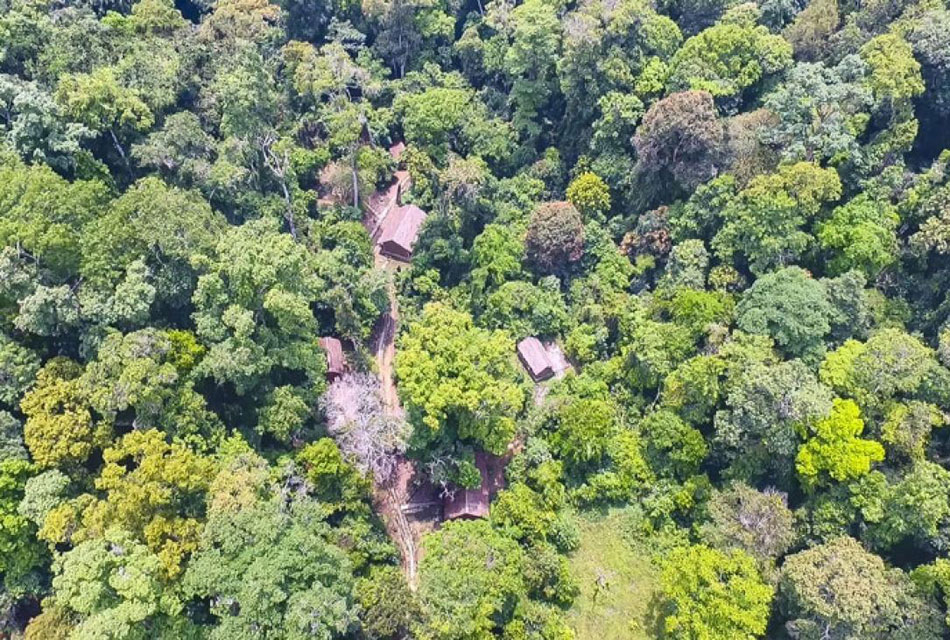
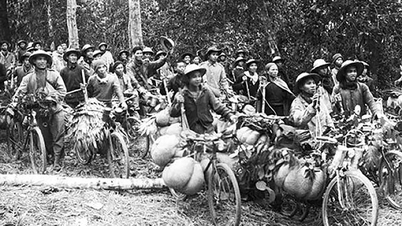
In March, amidst the bustling crowds, we arrived at the Muong Phang forest – affectionately and familiarly known by the locals as "General's Forest." It was in this forest that General Vo Nguyen Giap, along with the campaign command, issued decisive attack orders that led to the victories of each battle, culminating in the general offensive on May 7, 1954. Our troops captured and annihilated 16,200 enemy soldiers from the Dien Bien Phu stronghold, liberating Dien Bien Phu and bringing the resistance war against French colonialism to a victorious end.
The Dien Bien Phu Campaign Command Post historical site is located approximately 30km by road (about 15km as the crow flies) from Dien Bien Phu city. Situated along a small stream at the foot of Pu Don mountain, within an area of approximately 90km² of natural forest, the Dien Bien Phu Campaign Command Post was a field command and defense system consisting of interconnected trenches, bunkers, and shelters built from simple materials such as bamboo, reeds, and leaves readily available in the Muong Phang forest, suitable for combat conditions and ensuring secrecy and safety for the Campaign Command.
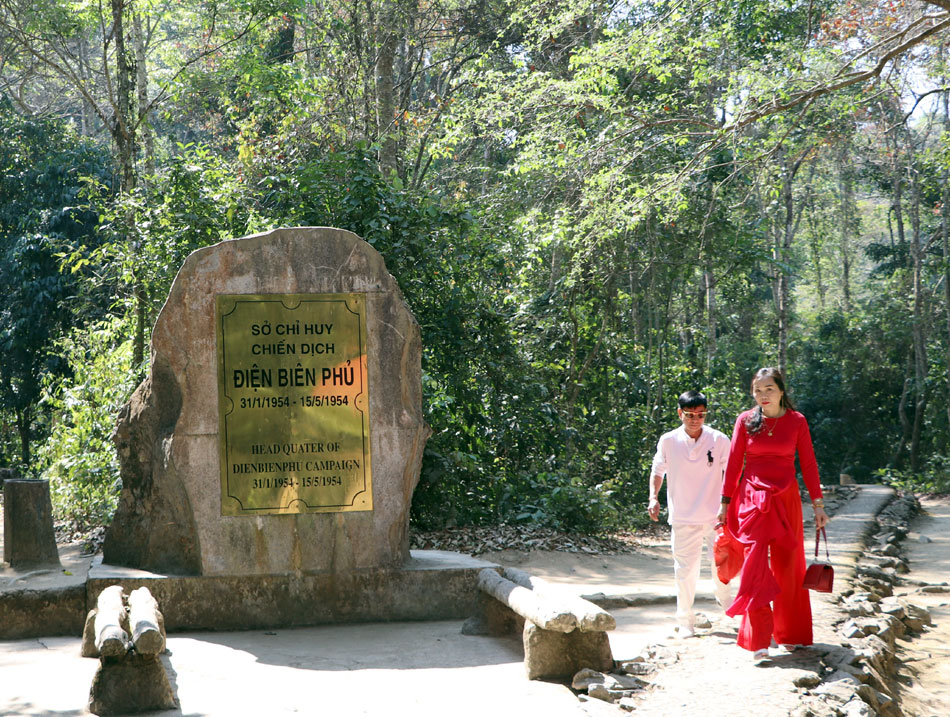
From the outside in, the Campaign Command Headquarters included the following positions: the forward guard post (protecting the Campaign Command Headquarters on the outer perimeter); the hut and working bunker of the communications agency, ensuring communication during the campaign, transmitting orders quickly, accurately, and securely. Next were the hut and working bunker of the liaison officer between the Campaign Command Headquarters and the military advisory group. Deeper inside was the tunnel through the mountain – a magnificent structure at Muong Phang, 69 meters long, connecting the hut of General Vo Nguyen Giap with the hut of Comrade Hoang Van Thai – Chief of Staff of the Dien Bien Phu Campaign. The combat hut was where the operations and military intelligence departments monitored the developments of the battle on the battlefield. It was here, at 3 PM on May 7, 1954, that General Vo Nguyen Giap ordered a general offensive on all fronts to attack the French command headquarters, capturing General De Castries and his entire staff.
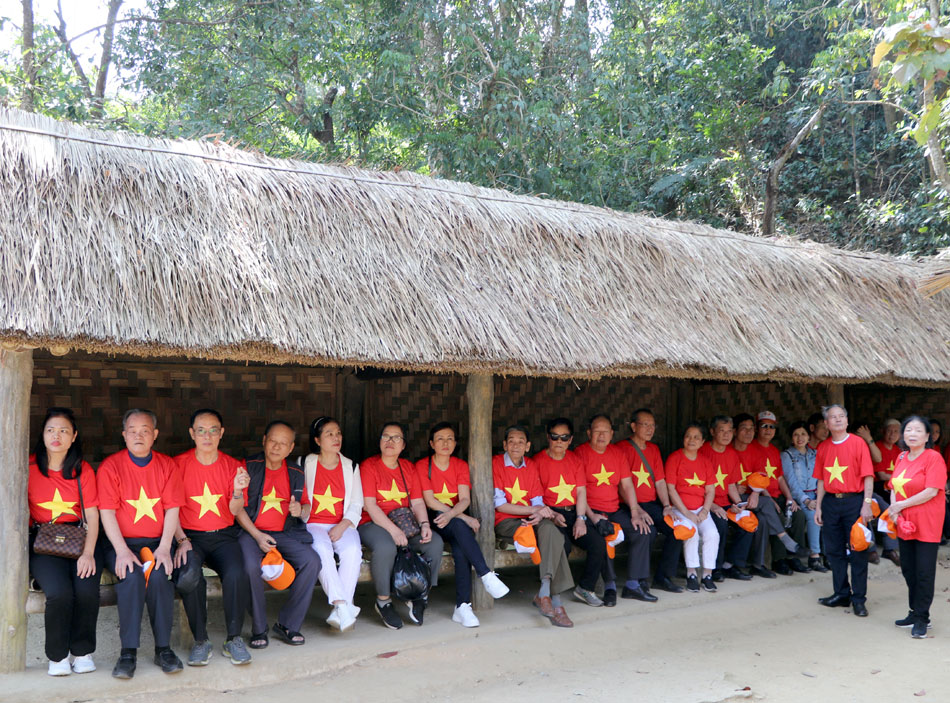
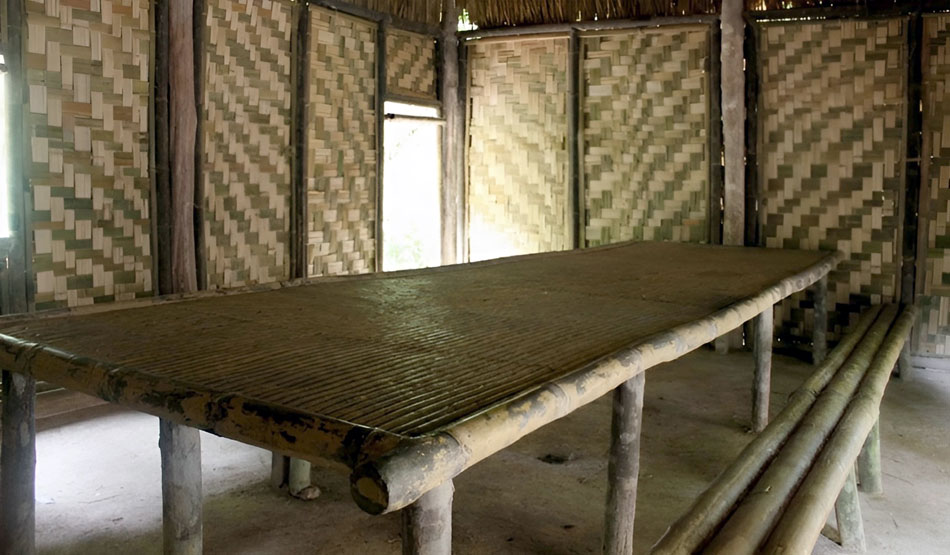
Located in the heart of the Campaign Command Headquarters was the system of huts where General Vo Nguyen Giap lived and worked during the 105 days of the campaign. The General's hut was simple and unpretentious, like many other huts in the Muong Phang forest. “…The materials consisted of bamboo, reeds, and leaves gathered locally. In the middle of the hut was a table large enough to spread out a map. On either side were two long benches, their seats made from split bamboo strips. At either end were two beds made of reeds, one for me and one for my bodyguard. I don't know who first came up with this type of hut. It was so stable that no improvements were needed,” – an excerpt from the General's memoirs in “Dien Bien Phu – A Historical Rendezvous” about his living and working hut.
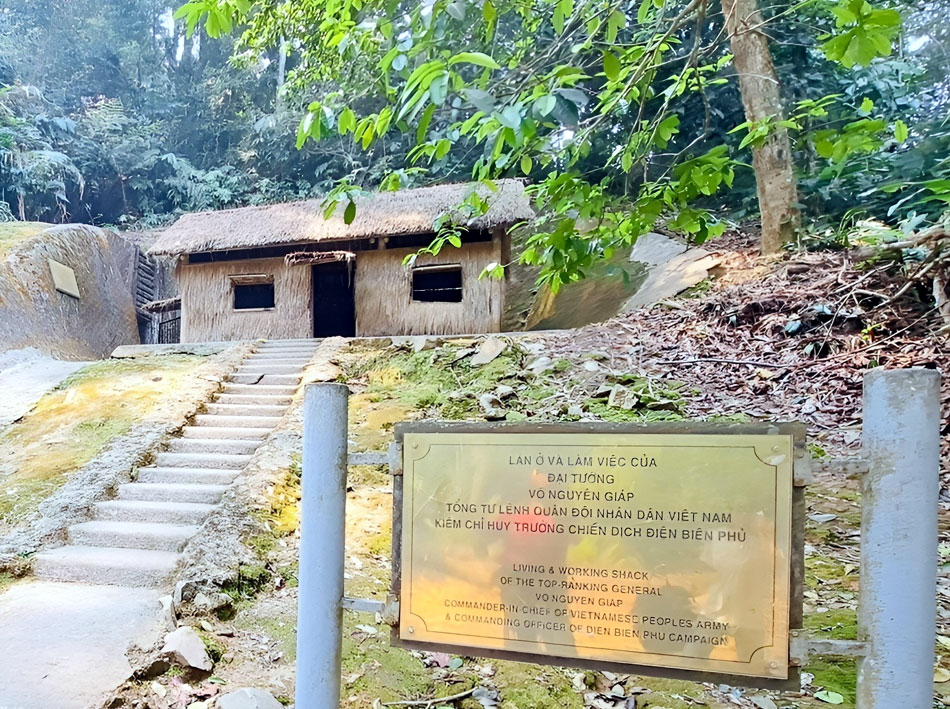
In that simple hut, the General's belongings were contained only in a worn-out backpack. On a bamboo table, the General spread out a map daily to study the war situation. Here, the General spent sleepless nights pondering and devising clever and flexible strategies for each battle to achieve victory. And in the Dien Bien Phu campaign, as Commander-in-Chief and Chief of the Campaign, the General made a historic decision: changing the operational strategy from "quick attack, quick victory" to "steady attack, steady advance." Later, the General shared that it was "the most difficult decision of my life." With this wise decision, our army and people achieved the Dien Bien Phu victory, "renowned throughout the world and shaking the earth."
From the command bunker, we went out to the hillside behind, climbed to the summit of Pú Huốt, the highest point in the Mường Phăng mountain range, and reached the observation post. From here, we could see the entire Mường Thanh valley with the Him Lam, Độc Lập, D1, C1, A1 hills, the Mường Thanh bridge, and the De Castries bunker. Every movement of the French troops at the Điện Biên Phủ fortified complex was monitored by our forces.
Ms. Nguyen Hong Loan, a tourist from Thai Nguyen, shared her feelings upon visiting Muong Phang: "This is the first time I've seen the Dien Bien Phu Campaign Command Post historical site with my own eyes. Not only did I enjoy the fresh air of the primeval forest, but I was also deeply moved and impressed by the relics such as: the living and working quarters of General Vo Nguyen Giap, the forward guard post, the telegraph operator's sleeping quarters, the telephone switchboard bunker, the information department's working quarters, the operations house... Even with just thatched huts and leaf walls, the will of our ancestors was incredibly strong, under the excellent leadership of the Party, to liberate the nation. Younger generations of Vietnamese visiting this old battlefield will learn from it and be determined to protect every inch of our homeland, for which our ancestors sacrificed so much blood and lives to regain independence and freedom today."
Seventy years after the victory at Dien Bien Phu, the constituent sites of the Dien Bien Phu battlefield complex have been gradually invested in, restored, and improved for tourism. The Dien Bien Phu Campaign Command Post in Muong Phang has received significant attention from the Party and State, with funding invested in the restoration and renovation of many items such as: the memorial area for General Vo Nguyen Giap, a 1,300m long historical site tour route, 12 shelters used for living and working by the Campaign Command, 3 tunnels including a 69m long tunnel... and other supporting facilities.

According to Mr. Lo Van Hop, Chairman of the People's Committee of Muong Phang commune, 70 years after the Dien Bien Phu Victory, the hut of General Vo Nguyen Giap and the Dien Bien Phu Campaign Command Post remain largely unchanged. The people of the ethnic groups here always preserve and protect Muong Phang as a sacred forest. Besides its historical value, Muong Phang is also one of the most diverse natural conservation areas with many rare and precious plant and animal species.
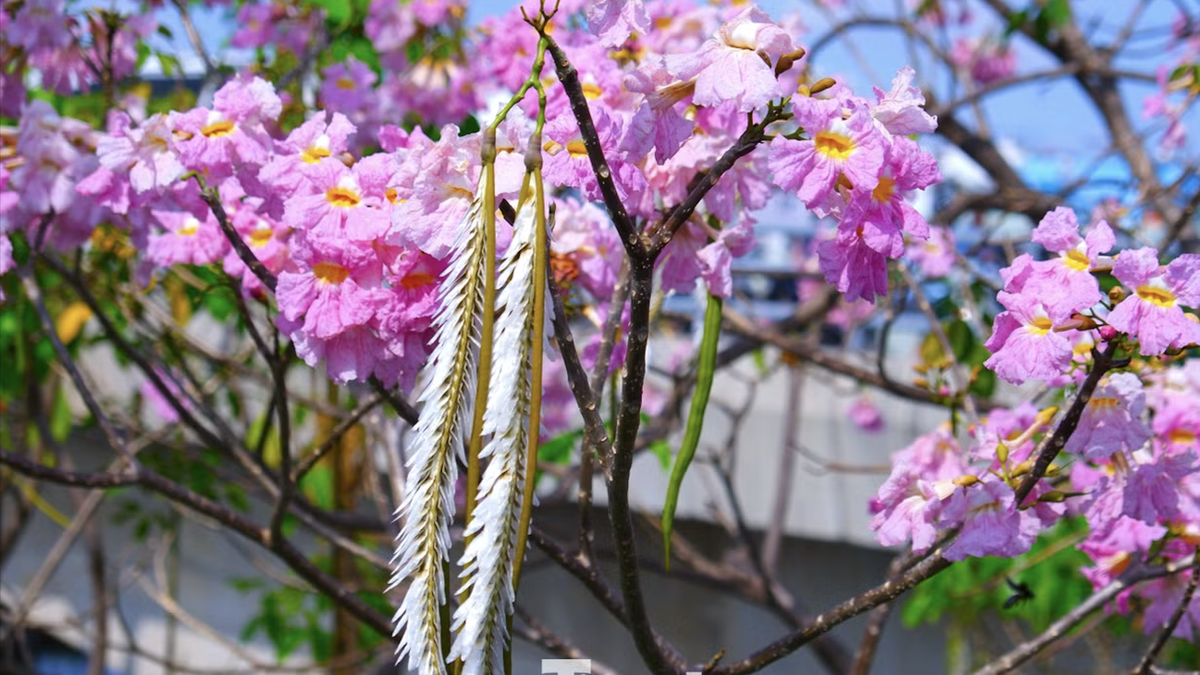
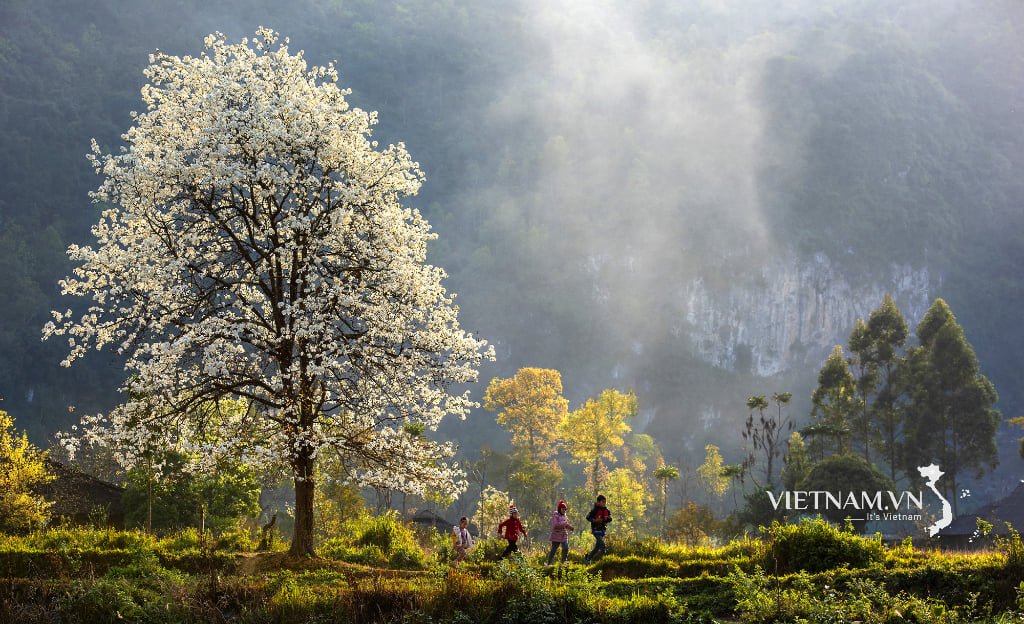
Not far from the Muong Phang forest, the serene and tranquil Pa Khoang lake is nestled amidst a sea of cherry blossoms that bloom beautifully every spring. Right next to the historical site are traditional Thai villages with simple, unique stilt houses, reflecting rich traditional culture.
Lesson 2: Contributing to the Victory of Dien Bien Phu
Source

![[Photo] Standing Committee member of the Party Central Committee Tran Cam Tu working with the Central Inspection Committee](https://vphoto.vietnam.vn/thumb/1200x675/vietnam/resource/IMAGE/2026/05/28/1779969579668_ndo_br_bnd-2495-jpg.webp)






































































Comment (0)