

The time is ripe.
NASA is developing a nuclear-powered spacecraft called SR-1 Freedom, designed to carry three Skyfall helicopters to Mars. This idea is similar to the Perseverance rover mission, which carried the Ingenuity helicopter to the red planet in 2021. Upon arrival, the Skyfall helicopters will survey potential landing sites for future crewed missions to Mars.
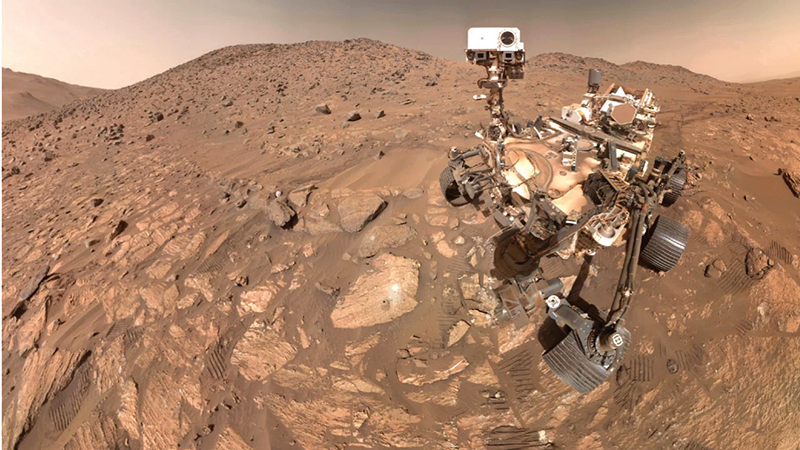
The Perseverance robot takes a selfie on Mars. Photo: NASA
SR-1 Freedom, currently only a prototype, is a nuclear-electric rocket, meaning it uses electricity to ionize propellant fuel such as xenon. This process creates a slow but steady thrust, allowing the spacecraft to gradually reach higher speeds than conventional chemical rockets. The spacecraft will be launched into space using a conventional rocket before activating its nuclear-electric propulsion system.
Since the 1960s, NASA has also researched nuclear propulsion technology to send astronauts to Mars in the 1980s, but this project was unsuccessful.
However, current efforts to return to the Moon and fly to Mars are receiving bipartisan support in the U.S. Congress as well as from the public. Therefore, NASA's efforts to apply nuclear technology – not only to propel spacecraft but also to power future lunar bases and Martian settlements – are more likely to become a reality.
SR-1 Freedom will take about a year to fly to Mars and deploy its helicopters. In the future, more powerful nuclear-powered rockets could deliver spacecraft to the planet in just 2-3 months, much faster than chemical rockets.
By shortening the travel time to Mars, nuclear rockets could significantly reduce the inherent risks of interplanetary space travel for crews and passengers, such as prolonged weightlessness and cosmic radiation.
Meanwhile, the plan of American billionaire Elon Musk and his company SpaceX to send humans to Mars and build a settlement for 1 million people still relies on the giant Starship spacecraft, which uses chemical rockets. Participants would have to fly interplanetarily for at least 7 months before landing on a harsh environment approximately 225 million kilometers from Earth. Furthermore, such a journey would only be possible after multiple refueling trips in low Earth orbit.
China integrates its lunar programs.
As the race to ascend to the Moon Goddess heats up, Beijing continues to refine its plans.
On May 23rd, just one day after SpaceX successfully launched its largest and most powerful Starship to date, the China Manned Space Administration (CMSA) announced further details about its plan to integrate manned and unmanned lunar landing programs into a single mission.
The aim of this plan is to make the most of the technical foundation and practical experience accumulated over decades from manned space programs and the Chang'e lunar exploration missions, according to CMSA.
China aims to send astronauts to the moon before 2030, while the US timeline is 2028. That would be the first time humans have set foot on the lunar surface since 1972.
HANH NGUYEN (According to Hill, SCMP)
Source: https://baocantho.com.vn/my-muon-rut-ngan-thoi-gian-bay-len-sao-hoa-a205500.html

































![[Image] Hanoi's urban life under the challenge of a "scorching hot" environment](https://vphoto.vietnam.vn/thumb/1200x675/vietnam/resource/IMAGE/2026/05/25/1779706979265_nang-nong-t5-2026-minh-duy-7-4636-jpg.webp)





























































Comment (0)