


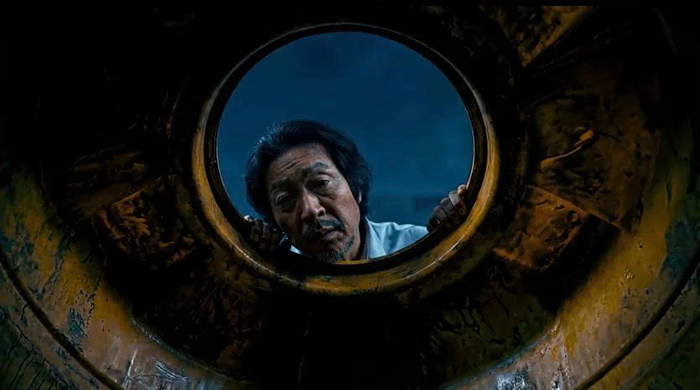
The horror film "The House" was filmed with real actors against a green screen, and the background was added later using AI. Photo: CJ ENM
Globally, Korean content is booming. Exports of Korean films and television have doubled between 2019 and 2024, and last year alone, the country's audiovisual industry contributed $16.4 billion to the economy , creating 291,100 jobs.
However, the South Korean film industry is also facing significant funding challenges. Domestic box office revenue has fallen 45% compared to pre-COVID-19 levels, partly due to the boom in streaming services. As a result, companies have had to cut budgets.
According to the Korean Film Council, only 20 films will be produced in 2025 with a budget exceeding 3 billion won (US$2.15 million), compared to 40-50 films per year before the pandemic. “Production costs have increased significantly in recent years, so even though Korean content is expanding globally, profits are not high,” said Hyun-jung Baek, head of content innovation at CJ ENM, South Korea’s largest content and entertainment production company.
In this context, CJ ENM and many other companies are turning to artificial intelligence (AI) to cut costs and speed up progress. Film critic Darcy Paquet argues that AI technology can not only improve labor efficiency but also help "cut costs, save effort, and speed up progress without compromising quality."
Filmmaking with AI can save 50% of time and costs.
South Korea has embraced AI-generated content for years – such as the short film “It’s Me, Moon-hee” and the webtoon “Cat Biggie” by CJ ENM – but the technology is increasingly appearing in feature films.
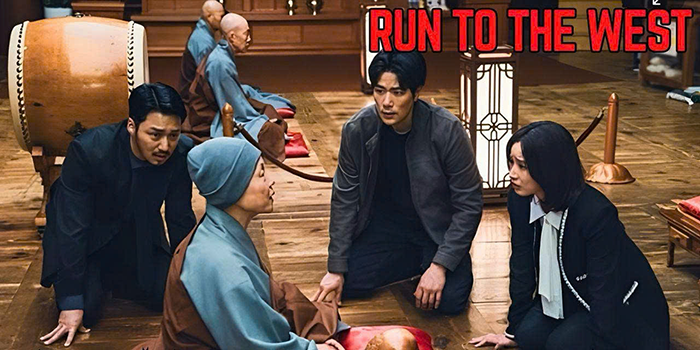
The first South Korean film to use AI is "Run to the West". Photo: BiliBili
“Run to the West,” touted as “South Korea’s first film to use AI,” is set to be released in October 2025. Its mythical creatures, fantastical settings, explosions, and special effects are all created by AI. Compared to traditional computer-generated imagery, AI tools are 10 times faster and halve the cost – according to Hansl Kwon, the film’s AI director and founder and CEO of Freewillusion, an AI film studio in Seoul. Other AI films that have garnered attention include the science fiction film about a robot trial, “I’m Popo,” and the historical drama “Man in Hanbok,” which has been featured at AI-focused film festivals.
Last month, CJ ENM released “The House,” a 60-minute horror film produced in collaboration with Google Cloud Korea. The film, with a budget of only 500 million won (approximately $336,000), was shot in just four days at a single studio, utilizing Google’s AI tools such as Imagen, Nano Banana 2, and Veo to create the backgrounds and visual effects.
Director Baek stated that AI can help save time and costs by reducing the need for actors and crew to travel to filming locations, while AI-generated settings are also more realistic and less expensive than elaborately staged sets. Baek estimated that AI could “reduce production time by 50%.”
Government support
The boom in AI products also stems from strong government support for AI. In 2026, the South Korean government tripled its budget for AI. Notably, in April, the government allocated 8 billion won (US$5.37 million) in emergency funding to the film industry, specifically for production projects utilizing advanced technologies, including AI.
Additionally, the Korean Film Council is organizing a screening of AI films at the Busan International Film Festival in September 2025, while the Korea Creative Content Agency is investing 19.8 billion won (US$13.3 million) in AI products.
Although the government is pouring resources into AI, not everyone agrees. Some critics argue that the aesthetics created by AI algorithms could erode the identity and humanity that have made Korean cinema iconic. Park Chan-wook, one of the country's leading directors, has voiced concerns about the encroachment of AI in the film industry, suggesting it will replace human labor. Similarly, Bong Joon Ho, director of the Oscar-winning film "Parasite," has also openly expressed his worries about the use of AI in the industry.
Meanwhile, producers are taking a more positive view, believing that AI applications can help restore the competitiveness of Korean cinema. They liken AI to "a useful tool" but not a complete replacement for humans. Director Baek emphasized that there are areas where AI cannot replace humans, such as story development, scriptwriting, and acting. "The characters in a live-action story are all real actors, and AI cannot replicate the eye expressions or subtle facial nuances of actors," Ms. Baek added.
The Korean Copyright Commission has issued numerous guidelines on AI generation – addressing which works are eligible for copyright protection, preventing copyright disputes, and the fair use of AI model training – but many questions remain unanswered surrounding copyright and ownership of AI-generated works. |
THANH TRÚC (According to CNN)
Source: https://baocantho.com.vn/dien-anh-han-quoc-tich-cuc-don-nhan-lan-song-ai-a205565.html




























![[Photo] Reception to welcome General Secretary and President To Lam and his wife on their State visit to the Philippines](https://vphoto.vietnam.vn/thumb/1200x675/vietnam/resource/IMAGE/2026/06/01/1780295488620_vna-potal-chieu-dai-chao-mung-tong-bi-thu-chu-tich-nuoc-to-lam-va-phu-nhan-tham-cap-nha-nuoc-toi-philippines-8798060-7855-jpg.webp)





























































Comment (0)