

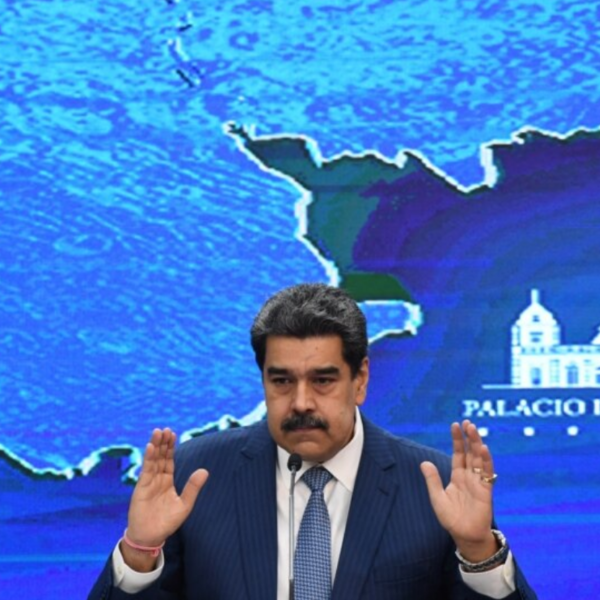
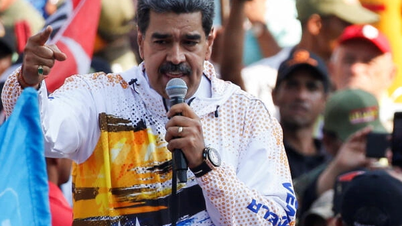
The United States is prepared to revoke all recent oil export licenses granted to Venezuela if the South American nation's president, Nicolas Maduro, fails to fulfill his election promises.
US Assistant Secretary of State for Western Hemisphere Affairs Brian Nichols said "everything is on the table," including revoking recently granted licenses allowing Venezuela to export oil and gas.
"If they don't take the agreed-upon steps, we will revoke the license we granted," Nichols said in an interview on November 16th on the sidelines of the 30th Asia-Pacific Economic Cooperation (APEC) forum in San Francisco, USA.
Earlier in October, the US Treasury Department eased most sanctions on Venezuela's oil and gold sectors, allowing the OPEC member nation to export crude oil, fuels, and natural gas to select markets for six months.
According to the US, this move is a gesture of goodwill in response to President Maduro's administration signing an agreement with the opposition regarding the 2024 presidential election.
Among the steps agreed upon was allowing opposition candidates to participate in the election. However, the Venezuelan Supreme Court suspended the results of the opposition primary election held on October 22 in Venezuela, which was won by Maria Corina Machado.
Despite his comments about the possibility of reimposing sanctions, Nichols expressed "confidence" that the current Maduro administration would abide by the agreement with the opposition and pave the way for Machado to run in the election.
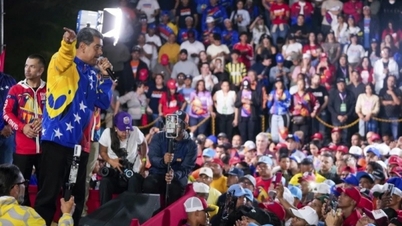
Maduro has repeatedly stated that he will not yield to what he considers "blackmail" demands from the United States.
PDVSA Petromonagas workers operate an oil rig in the Orinoco Belt – Venezuela's main oil-producing region. Photo: Orinoco Tribune
Venezuela's oil exports in September reached 800,000 barrels per day, the second-highest monthly average this year, as PDVSA and its joint ventures resumed production, particularly in the Orinoco Belt.
Although Venezuela has increased capacity and boosted crude oil exports this year, production has often been unstable from month to month amid frequent power outages, maintenance issues, and a lack of investment to expand output.
For example, in August, this OPEC member country achieved a production of 820,000 barrels per day, while exporting less than 700,000 barrels per day in October, due to disruptions in the country's main production areas. This suggests that it will take further time for Venezuela to stabilize production in a sustainable manner after the lifting of US sanctions.
The majority of Venezuela's September output was exported to China, both directly and through transit hubs.
Venezuela has also increased exports to its top political ally, Cuba, to around 86,000 barrels per day of crude oil, fuel oil, natural gas, and gasoline, up from 65,000 barrels per day in August. Cuba is facing fuel shortages and frequently risks power outages due to low fuel stocks needed to operate its power plants.
According to PDVSA documents and LSEG tanker tracking data, Chevron's Venezuelan oil exports to the U.S. in September fell to around 145,000 barrels per day, down from 147,000 barrels per day in August.
Immediately after US sanctions were eased, PDVSA began urging its traditional customers to re-establish trading relationships, primarily through spot sales. However, the company's requirement for upfront payment on all commodity sales, the lack of open market bidding, and oil quality issues hampered the payment process .
Minh Duc (According to Bloomberg, Reuters)
Source
![[Photo] Standing Committee member of the Party Central Committee Tran Cam Tu working with the Central Inspection Committee](https://vphoto.vietnam.vn/thumb/1200x675/vietnam/resource/IMAGE/2026/05/28/1779969579668_ndo_br_bnd-2495-jpg.webp)















































































Comment (0)