

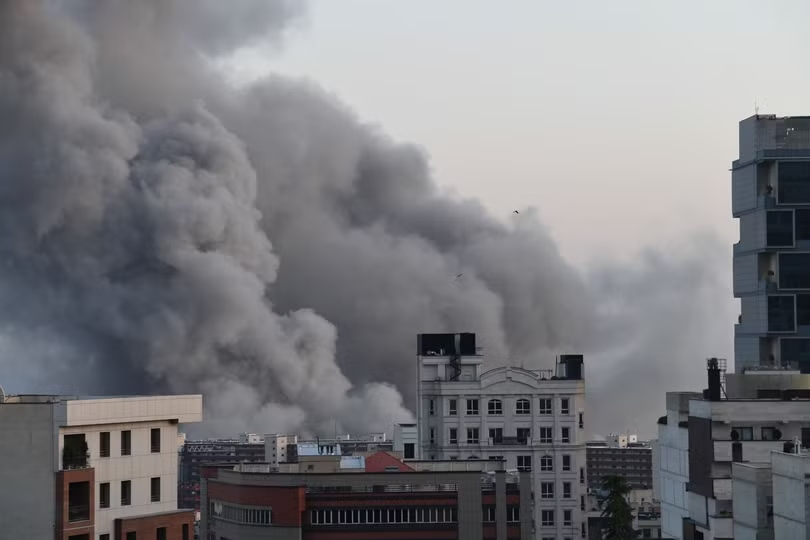
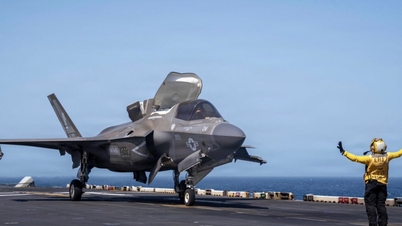
In a statement issued on June 1, CENTCOM said it had carried out self-defense attacks on Iranian radar sites and drone command and control facilities in Goruk (Iran) and on Qeshm Island over the weekend.
CENTCOM emphasized: “The attacks were conducted in a calculated and cautious manner on Saturday (May 30) and Sunday (May 31) in response to Iranian aggression, including the downing of a U.S. MQ-1 drone operating in international waters.”
According to CENTCOM, US fighter jets destroyed Iranian air defense systems, a ground control station, and two suicide attack drones deemed a threat to ships transiting the region's waters.
CENTCOM added that no U.S. servicemen were injured in the operation, and stressed that they will continue to defend U.S. forces, assets, and interests in response to unprovoked aggression from Iran while the ceasefire remains in effect.
Kuwait activates air defense system.
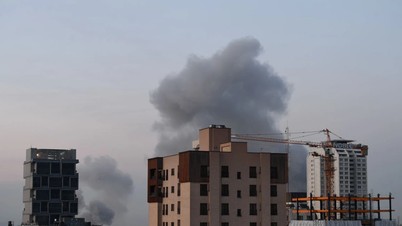
Immediately following the CENTCOM statement, according to Turkish news outlet Today, June 1st, the Kuwaiti military announced that its air defense systems were responding to threats from missiles and drones targeting Kuwaiti territory.
In a statement posted on social media, the Kuwaiti military said the explosions heard across the country were the result of interception operations carried out by air defense units.
Residents are advised to follow official security guidelines amid air raid sirens being activated in many areas nationwide.
Iran's Islamic Revolutionary Guard Corps (IRGC) confirmed that US airstrikes targeted a communications tower on Sirik Island, in Hormozgan province in southern Iran.
The IRGC claimed to have retaliated by attacking a US air base in Kuwait, which Tehran considered the origin of the attack, and asserted that it had destroyed multiple targets there.
The IRGC also warned that any further attacks would lead to a broader response and that Washington would bear full responsibility for any future escalation.
President Trump expressed optimism about a deal with Iran.
These latest developments follow last week's firefights, when US forces conducted airstrikes in Bandar Abbas province in southern Iran, near the Strait of Hormuz.
In response, Iran launched missiles targeting a US air base in Kuwait that Tehran identifies as a key hub for US military operations in the region.
Despite the military confrontation, diplomatic channels of communication between Washington and Tehran are being maintained.
Iranian Foreign Minister Abbas Araghchi said that talks and exchanges of messages between Iran and the United States are continuing.
Speaking on Iranian state television, he warned against drawing definitive conclusions before discussions yielded concrete results, emphasizing that current media reports remain speculative until officially confirmed.
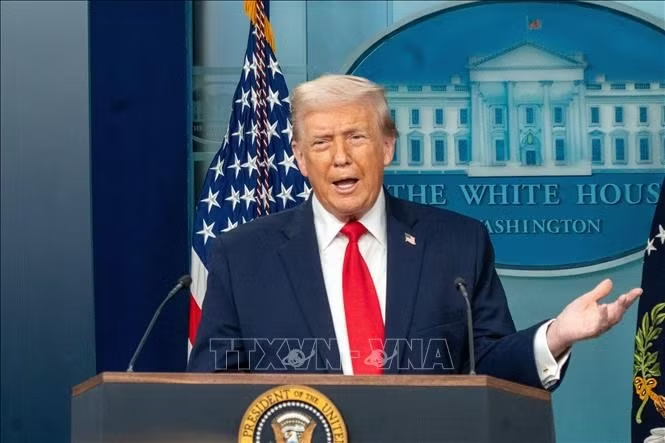
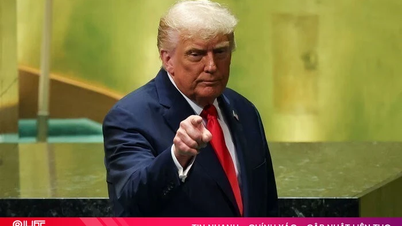
US President Donald Trump also commented on a proposed deal with Iran on May 31, asserting that the framework of the agreement clearly stipulates that Tehran cannot possess nuclear weapons.
Writing on the Truth Social platform, President Trump stated that the proposed agreement “makes it very clear that Iran will not have nuclear weapons,” while arguing that much of the document focuses on nuclear-related issues.
Trump has repeatedly emphasized that any future agreement with Tehran must include guarantees to prevent Iran from developing or possessing nuclear weapons.
In another post, President Trump stated that Iran “really wants to reach an agreement” and expressed confidence that the negotiations would ultimately yield an outcome beneficial to the United States and Washington’s partners.
Meanwhile, on May 31, the Speaker of the Iranian Parliament and head of the country's negotiating team, Mohammad Bagher Ghalibaf, declared that Tehran would not agree to any deal with the US until it was certain that the rights of the Iranian people were guaranteed, and stated that military achievements were the foundation for any subsequent diplomatic outcome.
In a video broadcast on state television, speaking at the first session of the third year of Iran's 12th Parliament, Ghalibaf said: "We will not ratify any agreement until we are certain that the rights of the Iranian people are guaranteed."
The Speaker of the Iranian Parliament and head of the negotiating team further emphasized this point by rejecting the value of any commitments from the US that remained merely verbal.
Ghalibaf declared, "It is impossible to place trust in the words and promises of the enemy," adding, "Our sole criterion is to achieve concrete results before making any reciprocal commitments."
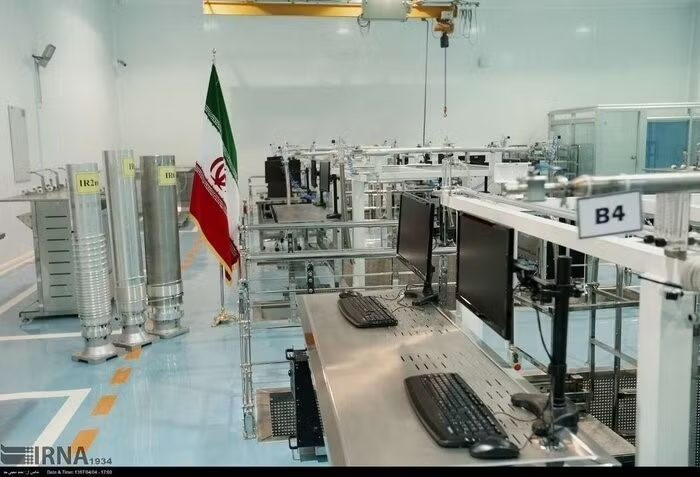
Regional tensions have escalated since the US and Israel launched attacks on Iran on February 28.
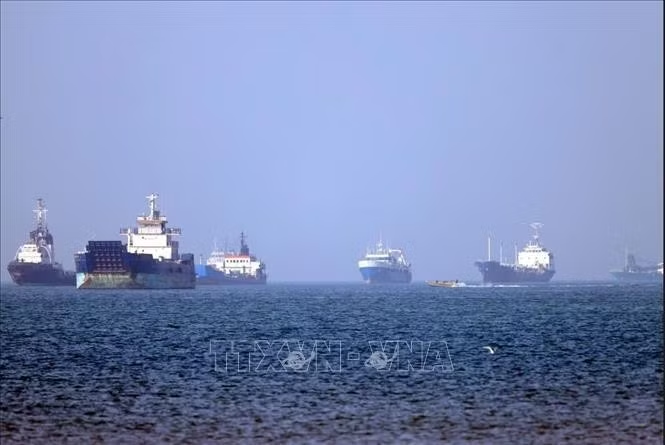
Tehran retaliated with attacks targeting Israel and US allies in the Gulf, and by blockading the Strait of Hormuz.
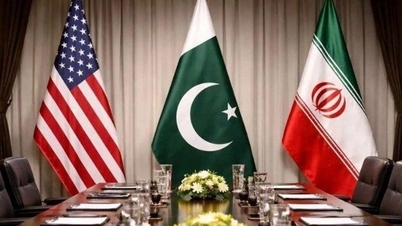
A ceasefire came into effect on April 8th through Pakistani mediation, but negotiations in Islamabad from April 11-12 failed to produce a lasting agreement.
Subsequently, President Trump extended the ceasefire indefinitely while maintaining the blockade on ships traveling to or from Iranian ports via the Strait of Hormuz.
Since then, Iran and the US have continued to exchange proposals and counter-proposals aimed at resuming direct talks and ending the war.
U.S. officials said the proposed framework could include extending the ceasefire for another 60 days along with a roadmap for further negotiations.
Source: https://baohatinh.vn/my-tan-cong-cac-tran-dia-radar-cua-iran-post311565.html


























![[Photo] Reception to welcome General Secretary and President To Lam and his wife on their State visit to the Philippines](https://vphoto.vietnam.vn/thumb/1200x675/vietnam/resource/IMAGE/2026/06/01/1780295488620_vna-potal-chieu-dai-chao-mung-tong-bi-thu-chu-tich-nuoc-to-lam-va-phu-nhan-tham-cap-nha-nuoc-toi-philippines-8798060-7855-jpg.webp)




































































Comment (0)