


Some banks have reported a significant drop in customer deposits. Photo: NAM ANH
This contradictory trend is raising the question: What is causing money to flow back into cash?
According to the latest data from the State Bank of Vietnam (SBV), the ratio of cash in circulation to total means of payment increased to 11.52% by the end of January 2026, the highest level in the past three years. Compared to the low of 9.48% recorded at the end of September 2025, this ratio has increased by more than 2%. Based on the total means of payment, the amount of cash in circulation in the economy increased by more than VND 360 trillion in just the last three months of 2025 and the first month of 2026.
Abnormal signs
In fact, cash flow in the banking system at the beginning of 2026 also showed several notable developments, with some banks recording a significant decrease in customer deposits. At the Vietnam Investment and Development Bank ( BIDV ), as of the end of the first quarter of 2026, customer deposits had decreased by approximately VND 82,030 billion, equivalent to a 3.69% decrease compared to the beginning of the year.
Similarly, Techcombank, TPBank, Sacombank , and other banks all recorded a decrease in customer deposits in the first quarter of 2026, with reductions ranging from several thousand to tens of thousands of billions of VND.
Notably, the latest figures from the State Bank of Vietnam show that over 2 trillion VND in deposits from economic organizations have been withdrawn from the banking system since October 2025 and there are still no signs of them returning. By the end of the first quarter of 2026, deposits from economic organizations will only amount to approximately 6 trillion VND, nearly 4 trillion VND less than deposits from individual customers.
This is considered a rather unusual development compared to recent years, when the scale of deposits from economic organizations and individuals was usually roughly equal. According to experts, one notable reason is that many businesses and enterprises tend to withdraw cash from the banking system to limit the monitoring of their cash flow.
Earlier this year, in a macroeconomic report published at the beginning of the year, experts from SHS Securities Company also stated that one of the important reasons for the outflow of cash from the banking system stemmed from changes in tax policies for individual business households.
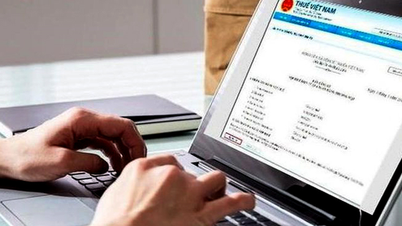
Specifically, from June 1, 2025, business households with annual revenue exceeding 1 billion VND will be required to use electronic invoices connected to the tax authorities, and according to the roadmap, the lump-sum tax mechanism will be completely abolished from 2026. Although the policy aims to increase transparency and tighten tax discipline, in reality, it has inadvertently created a sense of apprehension among some business households, causing them to prioritize cash transactions to limit the monitoring of their cash flow.
In the first half of June 2025, many large cities saw a surge in shops displaying signs indicating they only accepted cash and refused bank transfers. Various methods to avoid leaving transaction traces also became common, such as requesting customers not to include details in the transfer description.
According to SHS, the increasing trend of cash transactions may indicate that some transactions are shifting away from official payment channels.
The Paradox of Transparency
In reality, cash has never completely disappeared from small-scale transactions. However, it's noteworthy that a "return to cash" trend is emerging even among groups that have previously shifted heavily towards electronic payments.
In the free market for gold and foreign exchange, cash remains the primary method of payment, resulting in a large amount of cash being held outside the banking system for extended periods. For businesses accustomed to operating on a cash-based model, the fact that their entire cash flow is recorded makes them feel like they've lost their "safe zone."
According to SHS experts, the trend of money flowing back into cash is creating a double impact on the economy. On the one hand, it weakens the capital circulation in the banking system as the amount of money outside the system increases. On the other hand, this development contradicts the direction of increasing transparency in money flows and promoting cashless payments that Vietnam has pursued for many years.
Previously, the State Bank of Vietnam stated that the value of non-cash payment transactions in 2025 was approximately 28 times the GDP, exceeding the target of the Non-Cash Payment Development Plan for the period 2021-2025. Non-cash payments have continued to grow strongly in recent years, especially through QR Code.
However, by the first quarter of 2026, the amount of current account deposits (CASA) had decreased significantly at 23 out of 38 major banks. Compared to the same period last year, many banks recorded a CASA decrease of 15-30%. The decline in CASA also increased the pressure on banks to raise capital.
According to Vu Tuan Duy, a macroeconomic expert at SHS, by the end of 2025, the flow of cash in circulation will surge like "water draining from a river before the dry season." This shift will cause VND liquidity in the system to become significantly more strained.
Overnight interbank interest rates are fluctuating sharply, forcing the State Bank of Vietnam (SBV) to support liquidity through the SBV Swap channel, similar to the period around December 2025. Mr. Duy predicted that deposit interest rates at the end of 2025 and the beginning of 2026 will be continuously pushed up, "like a body having to increase its heart rate to keep blood flowing."
Ultimately, money only stays in the system when people feel safe, comfortable, and benefit from participating in it. Otherwise, the trend of cash transactions is likely to continue expanding, even as Vietnam is accelerating the development of its digital economy and digital finance.
According to Nhandan.vn
Source: https://baoangiang.com.vn/nen-kinh-te-tien-mat-dang-am-tham-tro-lai-a487218.html

![[Photo] Ba Lang An Lighthouse - the "eye of the sea" amidst the "rock museum" of Quang Ngai province.](https://vphoto.vietnam.vn/thumb/1200x675/vietnam/resource/IMAGE/2026/05/29/1780038698840_anh-man-hinh-2026-05-29-luc-14-10-42.png)


![[Image] Pleasant weather helps students enter the 10th grade entrance exam with confidence.](https://vphoto.vietnam.vn/thumb/1200x675/vietnam/resource/IMAGE/2026/05/29/1780034401612_ngay-1-thi-lop-10-minh-duy-8-5009-jpg.webp)






















































































Comment (0)