

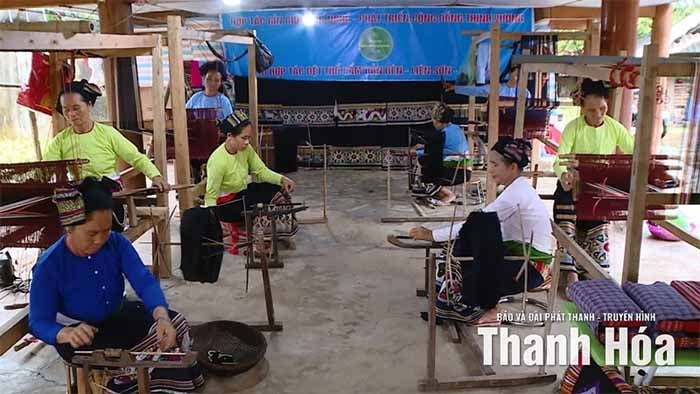
Ban Ben Brocade Weaving Cooperative, Lien Son Hamlet, Xuan Chinh Commune.
The Thai people typically live in high mountainous regions with harsh climates. Whenever they go to the fields to work or to the streams to fish, they devised ways to wrap cloth around their heads to protect themselves from dew and wind in the cold weather. Over time, with the creativity of the women, the headscarf became more elaborately embroidered and woven, creating a unique characteristic. Therefore, the scarf not only serves a health-protective function but also acts as a part of the clothing, enhancing the beauty of Thai women. Consequently, women often weave and embroider their own scarves according to their wishes, with vibrant patterns, and call them "piêu scarves."
Depending on the region and locality, the piêu scarf has its own unique characteristics. At nearly 60 years old, Mrs. Cam Thi Ngoc in Lien Son village, Xuan Chinh commune, still diligently works at her loom – her companion for over 40 years. Her hands are calloused, but each stroke of the shuttle, each thread, each pattern seems to blend with the breath of the mountains and forests to create vibrant brocade fabrics, embodying the soul and cultural identity of the Thai community in Xuan Chinh commune. Currently, she and more than 30 other women in the village participate in the Ben village brocade weaving cooperative. In the stilt house, the rhythmic clacking of the looms, arranged closely together, resonates; some spin yarn, others dye threads, and still others weave patterns – all creating a harmonious and cohesive process.
While meticulously weaving with the shuttle, Ms. Ngoc shared: "In the life of the Thai people, the piêu scarf has a very special meaning. The scarf is not only an ornament to beautify women, but also a symbol of love. In the past, every girl, upon reaching adulthood, would hand-embroider a piêu scarf to give to the person she loved. The piêu scarf thus became a token of love between couples."
The Thai ethnic people in Xuan Chinh commune often say, "Girls know how to weave cloth, boys know how to make fishing nets," referring to the standards of those reaching adulthood. In daily life, from the age of 8 or 9, girls are taught by their mothers and grandmothers how to spin yarn, dye fabric, and embroider to create beautiful brocade. This is also one of the important criteria for evaluating the skill and diligence of Thai girls. Therefore, the piêu scarf is a product deeply imbued with the ethnic cultural identity. Because of its aesthetic value, the piêu scarf is an indispensable accessory for Thai girls when going out, attending festivals, participating in Xòe dances, and Sạp dances... Along with skirts, blouses, and belts, the piêu scarf contributes to the unique beauty and character of the traditional clothing of the Thai ethnic group in Thanh Hoa province.
Ms. Vi Thi Luyen, head of the Ban Ben brocade weaving cooperative in Lien Son village, said: "Thai women use the 'pieu' scarf every day. During the off-season, the women in the village diligently embroider colorful 'pieu' scarves with patterns characteristic of the Thai ethnic culture. To preserve this traditional craft, we women participate in clubs and cooperatives to conserve the Thai ethnic culture."
The piêu scarf worn by Thai women in Thanh Hoa is typically the length of an adult's arm, and its decorative patterns are more subdued compared to the piêu scarves of the Thai people in the Northwest region. The patterns are usually embroidered in square or rectangular motifs and are located at both ends of the scarf. The colors that create the unique patterns on the piêu scarf are skillfully combined, including the green of the mountains and forests, the yellow of ripening rice paddies, and the red and white of flowers and plants. Each pattern on the scarf embodies the feelings of the Thai woman, expressing her love for nature and her village. Therefore, depending on the circumstances, they may wear piêu scarves with different colors and patterns. Sometimes they wear brightly colored scarves, while other times they wear scarves in muted colors, as if concealing sadness, hardship, and toil. All the joys and sorrows, happiness and suffering, seem to be clearly reflected in every stitch of each piêu scarf.
Today, in modern life, the piêu scarf is no longer confined to the village setting, but has become a unique cultural product, appearing in festivals, cultural performances, and even chosen by many tourists as a souvenir. The story of the piêu scarf is like a continuous cultural flow, adorning women with a beauty that is both radiant and elegant, noble and refined. Therefore, Thai women always cherish and preserve the piêu scarf and pass it down to their children and grandchildren.
Ha Hong (Source: Baothanhhoa)
Source: https://svhttdl.thanhhoa.gov.vn/van-hoa/net-doc-dao-tren-chiec-khan-pieu-cua-nguoi-thai-1009972
![[Photo] General Secretary and President To Lam meets with National Assembly delegates from ethnic minorities.](https://vphoto.vietnam.vn/thumb/1200x675/vietnam/resource/IMAGE/2026/04/20/1776696701056_a1-bnd-8331-3342-jpg.webp)
![[Image] National Assembly discusses the implementation of the socio-economic development plan.](https://vphoto.vietnam.vn/thumb/1200x675/vietnam/resource/IMAGE/2026/04/20/1776696707422_ndo_br_img-20260420-185419-jpg.webp)



















































Comment (0)