

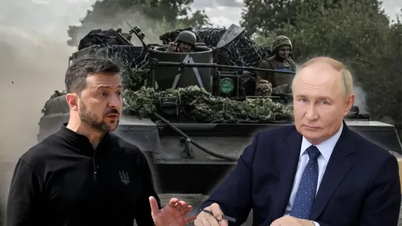
RIA Novosti reported on June 2nd, citing a statement from the Russian Ministry of Defense , that the country's armed forces conducted a large-scale attack on the night of June 1st, using hypersonic missiles, targeting facilities that Moscow considers to be enterprises belonging to the defense industrial complex.
The statement said that the Russian armed forces “launched a large-scale attack using high-precision long-range weapons in the air, on land and at sea, including hypersonic ballistic missiles and drones, targeting enterprises of the defense industrial complex (of Ukraine).”
According to the Russian Ministry of Defense, the country has achieved its stated goals.
Meanwhile, on the same day, Ukrainian officials said at least nine people were killed and dozens injured in missile and drone attacks across the country.
According to witnesses, multiple explosions were heard in the Ukrainian capital Kyiv, followed by fires and power outages in several areas. Kyiv Mayor Vitali Klitschko said four people were killed and at least 58 injured in the attacks.
Earlier, he had also issued a warning to residents about the risk of attacks. In Dnipro, at least five people were killed and 25 injured in the attacks.
Russian officials assert that the move was in retaliation for the drone attack on May 22nd targeting a college and student dormitory in the city of Starobelsk, in the self-proclaimed Lugansk People's Republic (LPR), which killed nearly 20 people and injured dozens more.
Also on June 1st, Russia reported drone attacks, with at least one person killed in an attack that occurred in the Kursk province, near the Ukrainian border.
A drone caused a fire at an oil refinery in the southwestern city of Krasnodar.
On June 1st, China's Permanent Representative to the United Nations, Fu Cong, stated that Beijing hopes Russia and Ukraine will resume talks "as soon as possible" to peacefully resolve the ongoing conflict.
The Chinese diplomat called for negotiations to appropriately and reasonably address the security concerns of all parties and to aim for a swift peace agreement.
According to him, China is ready to cooperate with the international community to continue playing a constructive role in finding a political solution to the crisis.
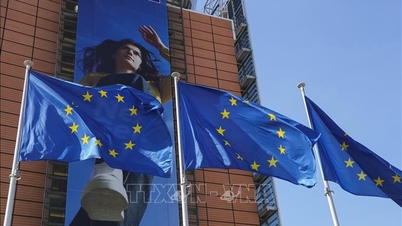
In another development, according to a VNA correspondent in Eastern Europe, the Netherlands will extend the deployment of its Patriot air defense system and approximately 150 soldiers in Poland for up to six months to protect a crucial logistics center of the North Atlantic Treaty Organization (NATO), which receives and transits most of Western military aid to Ukraine.
Dutch Defence Minister Dilan Yesilgoz-Zegerius said the mission at Rzeszow-Jasionka Airport in southeastern Poland was scheduled to end in early June, but has been extended at the request of NATO and Poland.
According to Ms. Yesilgoz-Zegerius, this decision demonstrates the Netherlands' support for Ukraine and shows its willingness to meet the demands of NATO and its allies.
Protecting the logistics hub located less than 100km from the Ukrainian border is part of NATO's rotation mechanism. Over the years, several member states have successively deployed air defense systems to the area.
The Netherlands took over the mission in December 2025, replacing German forces. Initially, the Netherlands deployed approximately 300 soldiers along with two Patriot missile batteries, NASAMS air defense missile systems, and anti-drone equipment to build a multi-layered defense network against threats from drones, aircraft, and ballistic missiles.
Under the new agreement, two Patriot missile batteries and approximately 150 soldiers will remain in Poland until early December 2026. Meanwhile, other military systems and the remaining soldiers will return to the Netherlands this month.
Patriot is one of the most advanced mobile air defense systems currently available, capable of detecting, tracking, and intercepting missiles, drones, and fighter aircraft.
The Polish armed forces currently possess two Patriot missile batteries and have ordered six more from the United States to enhance their defensive capabilities against regional security challenges.
Source: https://www.vietnamplus.vn/nga-tan-cong-quan-su-quy-mo-lon-nham-vao-ukraine-post1114054.vnp


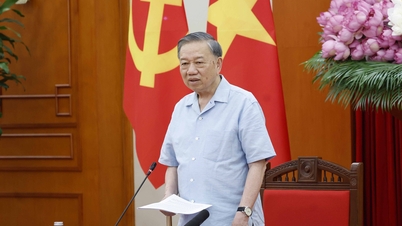
![[Photo] General Secretary and President To Lam presides over a meeting on preparations for the review of one year of operation of the three-tiered government system.](https://vphoto.vietnam.vn/thumb/1200x675/vietnam/resource/IMAGE/2026/06/02/1780391821195_a1-bnd-4595-9717-jpg.webp)





















































































Comment (0)