

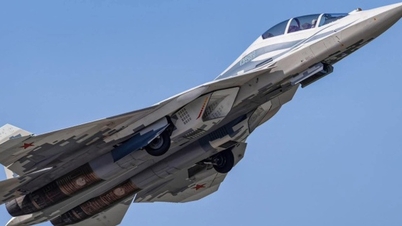
In recent times, Russia has primarily used Geran-2 unmanned aerial vehicles (UAVs), a version developed from Iran's Shahed series, to carry out attacks on Ukrainian territory. However, Moscow is also developing newer, faster variants equipped with jet engines, including the Geran-3, Geran-4, and Geran-5.
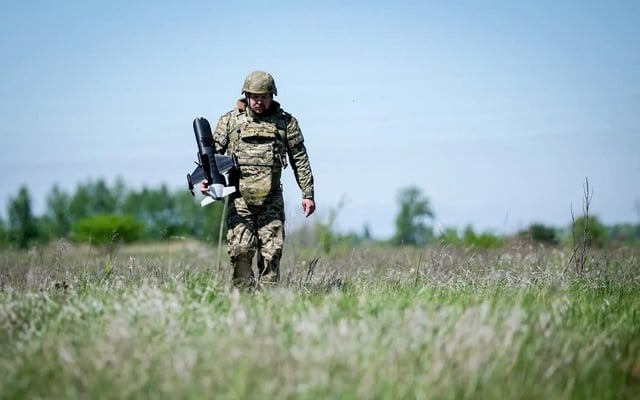
Russia's new jet-powered drone has been unveiled. (Source: Getty Images)
According to the Ukrainian Defense Intelligence Directorate (GUR), Russia began using Geran-4 UAVs in attacks in early May. The agency claims this is a measure aimed at reducing the effectiveness of the interceptor UAV network that Ukraine is widely deploying.
The race between attack UAVs and interceptor UAVs.
Inexpensive interceptor drones are now a crucial component of Ukraine's air defense system, as the country faces increasingly frequent missile and drone attacks from Russia.
Ukrainian Minister of Digital Transformation Mykhailo Fedorov recently stated that the number of Geran-type UAVs destroyed by interceptor drones has doubled since the beginning of 2026. At the same time, the number of interceptor drones supplied to the military has also increased significantly.
Interceptor UAVs typically carry small warheads, destroying targets through direct impact or detonation upon approach. However, most are designed to counter the Geran-2, a UAV with a speed of approximately 185 km/h, rather than the much faster jet variants.
What's new about Geran-4?
According to GUR, the Geran-4 is equipped with turbojet engines, allowing it to reach a maximum speed of approximately 500 km/h and operate at altitudes up to 5,000 m. This UAV can carry high-explosive warheads up to a distance of 450 km. Unlike the Geran-2, the Geran-4 is launched from a dedicated rail, accelerating before the jet engines start.
Ukrainian intelligence reports indicate that the new UAV model features a redesigned airframe, a more robust structure, and engines with greater thrust than previous versions. These improvements make it more maneuverable and harder to intercept.
Although not yet deployed on the same scale as the Geran-2, Russian jet-powered UAVs are appearing more and more frequently on the battlefield. Moscow is also believed to have expanded infrastructure at numerous air bases to support the operation of these new types of UAVs.
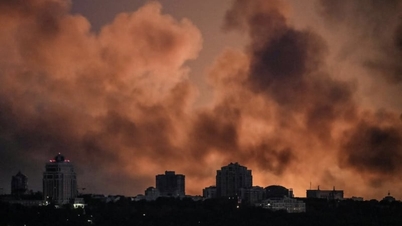
Serhii Flash Beskrestnov, an advisor to the Ukrainian Ministry of Defense , said that Russia used both Geran-3 and Geran-4 missiles in the large-scale attack on Kyiv last weekend.
In response to the appearance of Russian jet drones, Ukraine is accelerating the development of new, higher-speed interceptor vehicles.
Ukrainian military UAV manufacturers say they are developing interceptor UAVs fast enough to pursue new-generation Geran variants.
Meanwhile, Minister Fedorov said that Kyiv is also focusing on developing inexpensive interceptor missiles to counter jet-launched UAVs. Several testing programs have been launched, and Ukraine aims to build up a significant stockpile before this fall.
According to Ukrainian officials, this is a critical time because Russia typically intensifies its missile and drone attacks during the colder months.
The emergence of interceptor UAVs, followed by jet-powered UAVs like the Geran-3 and Geran-4, and then Ukraine's efforts to develop inexpensive interceptor missiles, shows that the conflict is becoming increasingly competitive in terms of technology.
Source: https://suckhoedoisong.vn/nga-tung-uav-phan-luc-moi-thach-thuc-luoi-danh-chan-ukraine-169260526094035028.htm
![[Image] Hanoi's urban life under the challenge of a "scorching hot" environment](https://vphoto.vietnam.vn/thumb/1200x675/vietnam/resource/IMAGE/2026/05/25/1779706979265_nang-nong-t5-2026-minh-duy-7-4636-jpg.webp)



























































































Comment (0)