

Why is the chaya plant called the MSG vegetable plant?
The plant commonly known as "MSG plant" is actually called "chaya plant" or "MSG plant" (or Ajinomoto plant) because its cooked leaves have an umami flavor, a savory or rich taste similar to that of MSG (monosodium glutamate). The plant contains high levels of natural compounds and amino acids that stimulate our taste receptors in a similar way to commercial MSG.
The origin of the MSG plant
Chaya, also known as "Mayan spinach" or "Mexican spinach," originates from the Yucatan Peninsula in Mexico. It has been a popular leafy vegetable among the Mayan people for thousands of years. Its natural range extends from northern Mexico to Peru in the south. It spread throughout the Caribbean and reached Florida through indigenous trade before European colonization. Chaya was introduced to Asia and Africa via transatlantic trade during the colonial period. Chaya is eaten as a leafy green and is very popular in Mexico. It is prepared similarly to spinach. It is a source of nutrients such as protein, vitamins, calcium, and iron, and is also a rich source of antioxidants. In fact, it has more nutritional benefits than spinach.
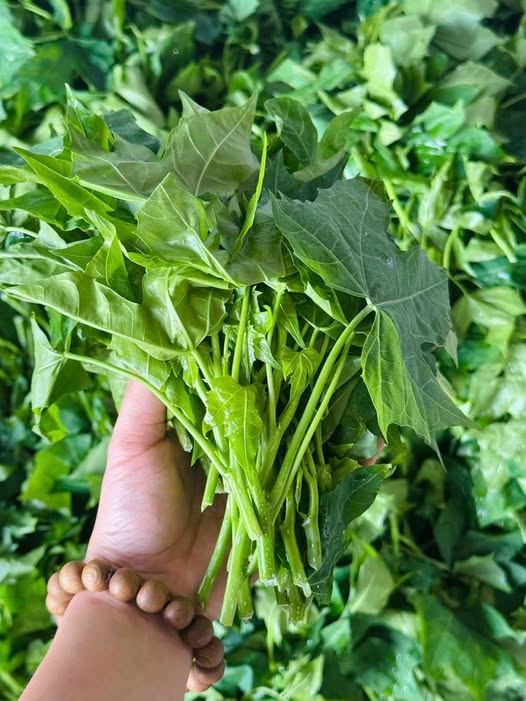
The cassava plant is a highly nutritious vegetable native to South America.
Structure and characteristics of the monosodium glutamate plant
The Chinese parsley plant is a perennial, dioecious, highly branched shrub with a thick, fast-growing stem, typically reaching 3 meters in height and 2 meters in width, although some plants can grow to 5 or 6 meters. It is found growing in damp and dry thickets in open woodlands, often in rocky clearings, and tolerates most soil conditions, thriving in moist, well-drained soil.
The leaves of the monocotyledonous plant are dark green, alternate, simple, smooth, often with a few hairs, and palmately lobed (similar to papaya leaves, although some say they resemble okra leaves). Each leaf is 6 to 8 inches wide and grows on a long, slender petiole. At the point where the petiole connects to the leaf, the veins are thick and cup-shaped. The wood of the young stem is soft, brittle, and easily decays. When cut, the stem exudes a white milky sap.
The flowers grow at the end of long, flat-tipped stalks, 3-5 inches wide, bearing many male flowers and few female (unisexual) flowers without petals. The flowers are terminal, blooming first, consisting of 5 white sepals more than 1/4 inch long that fall off early, and on the disc is a 1/4 inch long pistil with a pale green, hairy, egg-shaped ovary containing 3 chambers with 3 ovules and 3 widely functioning white styles.
There are two main types of MSG (monosodium glutamate) plants: wild and domesticated. The domesticated variety does not have the hairs that cause itching, so it is highly favored for use in cooking. The wild variety, however, is rarely used nowadays.
Whether wild or domesticated, the leaves of the MSG plant should not be eaten raw. Fresh leaves contain cyanogenic glycosides, toxic cyanide compounds (similar to those found in cassava) that release cyanide when chewed. To neutralize these toxins and make the plant safe to process, the leaves must be thoroughly boiled or stir-fried for at least 15 minutes before eating. The first boiling water should be discarded to remove some of the toxins.
Source: https://suckhoedoisong.vn/cay-rau-mi-chinh-bat-nguon-tu-dau-169260526095432012.htm




![[Image] Hanoi's urban life under the challenge of a "scorching hot" environment](https://vphoto.vietnam.vn/thumb/1200x675/vietnam/resource/IMAGE/2026/05/25/1779706979265_nang-nong-t5-2026-minh-duy-7-4636-jpg.webp)
























































































Comment (0)