

3 major challenges
According to Ms. Phan Thi Thanh Xuan, Vice President of the Vietnam Leather and Footwear Association (LEFASO), the Vietnamese leather and footwear industry is currently facing three strategic challenges.

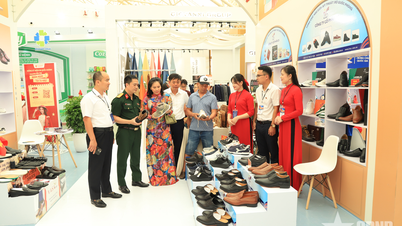
The Vietnamese footwear industry is currently facing three strategic challenges. Photo: Tran Viet.
The first and most persistent challenge facing Vietnam's footwear industry is price pressure. With continuously rising domestic production costs—from wages and logistics to electricity and increasingly stringent environmental and social standards—business profit margins are shrinking. Meanwhile, export prices are not increasing proportionally, and many orders are even being forced down.
Notably, even though many orders are shifting away from China, international partners still use Chinese pricing to negotiate with Vietnamese businesses. This creates significant pressure because the domestic supply chain for raw materials and components is not yet complete, making it difficult for Vietnamese businesses to compete on the same input costs.
The second challenge is technological limitations. Despite certain advances in automation and production management, the majority of Vietnamese footwear businesses remain in a processing role within the global value chain. Many orders requiring advanced technology, design, new materials, or sustainable production methods have yet to be shifted to Vietnam.
According to LEFASO representatives, many high-value orders remain "anchored" in China because Vietnamese businesses have not yet mastered core technologies, from product design and model development to the application of environmentally friendly materials and smart manufacturing processes. This lack of technological capability not only causes businesses to miss opportunities to increase revenue but also slows down the industry's progress in upgrading its position within the global supply chain.

The footwear industry faces the challenge of greening and reducing greenhouse gas emissions. Photo: Viet Anh.
With major markets like the EU and the US increasingly tightening green standards, labor standards, and traceability requirements, the technology gap risks becoming a significant barrier. Without systematic investment in technological innovation, digital transformation, and sustainable production, Vietnam's footwear industry could gradually lose its competitive edge to faster-moving competitors in the region.
The third challenge comes from the international competitive environment, particularly in Southeast Asia. Indonesia is currently considered one of Vietnam's major competitors in the footwear industry. The country is actively negotiating a free trade agreement with the European Union (EU). If this agreement is signed by the end of 2026 or early 2027, Indonesian footwear will have a significant tariff advantage when entering the EU market.
This puts Vietnam's footwear industry at risk of losing market share in one of its most important export markets. As tariff advantages are leveled or narrowed, the competitiveness of Vietnamese businesses will depend more on product quality, technology, delivery speed, and the ability to meet sustainability standards – factors that Vietnam is still in the process of perfecting.
Policy changes are needed to retain supply chains.
Given these challenges, LEFASO believes that the role of policy is particularly important in the current period. One of the most urgent issues is resolving obstacles related to on-site import and export. Currently, the lack of consistency between the law and guiding decrees is preventing many export-oriented manufacturing businesses, even those with a reliable domestic supply of raw materials, from claiming tax refunds.
As a result, many businesses are forced to switch to directly importing raw materials instead of purchasing them domestically, weakening the domestic supporting industry, which is considered the "backbone" for enhancing the competitiveness of the entire sector. LEFASO recommends that the Government and relevant ministries and agencies promptly review and adjust policies to encourage the use of domestically produced raw materials, creating momentum for the sustainable development of domestic supply chains.
In addition, LEFASO proposed that the Ministry of Industry and Trade hold urgent meetings with relevant parties to find immediate solutions, avoiding prolonged policy obstacles that could weaken the foundation of the industry. Regarding the idea of establishing a raw materials and components center for the textile, footwear, and wood industries, the businesses believe this is a new and complex model, requiring specific mechanisms and in-depth consultation.
Accordingly, this center should not simply be a place for concentrating raw materials, but should be designed as a complete ecosystem, integrating logistics, raw material markets, research and development (R&D), and quality control. To achieve this, Vietnamese trade offices abroad, especially in China, need to support connections, help domestic businesses learn from international experience, and develop feasible projects.
Source: https://nongnghiepmoitruong.vn/nganh-da-giay-viet-nam-doi-mat-voi-3-thach-thuc-lon-d789644.html


![[Image] Close-up view of the interchange connecting the two expressways and Long Thanh Airport.](https://vphoto.vietnam.vn/thumb/1200x675/vietnam/resource/IMAGE/2026/05/25/1779703378210_ndo_br_z7863716673926-224453a31600126cce10622af6290afd-4549-jpg.webp)


![[Image] Hanoi's urban life under the challenge of a "scorching hot" environment](https://vphoto.vietnam.vn/thumb/1200x675/vietnam/resource/IMAGE/2026/05/25/1779706979265_nang-nong-t5-2026-minh-duy-7-4636-jpg.webp)








































































Comment (0)