


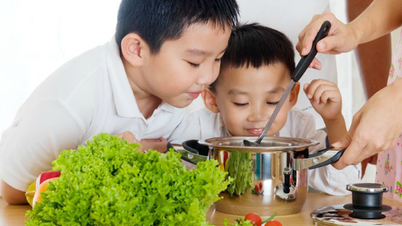
Many parents are frustrated because their children refuse to eat vegetables - Photo: NATURE'S PATH
A study conducted by scientists at Durham University and Aston University (UK) found that children who were exposed to the taste of certain vegetables through their mothers' diets during pregnancy tended to have less negative reactions to those same vegetables by the age of three, according to ScienceAlert on May 19.
The research team tracked children who had previously participated in an experiment since the fetal stage.
Pregnant mothers in their 32nd and 36th weeks were given capsules containing concentrated carrot or kale powder. Scientists then used ultrasound to record the fetus's facial reactions.
Results published in 2022 showed that fetuses appear to react differently to these smells even while still in the womb.
According to researchers, by the third trimester, around week 28 of pregnancy, the fetus has developed enough to sense smells and tastes through the amniotic fluid. Flavor compounds from the mother's food can pass through the placenta, creating the fetus's first sensory experiences.

A 3-year-old child responded positively (left) to carrots compared to kale (right) thanks to her mother taking carrot powder capsules during pregnancy - Photo: DURHAM UNIVERSITY
In a new study, when children turned 3 years old, researchers exposed 12 children to the scent of carrots and kale using scented cotton swabs. The children's expressions were recorded in two groups: positive reactions (happy faces) and negative reactions (unpleasant faces).
The results showed that babies had fewer negative reactions to vegetables they had been exposed to in the womb. Specifically, although kale, a bitter-tasting vegetable, often elicits less positive reactions, early exposure still helped reduce the level of discomfort.
This suggests that exposure to flavors in late pregnancy may create "olfactory memories" that last for years after birth, thereby influencing a child's eating preferences.
However, the authors also emphasize the limitations of the study due to its small scale, surveying only a population group and not fully tracking postnatal influencing factors. Furthermore, food preferences are also influenced by genetics, culture, and environment.
However, the results still open up a noteworthy research direction: early exposure to smells and tastes could become a tool to help children better accept vegetables they are often rejected.
The study was published in the journal Developmental Psychobiology .
Source: https://tuoitre.vn/nghien-cuu-moi-he-lo-cach-giup-tre-chiu-an-rau-20260519113939379.htm
![[Image] Hanoi's urban life under the challenge of a "scorching hot" environment](https://vphoto.vietnam.vn/thumb/1200x675/vietnam/resource/IMAGE/2026/05/25/1779706979265_nang-nong-t5-2026-minh-duy-7-4636-jpg.webp)









































































































Comment (0)