

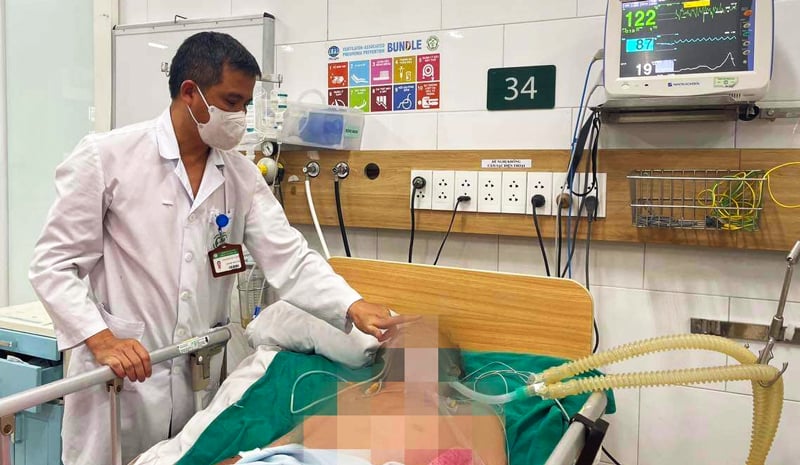
Treating patients with alcohol poisoning at the Poison Control Center (Bach Mai Hospital). Photo: Xuan Loc
Heartbreaking endings
At a house party, after almost finishing their drinks, four people in Dam Doi district ( Ca Mau province) mixed hand sanitizer into their alcohol before drinking. The next day, they all experienced headaches, fatigue, and vomiting but did not seek medical attention. When one person became ill and died at home, their family took the remaining three to Ca Mau Provincial General Hospital. There, all three patients were diagnosed with methanol poisoning. Due to delayed hospitalization, they all suffered dangerous complications, with one case having a poor prognosis. From the beginning of 2023 to the present, Ca Mau province has recorded three cases of methanol poisoning resulting in three deaths.
Previously, Dong Anh General Hospital ( Hanoi ) also treated a 56-year-old male patient with methanol poisoning, whose prognosis was very serious. The patient had a history of alcohol addiction and was brought to the hospital's Emergency Department in a deep coma, with cyanotic skin, cold extremities, and urinary incontinence. Blood gas analysis revealed severe metabolic acidosis. The patient was diagnosed with acute methanol poisoning with a very serious prognosis and transferred to the Poison Control Center (Bach Mai Hospital). There, tests showed very high levels of methanol in the blood, requiring emergency hemodialysis.
Since the beginning of 2023, the Food Safety Department ( Ministry of Health ) has issued warnings that several provinces and cities have recorded numerous cases requiring emergency treatment related to the consumption of unsafe alcohol, alcohol of unknown origin, and alcohol with high methanol content, including some fatalities. Methanol, also known as industrial alcohol, has many uses such as in paints and solvents. However, this substance is highly toxic to the body and should absolutely not be used in food-grade alcohol like ethanol.
After each case of counterfeit alcohol containing methanol being discovered, Bach Mai Hospital specifically informs the relevant authorities, but the situation continues. Dr. Nguyen Trung Nguyen, Director of the Poison Control Center (Bach Mai Hospital), said that methanol poisoning cases mainly stem from two causes: drinking low-quality alcohol mixed with methanol and consuming counterfeit medical alcohol, where ethanol is replaced with industrial methanol.
"The reaction to methanol-containing alcohol varies from person to person. Some people may experience normal drunkenness first, and only begin to show signs of poisoning after two days. Furthermore, methanol is metabolized and eliminated very slowly. Therefore, even if the patient doesn't die, methanol can still be detected in the body for up to eight days after consumption. However, if methanol remains in the body for even a short time, this toxin gradually transforms into formic acid, causing damage to the eyes and brain," explained Dr. Nguyen Trung Nguyen.
Do not soak medicinal herbs in alcohol arbitrarily.
Besides cases of methanol poisoning, the Poison Control Center (Bach Mai Hospital) also receives and treats many patients hospitalized due to poisoning after drinking various types of herbal-infused liquors to treat back pain, knee pain, and to improve overall health. Dr. Nguyen Trung Nguyen, Director of the Poison Control Center, stated that in some cases, tests of the liquor samples brought in by patients and blood tests revealed the presence of salicylate derived from herbal roots. Salicylate poisoning can lead to severe health consequences. Patients may experience dizziness, nausea, tinnitus, convulsions, coma, hypotension, brain damage, kidney damage, and are at high risk of death.
In reality, the use of herbal wines and tinctures is very haphazard, driven by the consumer's mentality of "soaking whatever is available." Some wines are infused with herbs such as ginseng, reishi mushrooms, Centella asiatica, chrysanthemum, Polygonum multiflorum, unripe bananas, etc., or with traditional Chinese medicine ingredients. Many people believe that herbal wines and root infusions are natural and harmless. Therefore, they use any plant, root, or leaf with medicinal and nourishing properties, soak it in alcohol, and drink it, thinking it can cure their ailments.
According to health experts, the practice of infusing herbs and animals in alcohol must be prescribed by traditional Chinese medicine doctors. Medicinal wines should be consumed like medicine, according to instructions and in specific dosages. With certain plants, animals, and insects, if used correctly, they can be beneficial remedies. Conversely, if used indiscriminately and improperly, they can be toxic, especially wild plants and herbs which often contain toxins that harm the nervous system, cardiovascular system, respiratory system, etc., and can even lead to death.
Dr. Nguyen Hong Tot, from the Department of Internal Medicine and Toxicology, Intensive Care Center (Military Central Hospital 108), further noted that methanol poisoning is very dangerous, with a high mortality rate, especially in cases where patients arrive late. If admitted too late, patients may die from multiple organ failure and severe metabolic acidosis. Some fortunate cases who survive may face neurological and visual sequelae. Therefore, people should consume alcohol from reliable sources and limit their alcohol and beer consumption to ensure their health, especially avoiding drinking alcohol or beer while driving.
Source: Hanoimoi
Source link


![[Photo] Standing Committee member of the Party Central Committee Tran Cam Tu working with the Central Inspection Committee](https://vphoto.vietnam.vn/thumb/1200x675/vietnam/resource/IMAGE/2026/05/28/1779969579668_ndo_br_bnd-2495-jpg.webp)

























































































Comment (0)