

 |
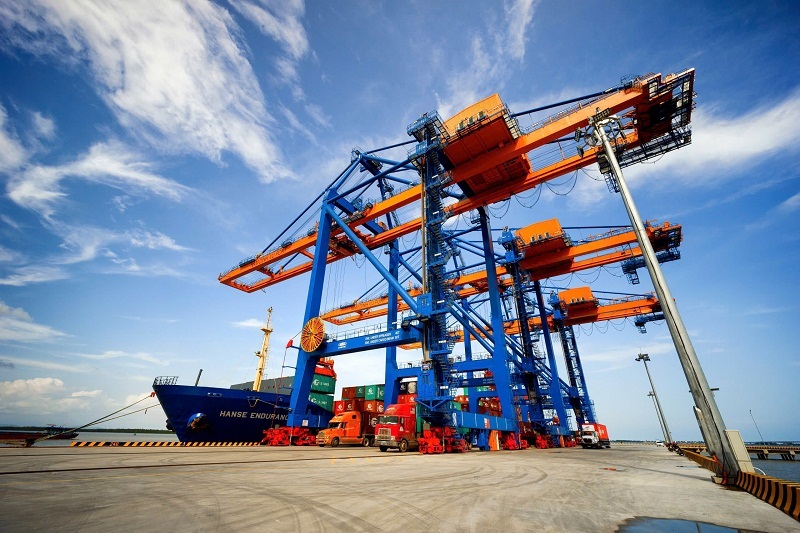
| Exports in the first six months are estimated to increase by 14.4%, resulting in a trade surplus of $7.63 billion. |
GDP growth for the first six months could reach 7.5-7.6%.
The final figures on the socio-economic situation in the second quarter and the first six months of 2025 will be officially released in the coming days. However, reporting at the regular Government meeting in June and the online Government conference with localities and organizations held yesterday (July 3), Minister of Finance Nguyen Van Thang stated that in the first half of the year, economic growth achieved the highest results in nearly 20 years, with many indicators and indices on production, business, and the state budget improving month by month and quarter by quarter; macroeconomic stability was maintained, and inflation was controlled...
“According to forecasts at the end of May, GDP growth in the second quarter is estimated at 7.67% year-on-year; and 7.31% for the first six months. However, estimated figures up to the end of June suggest that the six-month GDP growth rate may be 0.2-0.3 percentage points higher than the forecast, reaching approximately 7.5-7.6%, closely following the scenario in Resolution No. 154/NQ-CP (7.6%),” Minister Nguyen Van Thang said, adding that Vietnam’s growth rate in 2025 is projected to continue to be the highest in ASEAN and among the leading countries in the world and the region.
The head of the finance sector also used the phrase "contrary to the downward trend" of the global economy to emphasize the positive trend of the economy, amidst a series of difficulties and challenges. The difficulties and challenges were immense, but the entire economy made great efforts, showed determination and steadfastness in achieving its goals, demonstrated resilience in implementation, and responded promptly and effectively to the situation. As a result, socio-economic development achieved quite comprehensive results.
Besides the GDP growth rate closely following the projected scenario, numerous figures can be cited to support this assessment. The manufacturing industry in the second quarter increased by 10.65% year-on-year, and the overall growth for the first six months was 10%, meeting the projected scenario. This is among the few years since 2011 that have seen double-digit growth in the first six months. In the past nearly 15 years, industrial production has only seen double-digit growth in the first six months in four years.
Other noteworthy indicators include a 14.4% increase in exports over the first six months, with an estimated trade surplus of US$7.63 billion; a 9% year-on-year increase in total retail sales of goods and consumer service revenue in the second quarter, and a 9.3% increase over the first six months; total registered foreign investment over the first six months reached over US$21.5 billion, a 32.6% increase year-on-year (the highest since 2009), with implemented capital exceeding US$11.7 billion, an 8.1% increase; and 152,700 businesses entered or re-entered the market in the first six months, 20% higher than the number of businesses withdrawing from the market (127,200 businesses).
On July 2nd, at the Ministry of Finance's regular quarterly press conference, Ms. Trinh Thi Huong, Deputy Director of the Department of Private Enterprise and Collective Economy Development (Ministry of Finance), emphasized this point. She even stated that in June 2025, the number of newly registered businesses reached a record high of 24,422, more than double the number in the 2021-2024 period. This figure demonstrates a strong surge in startups and strengthens the business community's confidence in the prospects for economic recovery and development.
Efforts towards achieving an 8% growth target.
The Vietnamese economy achieved positive results in the first half of the year. This was emphasized by Prime Minister Pham Minh Chinh, members of the Government, as well as leaders of ministries, sectors, and localities at yesterday's meeting.
Even more positive is the fact that some targets have been exceeded compared to the scenarios set out. For example, the export growth rate reached 14.4%, while the target was 10%; the trade surplus reached US$7.63 billion, while the target was US$5.65 billion...
 Notably, according to the Ministry of Finance, after reviewing and consolidating growth figures, 17 out of 34 localities (after review and merger) achieved GRDP growth exceeding 8%. For example, Quang Ngai grew by 13.02%, Hai Phong by 11.42%, Quang Ninh by 10.89%, Ninh Binh by 10.75%, and Da Nang by 9.98%...
Local GRDP growth figures are also positive. According to the Ministry of Finance's report, 41 localities (before mergers) had higher growth rates in the second quarter than in the first quarter; 30 localities grew by over 8%. Key localities also generally grew by 8% or more, such as Ho Chi Minh City (7.82%), Hanoi (7.63%), Binh Duong (8.3%), Dong Nai (8.34%), Hai Phong (11%), Quang Ninh (11%), Nghe An (8.2%), etc.
When localities achieve positive GRDP growth, it will significantly contribute to boosting the national GDP growth. However, frankly speaking, Minister Nguyen Van Thang believes that the growth target for 2025 still faces many challenges. "To achieve the growth target of 8% or more in 2025, the last six months of the year need to grow by 8.6% compared to the same period," the Minister stated.
The issue is that the Vietnamese economy still faces many challenges. Exports are projected to face risks due to slowing purchasing power growth in markets, especially key markets; export orders have decreased. While consumption in the first six months showed positive growth, it hasn't seen a breakthrough and remains below the annual target (12%), failing to become a significant driver of economic growth. Private investment, although gradually recovering, is not yet stable. New growth drivers such as science and technology, digital transformation, financial centers, and free trade zones are in their early stages and require time to create change and achieve results.
A few days ago, S&P Global released the Vietnam Manufacturing Purchasing Managers' Index (PMI). According to the index, it fell to 48.9 points in June 2025, with a sharp decline in new orders. The US tariff policy is the underlying cause.
“June 2025 saw a weakening of international demand for Vietnamese manufactured goods as tariffs intensified. The sharp decline in exports contributed to a continued drop in overall new orders, forcing companies to cut jobs and reduce purchasing,” said Andrew Harker, Chief Economist at S&P Global Market Intelligence.
But that was the story of June. Positive news emerged just before the regular government meeting. At 8 PM on July 2nd (Vietnam time), General Secretary To Lam had a phone call with US President Donald Trump regarding Vietnam-US relations and negotiations on reciprocal tariffs between the two countries. Immediately afterward, President Donald Trump posted on social media that he had "reached a trade agreement with Vietnam." Accordingly, the US will significantly reduce reciprocal tariffs on many Vietnamese exports. This is expected to have a positive impact on Vietnam's trade and economy.
With these concerns somewhat alleviated, solutions to boost economic growth will continue to be promoted. At yesterday's conference, the Prime Minister once again emphasized the determination to achieve an economic growth rate of over 8% this year, with a series of directives on accelerating public investment disbursement, domestic consumption, and exports, removing obstacles to production and business, and promoting new growth drivers...
Source: https://baodautu.vn/nguoc-chieu-the-gioi-kinh-te-viet-nam-tang-toc-d321303.html


![[Photo] Standing Committee member of the Party Central Committee Tran Cam Tu working with the Central Inspection Committee](https://vphoto.vietnam.vn/thumb/1200x675/vietnam/resource/IMAGE/2026/05/28/1779969579668_ndo_br_bnd-2495-jpg.webp)































































































Comment (0)