

In 1870, Mr. Duong Van Vi built a five-room house here using precious wood. At the beginning of the 20th century, his son, Duong Chan Ky, had the entire house rebuilt, and it was completed in 1911.
Built in the traditional Southern Vietnamese style, the house (22 m wide, 16 m long) consists of three parts: the front house (for receiving guests), the middle house (for worship), and the back house (for receiving female guests). The house frame consists of 24 columns made of Cam Xe and Ca Chat wood, 4-6 m high.
Many traditional "tricks" were applied during the construction of this house. According to the information posted here, before laying the floor tiles, the homeowner sprinkled a 10 cm thick layer of coarse salt (to ward off insects and evil spirits). The brick walls were bonded with lime mortar (consisting of quicklime, fine sand, crushed seashells, and resin from the O Duoc tree) to increase waterproofing and protect the structure. The roof tiles have three layers; the bottom layer is dipped in white lime powder to create a bright and airy feel when looking up at the ceiling.
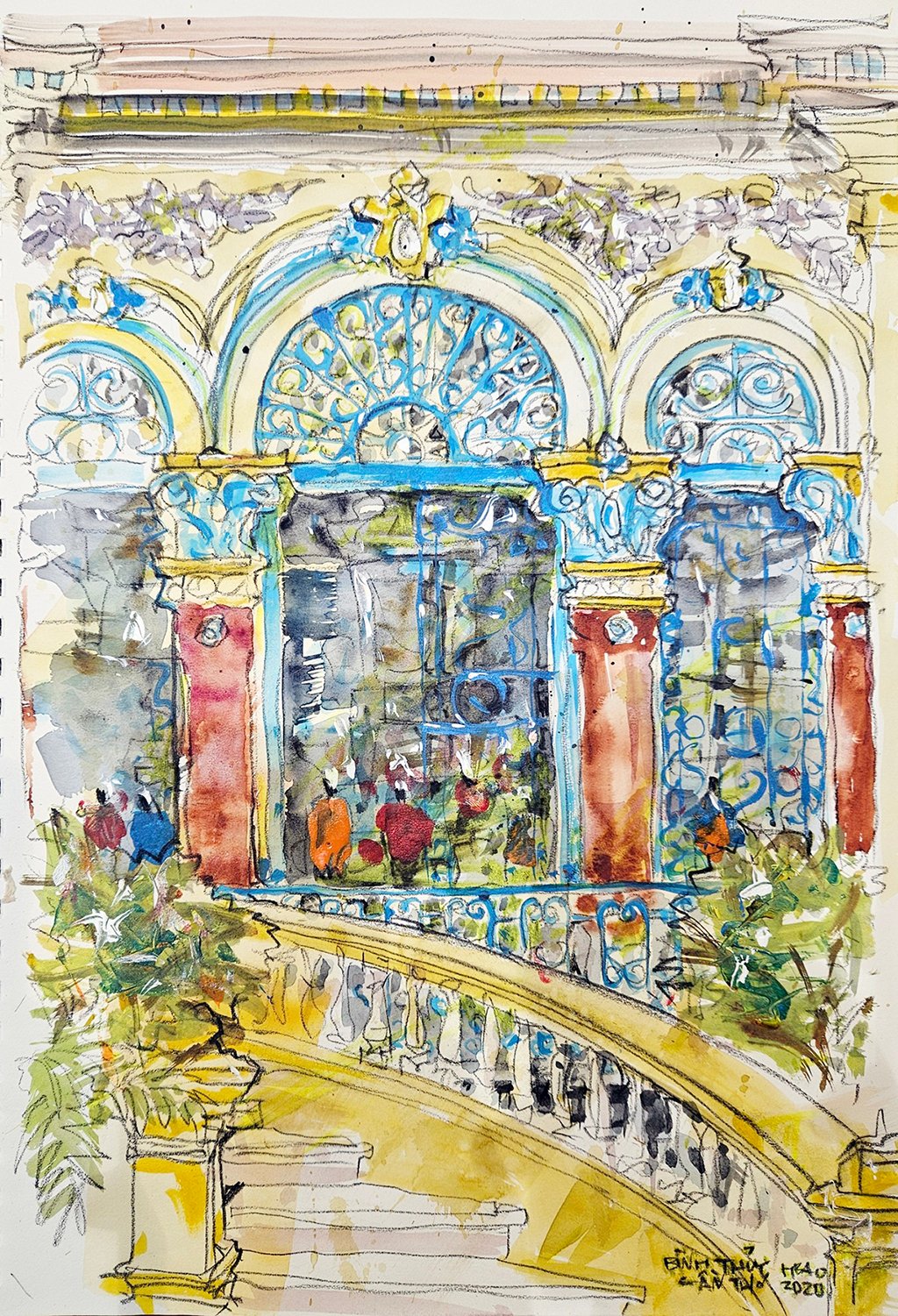
The facade features columns and decorative motifs in the Western style - Sketch by architect Bui Hoang Bao
The building blends modern Western and traditional Eastern styles. The front house has five bays, decorated in a Western European style. The floor is tiled with patterned tiles imported from France, the chandeliers are Western European, and the furniture is crafted in the Louis XV style from Southern Vietnam. A portrait of the owner, Duong Chan Ky, cast in glazed ceramic (a technique for making glazed ceramic portraits that was very popular in France and China in the late 19th century) hangs here.
Nevertheless, the most sacred space remains the purely Vietnamese worship area. The ornate wooden partitions and balustrades, carved with plum blossoms, orchids, chrysanthemums, bamboo, animals, and fruits, separate the front and middle sections of the house. The house still contains many valuable antiques, such as an 18th-century French oil lamp over 3 meters tall, a Tung Dinh tea set, a Ngu Lieu set, and Tuyen Duc Nien Phung teacups produced over 500 years ago…
This national-level architectural and artistic heritage site was once the setting for the French films The Famous Lover (directed by JJ Annaud), The Alluvial Paths (directed by Chau Hue and Tran Ngoc Phong), The Prince of Bac Lieu (directed by Ly Minh Thang), etc.
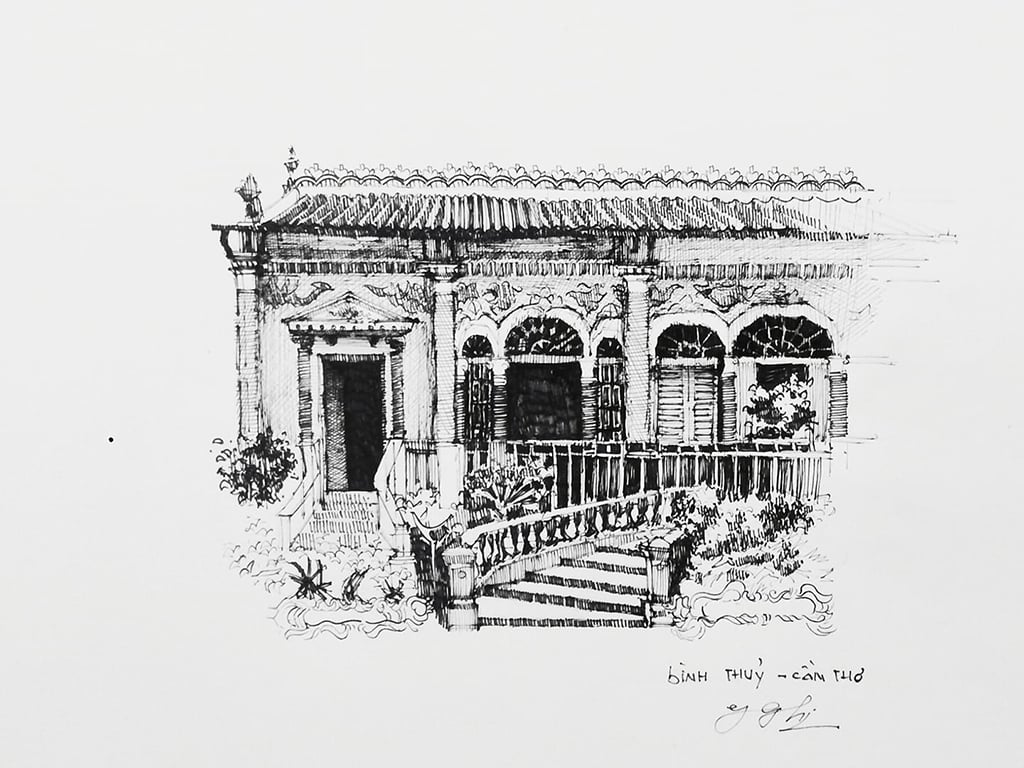
The path leading to the main house - Sketch by Nguyen Thi Ngoc Nghi
Source: https://thanhnien.vn/nha-co-150-tuoi-nhieu-lan-len-phim-185250816211238094.htm
![[Photo] Standing Committee member of the Party Central Committee Tran Cam Tu working with the Central Inspection Committee](https://vphoto.vietnam.vn/thumb/1200x675/vietnam/resource/IMAGE/2026/05/28/1779969579668_ndo_br_bnd-2495-jpg.webp)

































































Comment (0)