After moving to the US and working various jobs, at times feeling like his dreams were about to collapse, Dr. David Vu realized that 'only education could change his current situation,' and he became the owner of 28 patents.
In late 1991, after completing his major in Hydrogeology Engineering at the University of Science, Ho Chi Minh City (now part of the Vietnam National University, Ho Chi Minh City), David Vu moved with his family to Lincoln, Nebraska, USA. His limited English skills made it difficult for him to make ends meet. Initially, he worked for a frozen meat company, but soon realized that long hours of manual labor in freezing temperatures offered no future prospects for the small, ambitious 23-year-old.
To improve his English and earn money to pay for his studies, David Vu became an assistant at a local veterinarian's clinic. Financially , he often skipped breakfast, saving only a chocolate bar or a can of popcorn for lunch. He recounted that in Nebraska, winter temperatures could drop to -30 degrees Celsius, and with no transportation, he frequently had to run for hours, sometimes with numb hands and feet, and chapped, bleeding lips. Every winter, he would take the bus to school with his hood pulled down over his face, leaving only his eyes and nostrils exposed. It was so cold that his breath froze, making him look like a snow-covered beard.
"The beginning of my American dream seemed to have completely collapsed. I realized that I had to succeed academically to change my current situation," he told VnExpress about his first winter in a foreign land.
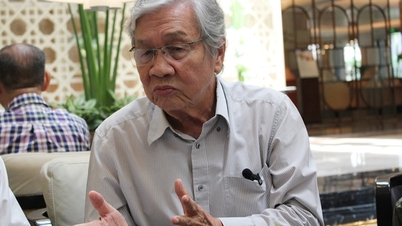
Dr. David Vu. Photo: Provided by the interviewee.
Driven by a desire for success, in 1993 he passed the entrance exam for Chemical Engineering at the University of Nebraska-Lincoln, a top 30% national research university in the US. He worked various jobs to make ends meet, sometimes as a translator at the Lincoln City Department of Education , other times as a research assistant for professors. David Vu later received the McNair Scholar Scholarship for outstanding students pursuing doctoral studies. This scholarship became a turning point in his academic journey and led him to his passion for research.
He worked with two professors from the chemical engineering and civil engineering departments, researching methods for detecting cracks in concrete bridges and steel. In 1997, David Vu graduated with a degree in chemical engineering and continued his studies for a master's degree, focusing on solid acid catalysts to replace liquid catalysts. In 1999, after receiving his master's degree in chemical engineering, he worked for ATARD Laboratory, a company researching polymer compounds for aircraft and electric motors. He then pursued a doctorate at the University of Nebraska. This was when he achieved breakthroughs with two patents. The first was a study on a method for separating caffeine from coffee in automatic coffee machines using zeolite and silica imprinting on cellulose fibers, and the second was a patent for producing nanotechnology (nano-particles and fibers) from chitosan (shrimp shell). His research on attaching zeolite to cellulose fibers made him the third person in the world to be granted a patent for this research.
Before receiving his PhD in December 2005, he worked for LNK Chemsolutions, a company specializing in medical research. There, he was granted a patent for using nanotechnology to develop cancer drugs. He also simultaneously wrote software for Kamterter Products LLC, a company specializing in agricultural technology and seeds, and has remained there to this day.
Dr. David Vu said that in the US, universities don't focus on in-depth knowledge training for graduate students, but rather on training them in scientific research methods. Graduate students can pursue new areas of passion after graduation. This is why his research directions "evolve" according to both passion and practical needs.
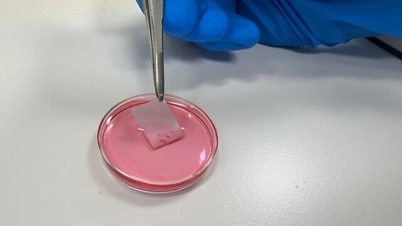
Among the research for which he received patents from the World Intellectual Property Organization (WIPO), nanotechnology was one example. In 2002, a year of rapid nanotechnology development, he used shrimp shells to implant cartilage cells from the knee onto a nano-mat (chitosan nanofibers mat). He became the first person in the world to create a chitosan nano-membrane with crosslinking. This was the first study to produce starch acetate nanofibers smaller than 40 nanometers.
Nanochitosan fiber with crosslinking from shrimp shells. Photo: Research team
Bone and cartilage cells from the knee were implanted onto a chitosan membrane made from shrimp shells. Photo: Research team .
At 56 years old, Dr. David Vu currently holds 28 patents granted in the US, including 4 WIPO patents. His inventions are concentrated in the fields of agriculture, medicine, chemistry, and internal combustion engines. His inventions have been applied to solve difficult problems in the practical fields of medicine and agriculture.
He shared his desire to bring technology and inventions to the agricultural sector, such as pesticide and herbicide spraying, or seed/plant growth stimulants that make plants more resistant to salinity, drought, pests, and acidity, and increase yields, to help Vietnam's agriculture develop and reduce its dependence on foreign countries. These inventions help reduce the harmful effects of pesticides and herbicides on the environment, protect the health of farmers, and save time and costs in production.
Dr. David Vu stated his willingness to share his experience and knowledge to guide young scientists in applied research, as well as to exchange technology, collaborate on research, and develop businesses. He also suggested that universities should increase investment in domestic research and create a favorable environment for young scientists and graduate students to access resources, and encourage support for small businesses.



![[Photo] Secretary of the National Assembly Party Committee, Chairman of the National Assembly presides over the meeting of the Standing Committee and Executive Committee of the National Assembly Party Committee.](https://vphoto.vietnam.vn/thumb/1200x675/vietnam/resource/IMAGE/2026/06/03/1780480353201_ndo_br_bnd-2585-jpg.webp)
![[Photo] General Secretary and President To Lam presides over a meeting with the Central Organizing Committee.](https://vphoto.vietnam.vn/thumb/1200x675/vietnam/resource/IMAGE/2026/06/03/1780482764658_a1-bnd-4741-3342-jpg.webp)
![[Photo] First session of the 14th Congress of the Vietnam Trade Union](https://vphoto.vietnam.vn/thumb/1200x675/vietnam/resource/IMAGE/2026/06/03/1780465947883_ndo_br_img-3852-jpg.webp)











































![[Video] Sunset at Lap An Lagoon – Where the sun sets over the fishing nets](https://vphoto.vietnam.vn/thumb/1200x675/vietnam/resource/IMAGE/2026/05/31/1780192137701_beach-landscape-sea-water-nature-grass-745871-pxhere-com.jpeg)





























Comment (0)