


A man cools himself under a misting system on a hot day in Tokyo, Japan, in September 2025 - Photo: AFP
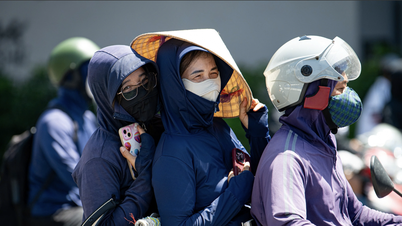
The South China Morning Post reported on February 27 that climate experts warn Japan could face another record-breaking hot summer, as global warming continues to shrink Arctic ice, alter wind direction, and heat up seawater.
Starting on February 27th, the Japan Meteorological Agency (JMA) launched a public opinion survey to select a new name for days with temperatures above 40 degrees Celsius, with plans to implement it this summer.
According to the Vietnam News Agency correspondent in Tokyo, data from the Japan Meteorological Agency (JMA) shows that in recent years, Japan has continuously recorded record-breaking heatwaves. Last summer, Gunma Prefecture recorded the highest temperature in the country, reaching 41.8 degrees Celsius.
In addition, about 30 other locations also recorded temperatures exceeding 40 degrees Celsius, indicating that extreme heat is gradually becoming the "new normal".
The JMA's climate forecast indicates that from March to May, temperatures in northern, eastern, and western Japan will be above the multi-year average.
During the period from June to August, temperatures across the country remain high, especially in the east and west, with a probability of temperatures exceeding 60%. This means that heatwaves can occur as early as spring, while summer will see many hot and humid days.
Currently, the JMA categorizes heat levels into thresholds: days with a maximum temperature of 25°C are called "summer days," 30°C or higher are "hot days," and 35°C or higher are "severely hot days." However, the agency believes a separate term is needed to warn of the higher danger level for days above 40°C.
The Japan Meteorological Agency (JMA) has proposed 13 options such as "super hot day," "extremely hot day," "scorching hot day," or "scorching hot day," and is calling on the public to contribute more ideas. The survey will run until March 29, before the agency and experts select the official name around May.
Standardizing terminology is expected to help raise public awareness of health risks, thereby strengthening measures to prevent heat-related illnesses in the context of increasing extreme weather events.
Source: https://tuoitre.vn/nhat-ban-doi-mat-mua-he-nong-do-lua-40c-la-thuong-thoi-20260228120758503.htm

![[Photo] General Secretary and President To Lam presides over the meeting to approve the draft report on the results of the second inspection by the Politburo of the Standing Committee of the Hanoi City Party Committee.](https://vphoto.vietnam.vn/thumb/1200x675/vietnam/resource/IMAGE/2026/05/26/1779789811432_a2-bnd-4430-9620-jpg.webp)


















































































Comment (0)