

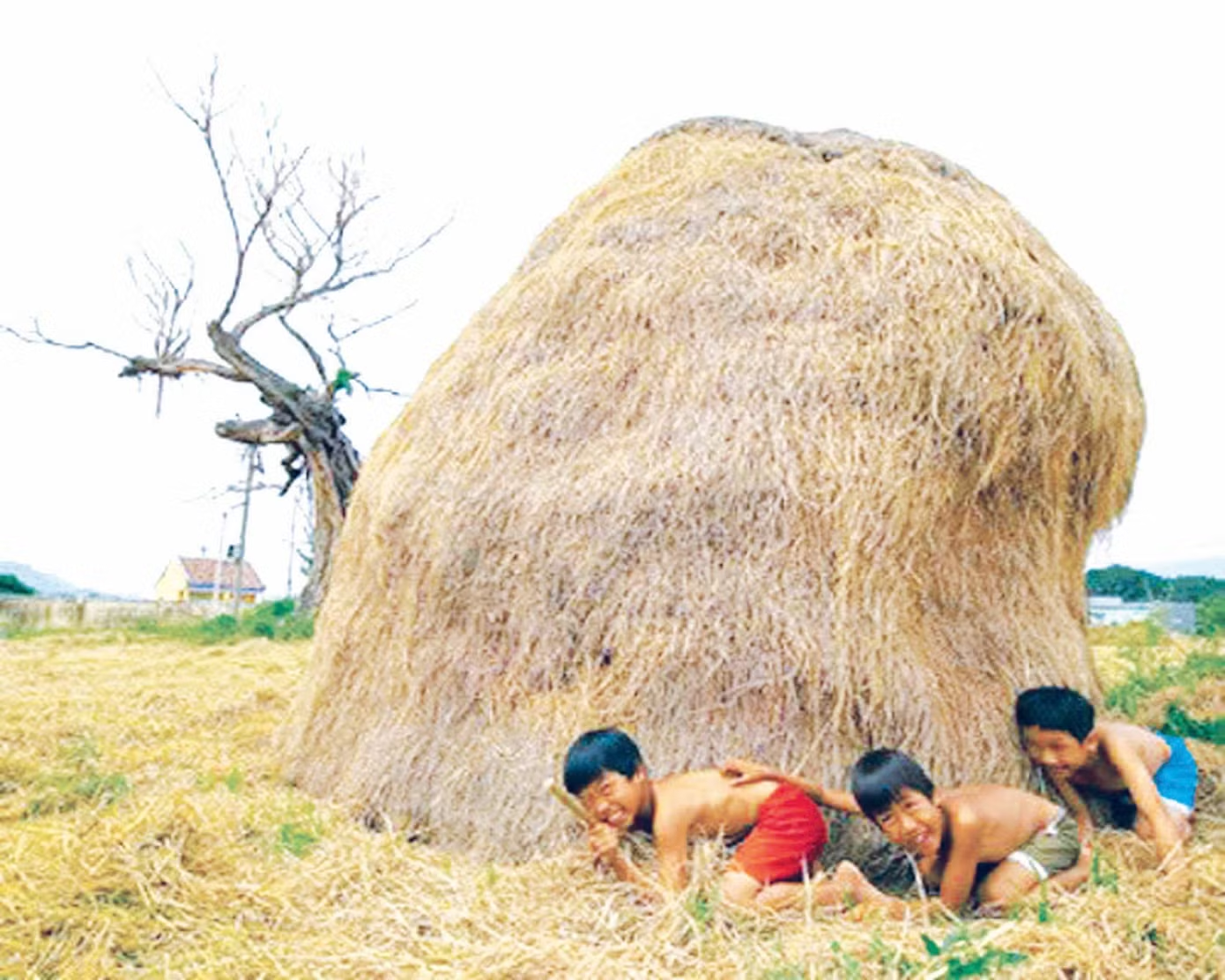
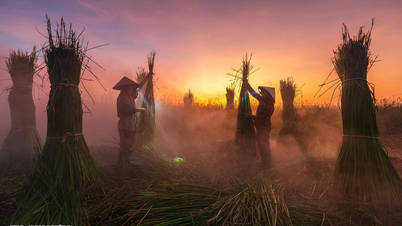
Nowadays, traveling through many rural areas, it's rare to see the same towering piles of golden straw stacked high in yards as in the past. Straw balers have gradually replaced the hands that used to carry the straw, and the fields are now less filled with barefoot children running around during the summer. But in the memories of our generation (those born in the 1970s), those straw piles were more than just leftovers after the harvest. They were an entire "kingdom of childhood," a place that held countless simple joys of sun-drenched summer days.
Back then, after each harvest, every yard was piled high with straw. The straw was gathered into large mounds, almost reaching the roof. Adults kept the straw for cooking, bedding for cattle, shelter from rain and wind, or to save for the harsh winter. For us children, however, it was the most fascinating place of the entire summer.
As evening fell, when the sun began to soften and the fields still carried the scent of freshly harvested rice, the children of the village would excitedly call out to each other and gather in the yard. They were all barefoot, their clothes stained with dust and dirt, their sun-bleached hair a golden hue. There were no phones, no video games, no need for modern playgrounds; just a large pile of straw was enough to fill the entire afternoon with laughter.
The most familiar game is still hide-and-seek. After a heated game of rock-paper-scissors, the loser will bury their face in a pile of straw, cover their eyes with their hands, and count aloud: "One... two... three... four...".
Meanwhile, they all scattered and ran away. Some quickly climbed to the top of the haystack and lay down, pressed close to avoid being discovered. Others cleverly slipped into the middle of the haystack, where the adults had removed straw over time, creating small, cave-like spaces. Inside, it was dark, cool, and smelled strongly of sun-dried straw. There were also some more daring "experts" who ran to the ditch, hid behind banana trees, or lay still behind a pile of straw at the end of the garden.
What I remember most is the feeling of hiding deep inside a haystack and lying perfectly still. It was dark all around, with only a few tiny rays of sunlight filtering through the straw like swirling golden dust. Outside, there were the sounds of running footsteps, shouts, and suppressed laughter that shook my shoulders. My heart pounded every time I heard the sound of someone coming closer. Sometimes, we hid so well that the person searching couldn't find us, and in frustration, he stood in the middle of the yard, hands on hips, shouting, "I know you guys are hiding in the haystack!"
They were all trying to suppress their laughter, but finally couldn't hold it in any longer and burst into giggles. They were caught, and the whole group scattered in all directions across the sun-drenched courtyard.
Those summer afternoons in the countryside seemed endless. Children's laughter mingled with the calls of birds in the bamboo grove, the jingling of cows returning to their pens, and the rustling of the wind blowing through the freshly harvested straw. In the distance, the fiery red sun slowly sank behind the fields, bathing the entire village in a gentle, honey-golden light that was both captivating and heartwarming.
Our childhood was spent amidst such simple things. The haystack wasn't just a place to play; it was also a part of our memories of those impoverished but warm years filled with family love.
Back then, it was very cold in my hometown. Every winter, the north wind swept across the desolate fields, seeping through the earthen walls, chilling us to the bone. Our family was poor, and warm blankets were very rare. Many nights, my siblings and I had to huddle together under a single thin, worn-out blanket.
Every time the cold weather intensified, my father would quietly go to the backyard and select the driest, yellowest bundles of straw to bring inside. He would weave the straw into a large bed and spread it thickly on the wooden platform or on the earthen floor. He would then cover it with an old mat for my siblings and me to sleep on.
Surprisingly, that rustic straw kept me warm very well. Crawling into the straw bed felt soft and warm against my back. The smell of dry straw mingled with the scent of wood smoke, the earthy smell of the countryside, and the crackling of burning wood, making the winter chill seem much less intense.
Looking back now, I realize that our generation's childhood, though lacking in material things, was incredibly rich in memories. We didn't have expensive toys, air conditioning, or smartphones, but we had fields to run around in, afternoons spent roaming until we forgot the time, and a childhood truly connected to nature, the land, and human kindness.
As the years pass, what remains most deeply ingrained is sometimes not the grand gestures, but the scent of fresh straw after the harvest, the laughter echoing from the cool, dark haystack, and the calloused hands of a father silently weaving a straw nest to protect his child from the cold on a poor winter night.
Now, whenever I happen to pass by and see people burning straw after the harvest, and smell the smoke rising in the late afternoon, my heart sinks. Memories from years ago come alive – those sun-drenched summer afternoons, those seemingly ordinary children's games that turned out to be one of the most beautiful parts of life.
That small pile of straw back then eventually became enough to fill an entire realm of cherished memories.
Source: https://tienphong.vn/nho-tuoi-tho-ben-rom-ra-post1847435.tpo

















































































Comment (0)