

Built in the last century, the road connecting small towns is becoming an interesting area to explore and attracts tourists by car. RIA Novosti news agency reports on rare folk crafts and churches with unique frescoes, unusual museums and ancient monuments not to be missed along the way.

Mikhailov: The secret of exquisite lace
For a long time, people here have been weaving lace with the world's only colored threads.
“These spools of thread are at least a hundred years old; they have no weight at all,” says Tatyana Presnova, chief artist at the Truzhenitsa factory. The lace makers create one meter of lace in three hours, using a chain weaving technique. The fabric is placed on a sturdy mat.
The threads are woven into intricate patterns on tablecloths, napkins, and towels. All of this is done without any prior design.
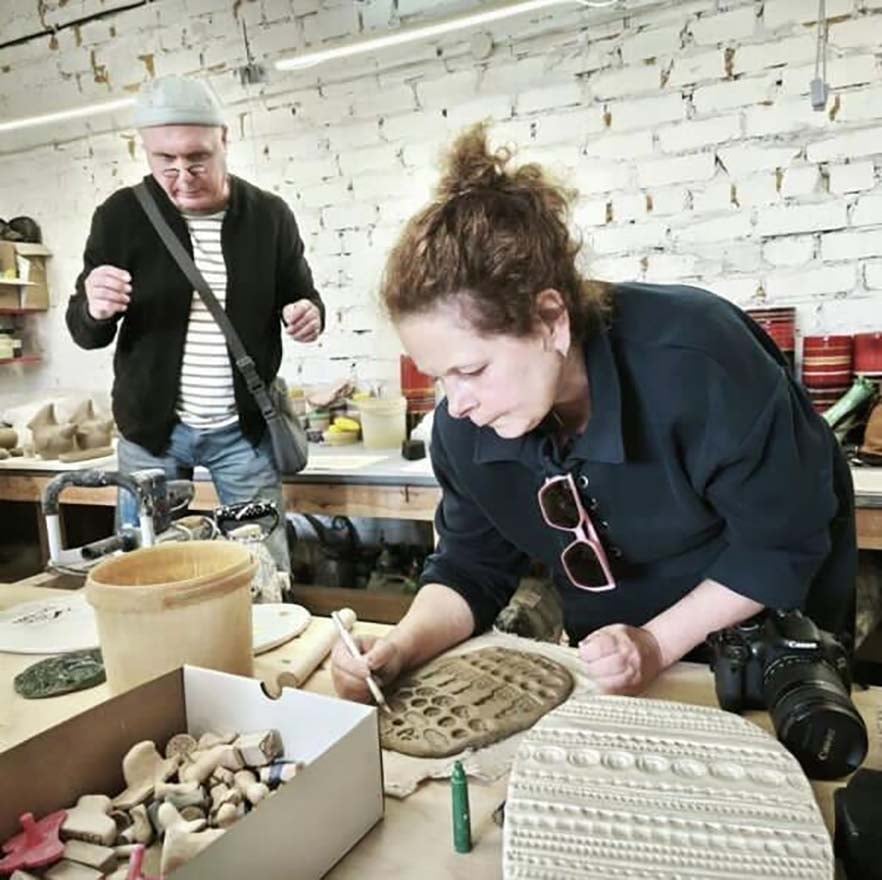
Skopin: The birthplace of famous pottery.
The pottery trade in these areas began in the mid-17th century.
A striking feature is the decorative borders: countless details, curves, and protrusions. The surfaces of the products are glazed, creating unique vases and candlesticks in the shape of exotic animals: fish, birds, and dragons. The lion's mane is sculpted with great care—the clay is sifted through a sieve.
"The main purpose is to bring joy to the soul," said Russian folk artist Sergei Krasnikov, while presenting his work at the Center for Folk Arts and Crafts.

Sasovo: Memories of Songs
The only museum dedicated to Russian music in Russia is located here and is named after Alexander Averkin, who was born here. He wrote the songs "Mother, My Dearest Mother, How I Love You" and "The Young Sailor on Vacation" for Lyudmila Zykina. Among the exhibits are collections of performance costumes by Zykina, Tolkunova, Shavrina, and Strelchenko.
Another music museum in the region is dedicated to Alexander Alexandrov. The exhibition is housed in a school in the village of Plakhino in the Zakharovsky district, the birthplace of the composer of the Soviet national anthem and the famous song "Svyatnaya Voina" (Holy War). The display cases showcase musical instruments, sheet music, the costume of a band member, and the boots of the artistic director.

Ryazhsk: The history of the old railway station.
The Railway Station Museum is housed in the station building constructed in 1875. It displays over a thousand artifacts, including documents and photographs.
The building boasts high ceilings, pristine 19th-century white plaster walls, early 20th-century chandeliers with crystal lampshades, and antique furniture. At the entrance stands a bell cast in 1900, used to signal the arrival of trains.
Shatsk: Cossack Customs
At the mini-museum, visitors are introduced to the customs and traditions of this class. Visitors can even get acquainted with the Cossack spirit through songs performed by the "Kazache Razdolye" band, experience matchmaking rituals, and learn how to manage a household and welcome guests.
It is believed that the Cossacks arrived here in 1553 to defend their homeland. This summer, on June 6th, the village of Starocherneyevo in the Shatsky district will hold a festival titled "On the Love, Freedom, and Destiny of the Cossacks".

Meshchera and Paustovsky
The Meshchersky Forest stretches across the Klepikovsky and Ryazansky districts. Today, it is the Meshchersky National Park with its ecological trails. On the banks of the Pra River lies the Kordon 273 settlement, praised by Konstantin Paustovsky. The air is fresh, the scenery spectacular, although there are many mosquitoes – mosquito repellent is essential. Reaching this pristine wilderness is quite challenging: you will have to drive on dirt roads and even cross a dry stream bed, testing the capabilities of off-road vehicles.
Visitors can explore wooden architecture at the Groshev Museum, located in a spacious open area near the village of Lunkino, in the middle of the Meshchera forest. The museum displays wooden sculptures, swings, tents, and household items.

Monasteries and churches
Opposite the starting point of the Paustovsky Trail in Solotcha is the Monastery of Our Lady of the Nativity. It looks like a miniature replica of the Kremlin. During the invasion by the Golden Horn Khanate, the monastery served not only as a spiritual center but also as the northern outpost of the city of Pereyaslavl-Ryazansky, the predecessor of present-day Ryazan.
The monastery was founded by Prince Oleg of Ryazan, and he is buried here. His head, gilded and placed behind a glass case called "The Honest Head," is the monastery's most important relic. "He had many wounds; he was a brave warrior," Sister Anastasia said.

The magnificent Holy Trinity Church in Tuma was built in the 19th century. The frescoes were created based on sketches by Viktor Vasnetsov, Mikhail Nesterov, and other famous artists. The walls are decorated with masterpieces of Russian painting: "Christ Appears to the People," "Christ in Russia," and "Christ in the House of Martha and Mary." The highlight of the church is the marble altar, the icons on which were painted by the Vladimir icon painters of the Rublev school. The floor is paved with Mettlakh glazed tiles.
The Vvedenskaya Church in the village of Pet is the only church in the Ryazan region built in the Neo-Russian style. The church was built in 1913. Traces of the paintings are still preserved on the walls. Local architecture enthusiasts are trying to raise funds for the restoration of the church, whose bell tower offers stunning views of the surrounding area.
Source: https://danviet.vn/nhung-bi-mat-cua-vung-hoang-mac-ryazan-d1430745.html
![[Image] Nearly 125,000 Hanoi students completed the Literature exam for the 10th grade entrance exam.](https://vphoto.vietnam.vn/thumb/1200x675/vietnam/resource/IMAGE/2026/05/30/1780117233041_ndo_br_thiet-ke-chua-co-ten-2-png.webp)














![[Photo] Admire the coral "masterpiece" amidst the million-year-old heritage of Dak Lak province.](https://vphoto.vietnam.vn/thumb/1200x675/vietnam/resource/IMAGE/2026/05/30/1780107638639_y25-jpg.webp)




















































Comment (0)