

Nights spent staying up with my child.
Recalling her time living in Hanoi with her firstborn son, what comes to mind most clearly isn't the busy workdays or the rare family gatherings, but the long nights in the hospital. Her son was frequently ill.
Some months, the mother and child would be hospitalized several times. Whenever the child had a high fever or seizures, she would frantically prepare clothes and paperwork, then take the child to the emergency room alone. There was no husband by her side to share the burden, nor any relatives who could immediately appear when needed. Far away, Mr. Cuong was still on duty, while she silently endured long nights with her child.
During those years, the Pediatrics Department (Military Hospital 103) became a familiar place for her and her child. Every time her child was sick, her phone was full of alarms. Sometimes every 5 minutes, sometimes every 10 minutes, just to remind her to check her child's temperature because her biggest worry was falling asleep while her child had a high fever.
Their firstborn son was named Hai Quan (Navy). The name was a way for the young mother to express her affection for her husband, who was always away on duty. Whenever she took her son to the hospital, the doctors and nurses would jokingly ask, "Is your father a sailor?" Each time, Ms. Hue would just smile and nod. Behind that smile lay a long period of time she had become accustomed to her husband's work on the island while she quietly cared for their child on the mainland.
Recalling the experience, she laughs and says she doesn't understand why she was so brave back then. She carried her child to the hospital alone, handled the admission procedures alone, and stayed up many nights in a row alone. Both sets of grandparents loved their child and grandchild very much, but they couldn't be there every time the child was hospitalized. "I didn't feel like I was struggling. What I felt most sorry for was that my child didn't have a father by her side," Ms. Hue said.
Those long nights seemed to encapsulate the entire period of separation between Huệ and her husband. Behind the times she carried her child to the hospital in the middle of the night lay a story of waiting, sacrifice, and faith built up over the years.
The soldier once chose to leave the one he loved.
In 2009, at a wedding in their hometown of Nghe An, Hoang Van Cuong and Nguyen Thi Hue first met while both were part of the wedding procession team. At that time, Cuong was being sent by the 5th Naval Region to study music in Hanoi, while Hue was a student studying in Vinh City.
Six months later, during a summer break when they returned to their hometown to participate in cultural activities organized by the local youth group, the two had the opportunity to talk more. From those brief encounters and text messages, feelings between them gradually blossomed naturally.
The geographical distance meant their love story was nurtured almost entirely through phone calls and text messages. From the time they confessed their love until their wedding day, Cuong and Hue only met three times. And they only had one proper date.
That rare date was just a trip to the supermarket in Hanoi. A very ordinary experience, yet it became a special memory in their love story because it was the only time the two of them got to stroll through the streets together before getting married.
Two years of dating meant two years of long-distance calls, text messages, and few face-to-face meetings. But it was also during that time that they built trust and ultimately decided to commit to each other for life.
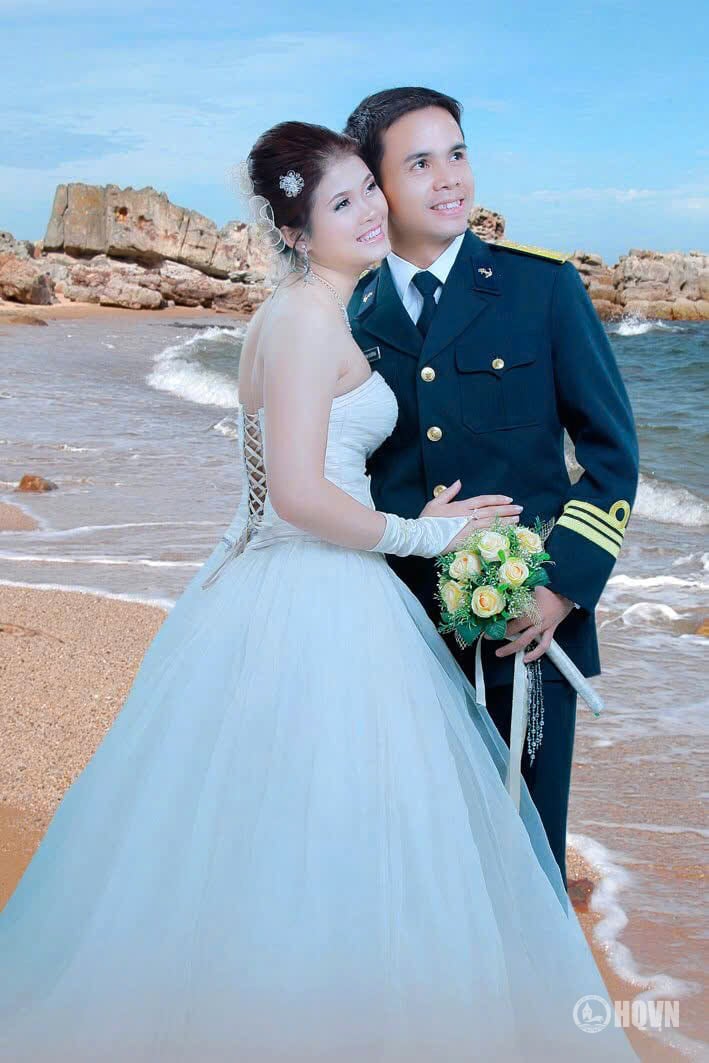
Hoang Van Cuong and Nguyen Thi Hue, a married couple, on their happy wedding day in 2012. Photo provided by the couple.
What made Huệ fall for Cường wasn't his sweet words or romantic gestures. In her mind at the time, he was calm, sincere, and trustworthy. Since childhood, she had held a special respect for the image of a soldier because her grandfather had also been in the army. Perhaps that's why Cường's soldierly qualities left such a positive impression on her.
However, it was this very man who had once proactively distanced himself from the woman he loved. Knowing he was about to return to the island for a long work assignment after finishing his studies, Mr. Cuong gradually reduced contact and then lost contact completely. Without explanation, without a word of farewell, he silently left the young woman behind, filled with disappointment and questions. “I cried a lot then. I didn’t understand what I had done wrong,” Ms. Hue recalled.
Only much later did she learn that the young soldier had considered the hardships his girlfriend might have to endure. He feared that marrying someone far away would mean living in constant waiting, facing difficulties that he himself foresaw. “I thought that if she found someone closer to home, life would be easier and less difficult. Therefore, when I decided to return to my old unit, I chose to remain silent, thinking that might be the best way for her,” Cường shared.
What Cường considered best for Huệ's future only strengthened her belief in her feelings. Knowing his reasons and thoughts, she chose not to leave. On the contrary, she grew to love the sailor even more. For Huệ, the fact that he always thought of her before his own happiness was the clearest proof of his sincerity.
Six years of being both a father and a mother alone.
Their love also faced challenges from their families. As a beloved granddaughter from a young age, Huệ understood why everyone worried when they learned she was in love with a soldier working far from home. No one objected to Cường, but everyone felt sorry for her. Every time the topic of the future came up, her grandparents and parents advised her to find someone closer to home to make life easier. Her grandfather often said, "We won't forbid you from loving him, but if you marry someone from a remote island, it will be like we've lost a granddaughter."
Before the two families discussed the wedding arrangements, Huệ still remembered a conversation with her grandfather. That day, the shy granddaughter asked, "Grandpa, can I marry Cường?" Her grandfather, who had often worried about his granddaughter marrying someone far away, remained silent for a moment before saying, "If Heaven doesn't listen to Earth, then Earth must listen to Heaven, my dear. Your grandparents and parents only want what's best for you. If you feel that's the path you want to take, then just go for it."
Those words brought her immense relief, as if a huge burden had been lifted from her heart. Because more than anyone else, she understood that this agreement was not just an acceptance of a marriage, but also a testament to her family's trust and confidence in her choice.
Their engagement ceremony took place in a very special way. On the day the two families met, neither the bride nor the groom were home; one worked in Hanoi, and the other was on duty on a remote island. The meeting was attended only by the parents of both sides, who spoke on behalf of their children and discussed the wedding arrangements. Cường only got leave for the wedding day. But that happy reunion was short-lived. After the wedding, he returned to his unit in the southwestern sea region, while she continued working at a bank in the North.
After getting married, Ms. Hue wasn't in a hurry to follow her husband to the island. Her stable job at the time was one reason, but more importantly, she wanted more time for her family to understand and appreciate the difficulties and hardships of living apart as husband and wife. She believed that when everyone witnessed what she had gone through, her decision to move south to reunite with her husband would receive more approval and reassurance from her parents and grandparents.
During her pregnancy with her first son, Ms. Hue almost single-handedly experienced every emotion of motherhood. The most memorable moment was the ultrasound at 12 weeks. The doctor looked at the screen and said, "Call your husband in to see the baby." She could only smile because the father was on a distant island at the time. Seeing other couples eagerly awaiting their child's first image, she couldn't help but feel a pang of sadness.
On the day of delivery, she went through labor from early morning until late afternoon before successfully giving birth. Outside the delivery room, grandparents and parents took turns encouraging her and waiting for good news, while her husband was still on duty on the island. Two months later, he was finally granted leave and held his son in his arms for the first time.
The following years were a series of days where Huệ was both a mother and took on the responsibilities of caring for and managing the family in place of her husband. During the day, she worked at the bank, and at night, she cared for her young child. Her firstborn son was frequently ill, making sleepless nights watching over his fever or rushing him to the hospital a familiar routine for the young mother.
Six years passed like that. When their son started first grade, the family also had a baby girl. Ms. Hue understood that the early years of a child's life, especially when they enter school age, require the companionship of both parents. After much discussion, she and her husband decided to take their children to Phu Quoc so the family could be reunited.
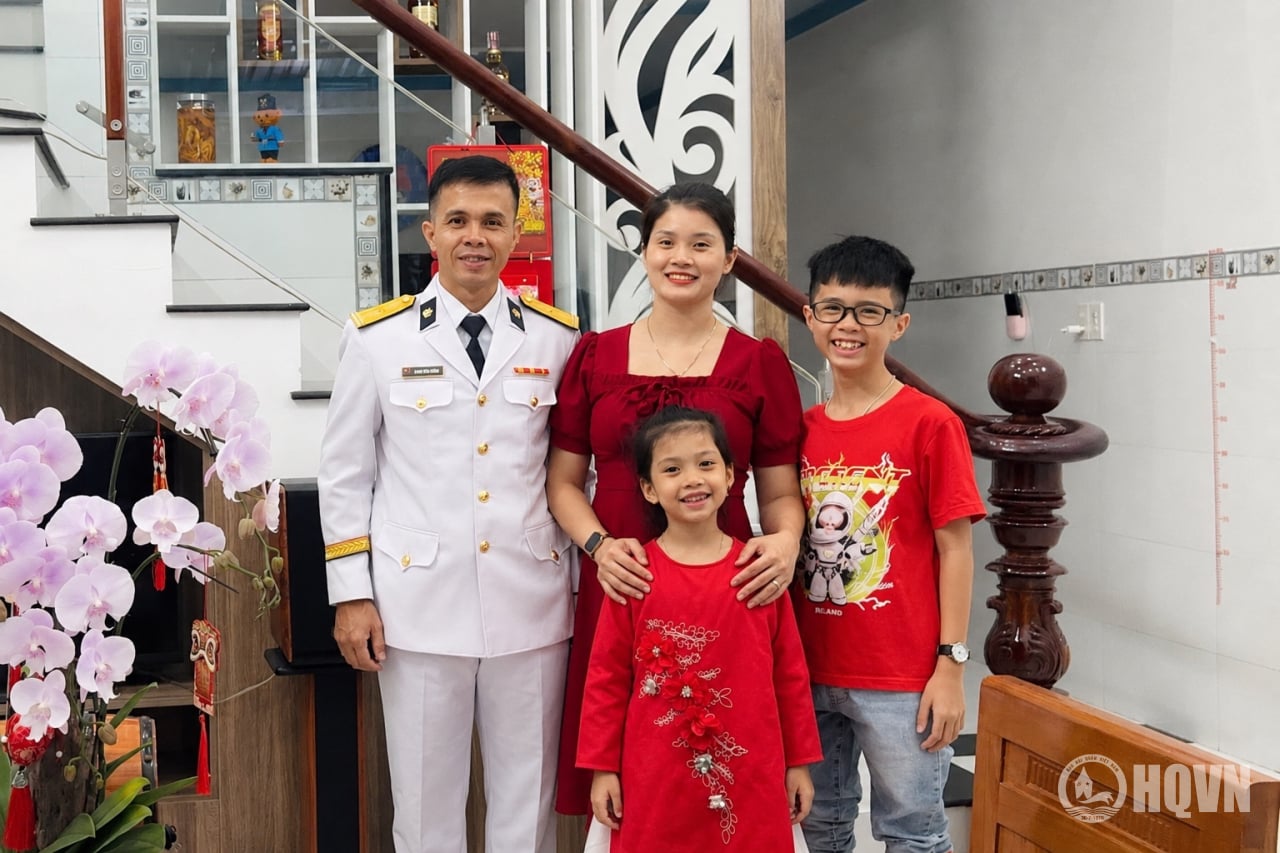
The family of Mr. Hoang Van Cuong and Ms. Nguyen Thi Hue at their small house in Phu Quoc. Photo provided by the subjects.
When they learned of her decision, those who had been most worried about her became her biggest supporters. Having witnessed their daughter raising her children alone for six years, her grandparents and parents understood better than anyone the hardships of a long-distance marriage. They also understood that what she needed most right now was a real, reunited home where her children could have both a father and a mother by their side every day.
A place where love is anchored.
In 2020, after eight years of marriage, with savings from their salaries and support from family, relatives, and their workplace, the couple built their own house on Phu Quoc Island. The house isn't large, but it's the result of years of hard work, a place where long-distance calls have given way to daily family meals.
When asked what helped them maintain their faith in each other throughout their years apart, Ms. Hue looked over and smiled: “Perhaps it’s because from the beginning we both understood that the path we chose wouldn’t be easy. He never promised grand things, and I never wished for my life to be like others’. We just trusted each other. He believed I would always be his support system. And I believed that wherever he was, he would always be thinking of his family. That very trust helped us get through the most difficult years.”
Evening falls on the island. In the small courtyard in front of the house, Mr. Cuong has just returned from work, and his two children rush out to greet him. The older son tells his father all sorts of stories about adolescence, while the younger daughter clings to his hand, excitedly sharing what happened at the end-of-year school ceremony. In the kitchen, Mrs. Hue prepares dinner, occasionally glancing out at the courtyard filled with laughter. The scene is so simple and peaceful that it's hard to imagine the long journey of love and waiting behind it all.
Suddenly, I remembered those nights years ago, when the young mother carried her child to the hospital alone in the streets of Hanoi. Those long nights are now a thing of the past, but perhaps they were also part of the journey that led to the peace and reunion their family enjoys today. After all the storms they've weathered, their small home on the remote island is now filled with laughter, becoming a haven of love for this family of naval soldiers.
Article by: Van Dinh
Source: https://baohaiquanvietnam.vn/tin-uc/nhung-dem-khong-co-bo


![[Photo] First session of the 14th Congress of the Vietnam Trade Union](https://vphoto.vietnam.vn/thumb/1200x675/vietnam/resource/IMAGE/2026/06/03/1780465947883_ndo_br_img-3852-jpg.webp)







































![[Video] Sunset at Lap An Lagoon – Where the sun sets over the fishing nets](https://vphoto.vietnam.vn/thumb/1200x675/vietnam/resource/IMAGE/2026/05/31/1780192137701_beach-landscape-sea-water-nature-grass-745871-pxhere-com.jpeg)



































Comment (0)