

Truong Gia Binh is an unconventional businessman in the eyes of many. Even more remarkable is the way this tech tycoon talks about his failures and how he rose to become a "Vietnamese who doesn't bow down."
At Sheremetyevo International Airport (Soviet Union) in 1985, 29-year-old Truong Gia Binh waited for his flight back to Vietnam after 12 years of studying. The young scientist 's journey home, alongside his aspirations and ambitions, was fraught with belongings: heating elements, pressure cookers, irons… Like many Vietnamese laborers at the time, he was forced to use a separate entrance due to the long line of luggage they brought back to the country to earn a living and support their families.
Holding his baby daughter in his arms as he stepped off the plane and onto his homeland, watching the cows peacefully grazing along the vast, deserted runway of Noi Bai International Airport, Mr. Binh silently shed tears…

"Our generation was born and raised during a time of war. We carried within us a great sense of national pride because we were surrounded by so many steadfast heroes. It was wartime, you'd meet a hero everywhere you went. And when I went abroad to study, I carried the mindset of representing an indomitable nation that had defeated French colonialism and American imperialism."
However, traveling extensively has revealed a harsh reality: many Vietnamese people abroad face discrimination. I vividly remember seeing a friend, a graduate student at the Soviet Academy of Sciences, off at the airport. I witnessed firsthand the brutal behavior of a local police officer dealing with a Vietnamese passport.
It felt incredibly painful at that time.
Those memories, deeply ingrained in me, only fueled my determination to see Vietnam free from poverty.
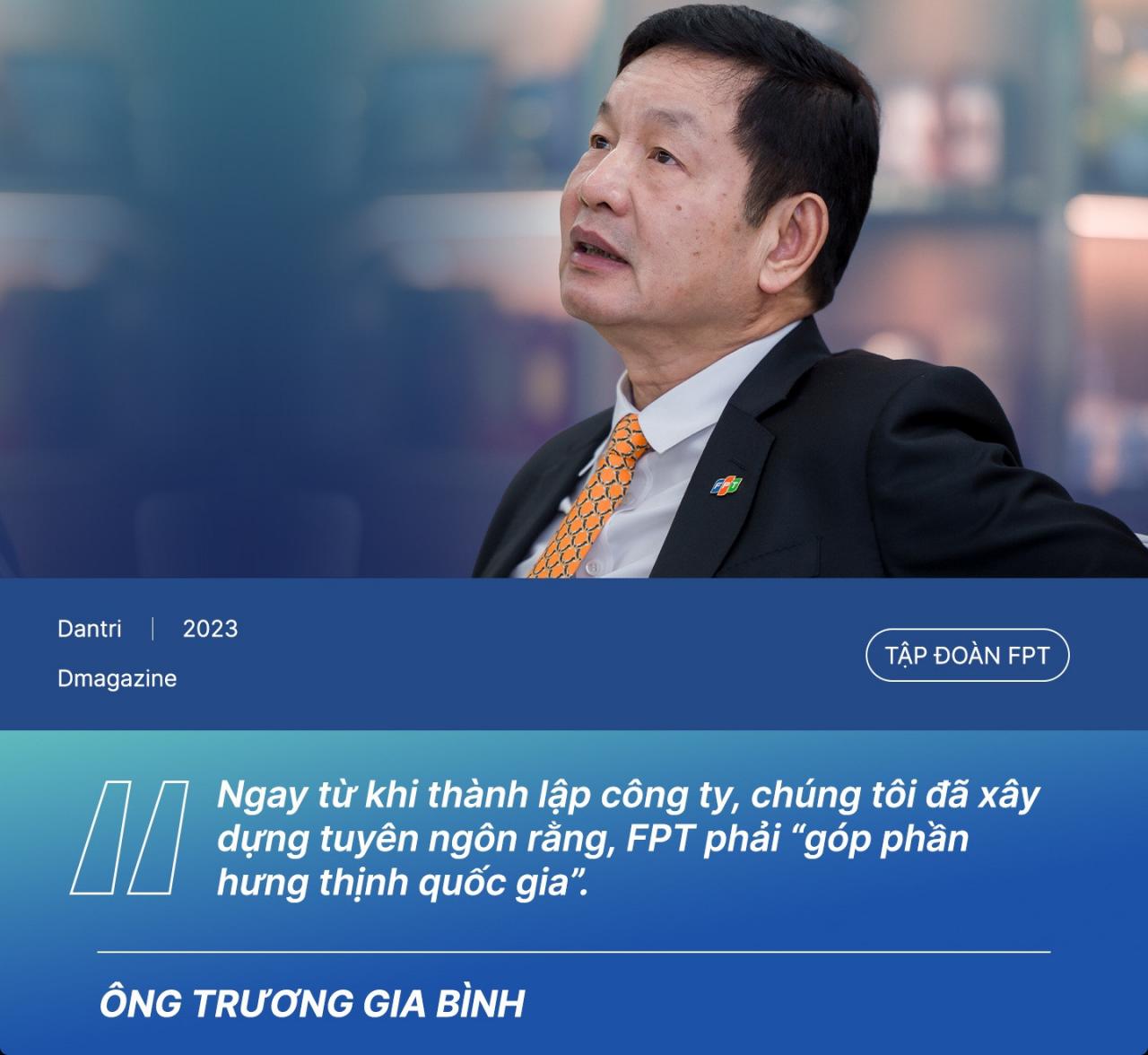
Therefore, right from the company's inception, we established the declaration thatFPT must "contribute to the prosperity of the nation . " When we wrote those words, deep in our hearts and minds, we sincerely wished for a strong and prosperous country. It is also the vow of an entire generation that grew up amidst hardship and adversity," Mr. Truong Gia Binh shared.
When did he begin fulfilling that "vow"?
In the early 1970s, I was one of 100 students from all over North Vietnam carefully selected by the Military Technical University (now the Military Technical Academy). They received a year of training in foreign languages and knowledge in Vietnam before being sent to the Soviet Union to study specialized subjects.
The country was still facing hardships, and although we were very young, we received excellent training. The country provided us with great advantages, including enough food and warm clothes.
Associate Professor Dang Quoc Bao, former Head of the Central Committee's Science and Education Department, and then Rector and Political Commissar of the Military Technical University, often told us: "After graduating, you have the task of accelerating the country's economy."
The professor invited leading Vietnamese scientists such as Professor and Academician Nguyen Van Hieu, Professor and Doctor of Physics Vu Dinh Cu, Professor of Mathematics Hoang Xuan Sinh, etc., to talk to us about science. We had the opportunity to interact and exchange ideas with the greatest minds in the country.
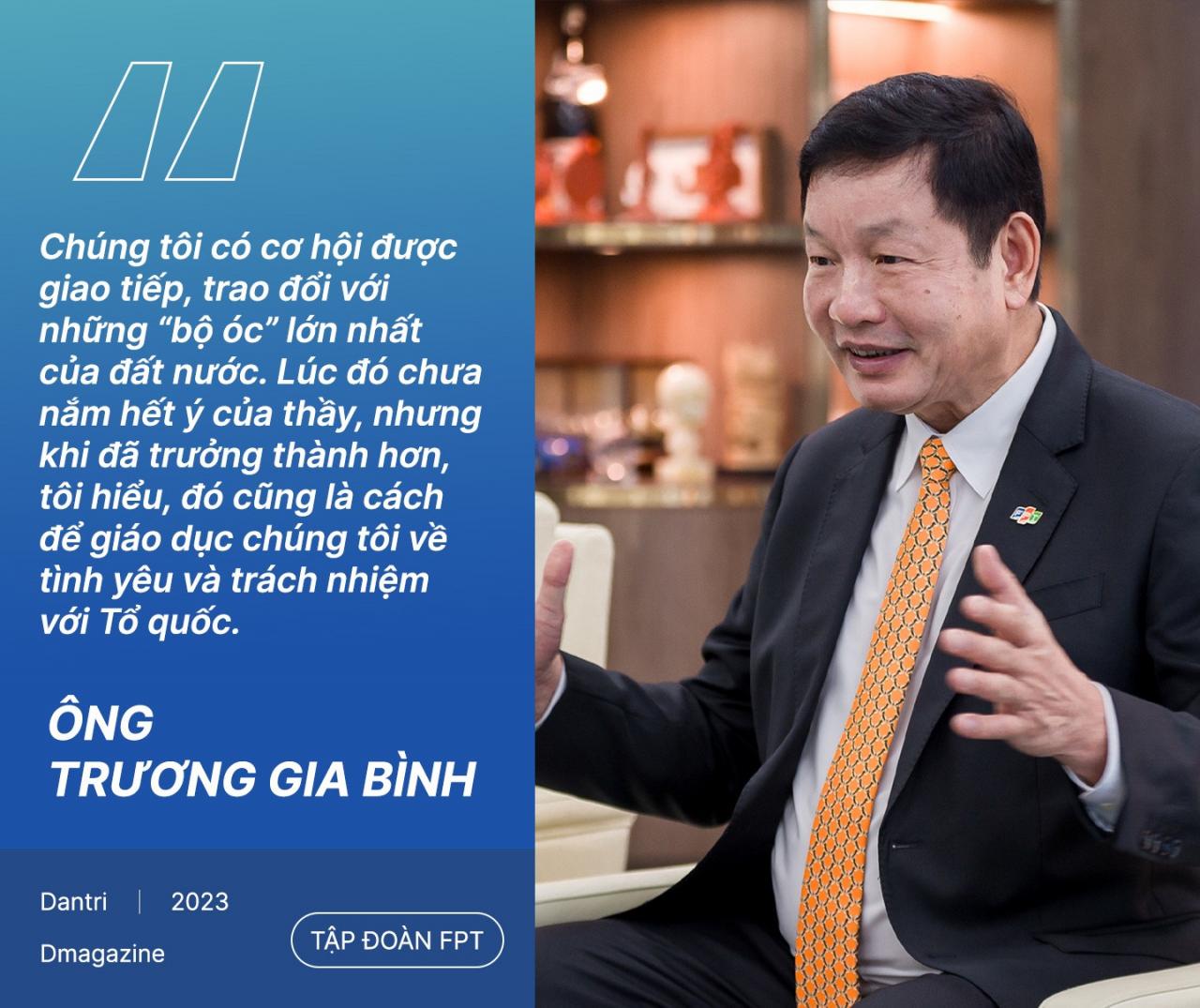
At the time, I didn't fully grasp my teacher's meaning, but as I matured, I understood that this was also his way of educating us about love and responsibility towards our country. His teachings about the aspiration to revitalize the nation resonate deeply with me even now, as I sit here answering your interview questions.
When I went to study in the Soviet Union, I had the opportunity to learn from world-leading teachers and scientists, people with vision and brilliant knowledge. Being around these people nurtured our aspirations and ambitions to elevate our country to the highest level.
What was the reason behind his decision to start a food company in 1988?
After returning from my studies, my group of friends and I worked in science at the Institute of Mechanics under the Vietnam Academy of Science (now the Vietnam Academy of Science). At that time, inflation was in triple digits, and our salaries (around 5 USD) were only enough to live on for a week. A friend said to me, "Binh, please help me. I don't have enough money to support my wife and two children." That made me think.
After much deliberation, I went to see Professor Vu Dinh Cu (who was then the Director of the Vietnam Academy of Science). "Sir, I want to establish a company," I said. Professor Cu replied, "Whatever you want to do… the company name must still include the product name, like: light bulb, thermos flask, matches." I responded, "We only want to work in high technology."
Mr. Cu suggested: "So let's establish a food processing technology company, one that possesses all the most advanced technologies in food processing."
We received the decision and seal from the National Institute of Technology Research. On September 13, 1988, we, 13 Vietnamese scientists, founded FPT Food Technology Company, the predecessor of FPT Corporation today.
Starting a business requires capital. So what assets did you and your team possess at that time?
My greatest assets and those of my comrades are our hearts, minds, and the character that our nation has passed down to us: a nation that never bows its head. That is our most precious asset.
And what are the first steps in starting a business…?
When I returned from abroad, I brought back a few household items like a slow cooker and an iron... I accumulated them, sold them, and bought gold. When the company was established, I sold the gold again to get the money to pay everyone's salaries every month. In that context, we were determined to just survive first. All the employees at the company were poor; most walked to work, only a few had bicycles...
Is that why, even now, some members of FPT's founding board still recall those difficult days at 30 Hoang Dieu Street as an unforgettable memory?
In the early days, we all gathered daily at house number 30 Hoang Dieu to discuss ideas. General Vo Nguyen Giap graciously gave us a small room there, where we set up a computer to work in.
During those days at 30 Hoang Dieu, the members did everything they could to survive.
The company was established with virtually no operating capital, no headquarters, and very little business experience. At that time, our greatest determination was to bring computers to Vietnam and develop information technology.
We invited Mr. Nguyen Chi Cong from the Institute of Computing and Control to join FPT. He was one of the members of the research team that designed and built Vietnam's first computer. He was also our first teacher in the field of computers.
We continued to learn and think, teaching each other, and we decided that once we thought something, we had to put it into action; we wouldn't just think or talk about it.

Why did he choose to pursue a career in computer science at that time, instead of the scientific field he was trained in?
Science is research, and computers are technology. You need products and services to sell and make money. Computers were just starting to enter Vietnam at that time, so this field certainly had great potential.
How long did it take for him and his teammates to land their first major contract?
Not long after, following a year of struggling to secure funding to keep operations running, FPT landed its first contract – building the air conditioning system for the Thanh Hoa Tobacco Factory. The contract was worth 10.5 million VND, while our salaries at that time were only around 100,000 VND per month.
The second contract was to supply computers to the Soviet Academy of Sciences. Before returning home, I worked at the Soviet Academy of Sciences. I noticed they didn't have personal computers, so we sent them our offer.
I drafted a letter for Mr. Nguyen Van Dao to send to the Vice President of the Soviet Academy of Sciences. They immediately invited us over for a meeting. It was a record-breaking contract in terms of revenue at the time, worth 10.5 million rubles (equivalent to 16 million USD at that time).
It was also thanks to this contract that FPT established a relationship with the computer company Olivetti and focused on developing its IT model. In 1990, the company changed its name to Financing and Promoting Technology Development Company and has retained the abbreviation FPT to this day.
Many people believe that one of the things that contributes to FPT's success is the fearless spirit of those who dream big. What is your opinion on this statement?
I think the most important thing is "team spirit." During difficult times, everyone has to save themselves. They do all kinds of jobs, but usually they do it individually.
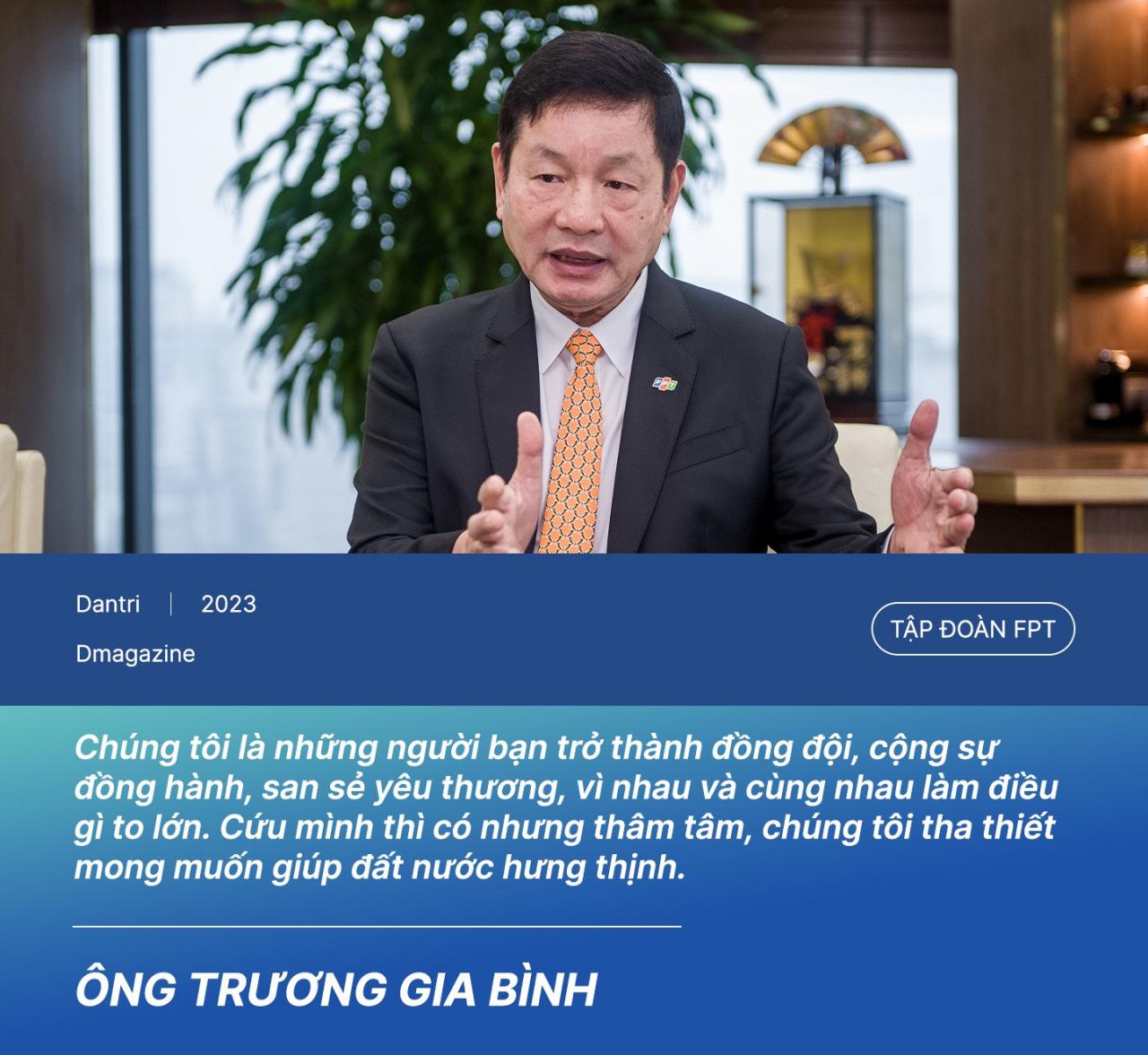
As for us, we are friends who have become teammates, partners, sharing love, caring for each other, and working together to achieve something great. We may be concerned with saving ourselves, but deep down, we earnestly desire to contribute to the prosperity of the nation.
Secondly, it was about "learning." In the early, difficult times, we often bought books to read and then explained them to each other. Once, while visiting Harvard University (USA), I found a very good book called "Mini MBA," which I read and decided would be the first textbook for all FPT employees. In the beginning, anyone who wanted to join FPT had to go through all departments (accounting, sales, administration, engineering, etc.). Only after passing the exams would they be accepted.
In 1995, with the support of education experts and state leaders, and recognizing the importance of professional training in business, I contributed to the establishment of the Faculty of Business Administration at Hanoi National University.
The department collaborates with the Business Administration Department at the Amos Tuck School of Business, Dartmouth University, sending many first-generation entrepreneurs abroad to learn from the best programs. This learning process instilled in us the dream: "If they have it, we must have it; if they can do it, we must be able to do it."

The aspiration to master technology and bring Vietnam to the world stage has been FPT's driving force for decades. Throughout that process, what do you remember most?
In 1998, FPT became the leading information technology company in the country. Most of the major IT systems in Vietnam were developed by us, such as the ticket reservation system for Vietnam Airlines and software for numerous banks.
We even managed to complete projects with tight deadlines (the nationwide value-added tax system) in just 6 months, whereas similar international projects typically take 2-3 years to complete.
However, in the same year, 1998, IBM – then the world's largest IT company – fell into crisis. A giant in the information technology field fell into crisis, having become complacent and losing nearly ten billion dollars each year.
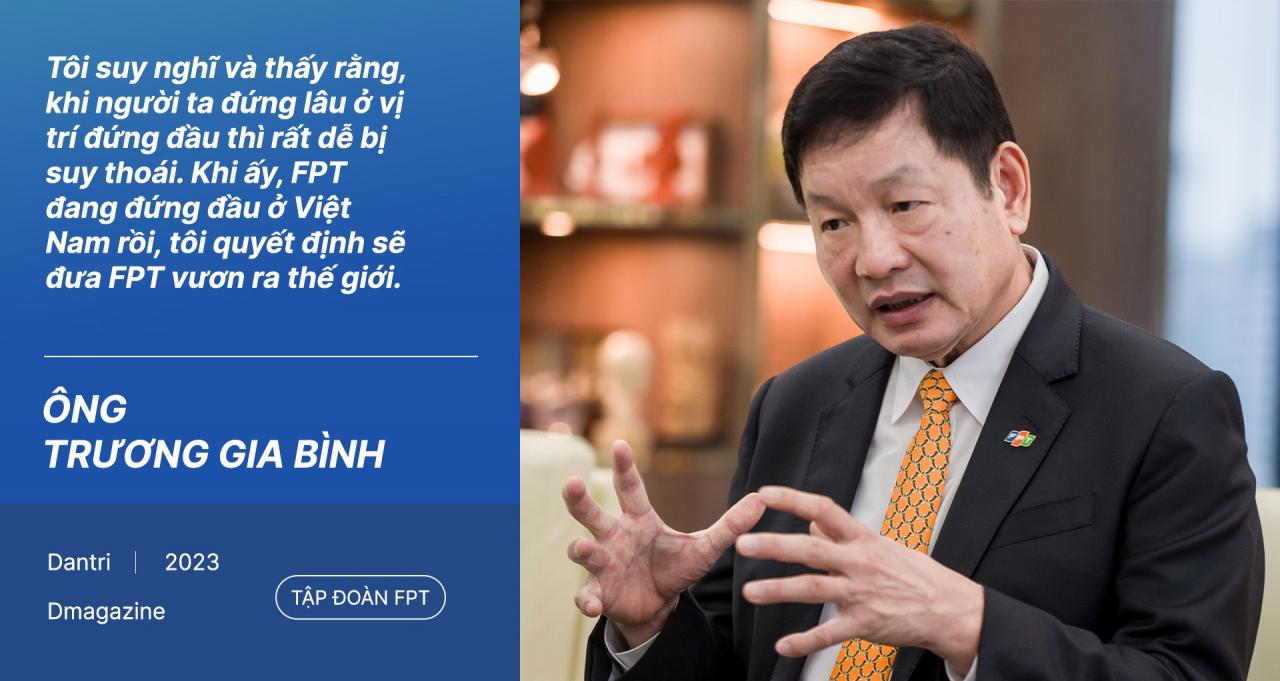
I thought about it and realized that when people stay in the top position for too long, it's easy to decline. At that time, FPT was already the leading company in Vietnam, so I decided I had to take FPT to the world.
The early days of venturing into the global market must have been incredibly challenging. So, what was the key that allowed FPT to step outside the box?
Previously, I had the opportunity to visit Bangalore (India) and realized a very promising path: Software development. I was surprised to see the chaotic scene of cars, people, pigs, and cows on the streets, but the technology companies were so impressive. I secretly thought that their products probably weren't that great.
I asked them a rather naive question: "Is the technology you produce for America as good as American technology?" They replied: "Whatever we produce is, of course, at least as good as or better than American technology."
From then on, I dreamed of going global in software. Although I had access to the theory from Bill Gates' memoirs, my practical experience was absolutely zero. I knew that India made software for the US, but no one knew the specifics.
We tried to learn again. We learned in a completely naive way. Fortunately, we learned very quickly. We immediately realized the key point: they all followed the world's standard procedures: ISO. Soon after, we hired consultants to build procedures for FPT.
FPT is gradually approaching international standards. Once we achieve these standards, we immediately submit them to the Ministry of Science and Technology so that the Ministry can share them with any relevant organizations. I want to work with Vietnamese IT companies to put Vietnam on the world's digital map.

When he entered the software export business, he persevered for 10 years despite not making a profit. What motivated him and his colleagues to be so patient?
Before venturing into software export, FPT persistently developed its team of programmers despite the lack of profit. After 10 years of building, we only had 34 programmers. I told everyone: I want the meeting to have thousands of programmers. To achieve that, we opened a company in Silicon Valley (USA).
The result was failure; a whole year without a single contract, millions of dollars lost. I continued to "move" the company to India, naively thinking that it was the world's technology hub, and that having a stall there would attract customers and lead them to entrust me with work. But I was wrong, and I failed miserably again. My capital gradually ran out.
What is the main lesson here, sir?
It means understanding yourself, believing in your inner potential, and having nothing to fear or be afraid of.
When the Vietnamese sales team couldn't sell the goods, we hired an American sales expert, but he still couldn't secure any contracts despite making many promises. To pave the way during this difficult period, I personally went around pitching the products to potential partners.
My first destination was IBM because at that time we were a major customer buying a lot of IBM equipment. I wondered: We buy so much from IBM, why doesn't IBM buy from FPT? I asked IBM Vietnam to arrange for me to meet with IBM in the US.
I went to America alone. Walking into the meeting room, I was surprised to see 20 IBM executives from various countries seated there. They said, "Why Vietnam?" – a polite way of declining my request.
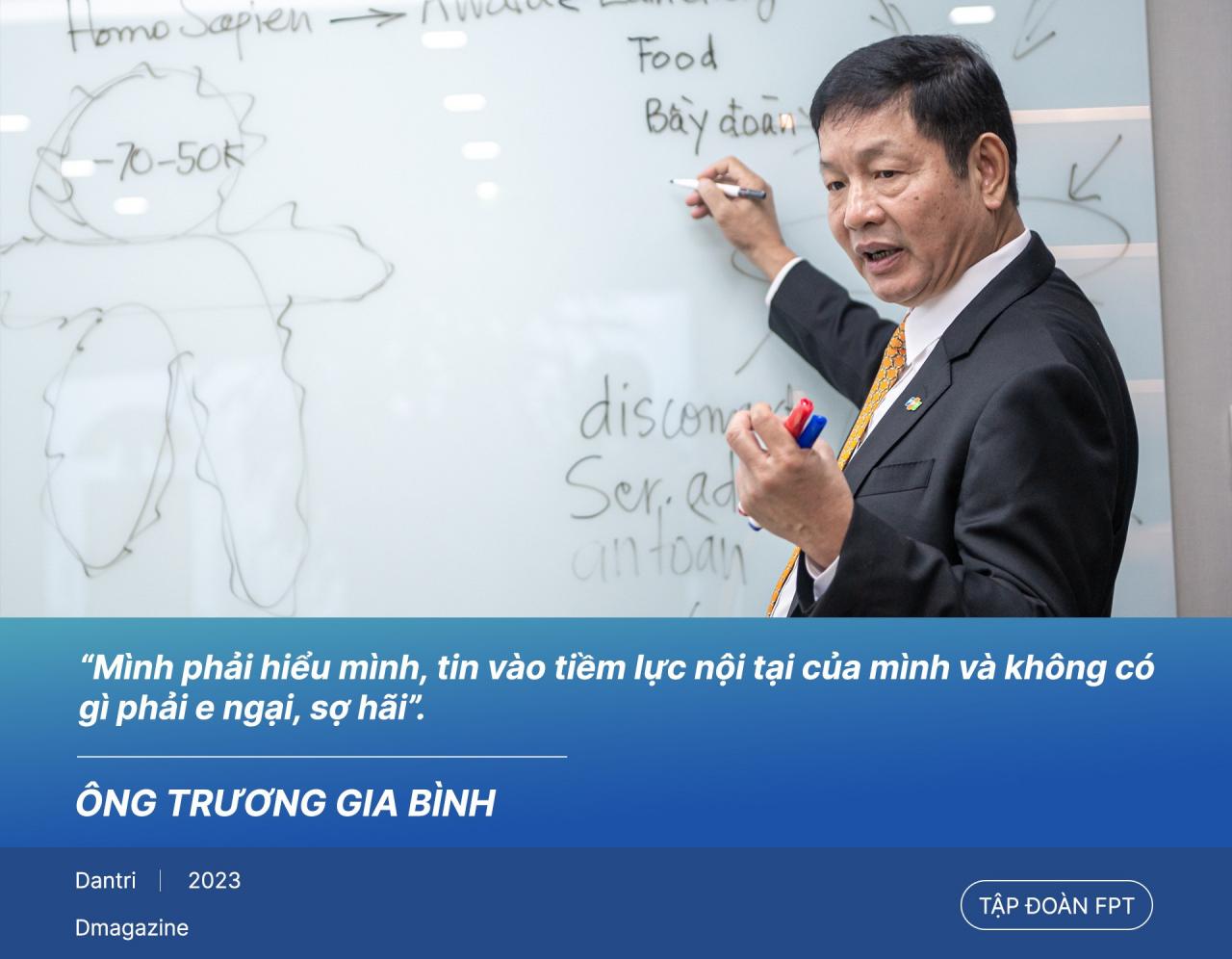
They watched me impatiently, waiting to see what he would say. I slowly walked to the blackboard, picked up my pen, and began writing – a habit I often used to explain things. I continued to apply my mathematical knowledge, drawing a "waterfall" diagram.
They listened attentively as I explained: "Vietnam has a large population, like water. To generate energy, like hydroelectric power, you need a lot of water and a very low per capita income. Vietnam is the best place; we need to give jobs to Vietnamese people. A product, no matter where it's made, has the same output. But if you pay an American or a Japanese person, you have to pay them 3-5 times more than you pay a Vietnamese person."
That's why partners should choose Vietnam. The partners listened as if they'd been struck by an electric shock, recognizing it as the most crucial point. Immediately afterward, they sent people to Vietnam to implement the next steps.
In 2000, my colleagues and I traveled around the world searching for software markets. During this time, I met Mr. Nishida, the former CEO of Sumitomo Corporation, Japan.
Mr. Nishida shared my vision of the Waterfall-Overpass concept, considering it a "stroke of luck." He advised us to go to Japan and wholeheartedly helped arrange meetings with numerous Japanese partners.
Finally, one client, NTT-IT, sensed our enthusiasm and emailed FPT asking if they wanted to give it a try. The Japanese will choose you if they see that you are truly determined.
What are your thoughts on the fact that, even now, many people still believe that FPT is simply a company that has been successful in software outsourcing?
Outsourcing is also a good thing, isn't it? World-renowned companies like IBM, NTT, KPMG… all outsource. Perhaps it's a linguistic issue; translating "outsourcing" as "gia công" (outsourcing) creates the misunderstanding that it's a simple task. If I had to choose again, I would translate it as "contracting out".
To evaluate a company, the first things to consider are its revenue, number of employees, ability to execute projects, and expertise in advanced technology.
FPT currently has nearly 70,000 employees working in many countries. Having nearly 70,000 people worldwide is quite impressive. We are even much larger in scale than many of our major clients and partners.
FPT has researched, invested in, and developed high technologies such as IoT, AI, and Blockchain, and has a global presence. That's our class. Regarding partners, we have hundreds of client companies among the world's top 500 across all continents. We also have software and solutions ranked among the top 6 globally, such as akaBot.
We have been preparing our resources for 35 years, and now we are starting to do the best things in the world. While in the past FPT always had to proactively seek out partners and customers, now many major customers and partners are proactively approaching us.
We are filled with hope that the day of national prosperity is drawing near.

| "Vietnam is becoming a new destination for leading global technology and semiconductor companies. Recently, US President Joe Biden visited Vietnam, and the US now considers Vietnam a 'key partner in the region.' Vietnam is emerging as a destination for many leading semiconductor manufacturers such as Intel and Samsung, with numerous projects ranging from hundreds of millions to billions of USD invested in building factories, expanding production, and assembling... Some Japanese businesses – our clients – also want to invest more heavily in Vietnam. Vietnam's competitive advantage lies in its global reach. Vietnam learns from other countries, recognizes effective models around the world, and applies them in its own way. FPT is also ready to seize this opportunity. It's time the world needed Vietnam," said Mr. Truong Gia Binh. | He is devoting much of his energy to education and talent development. Perhaps this is his way of nurturing a new generation, to continue the aspiration for a strong and prosperous Vietnam, just as the state cared for people like him in the past? For 35 years, my colleagues and I have never forgotten the aspiration for national prosperity. We are very grateful to those who sowed the dream of a strong and prosperous nation in the hearts of the country's talented students back then. On one occasion, I spoke with Associate Professor Dang Quoc Bao about my desire to repay the country by nurturing talented individuals. In 1999, I established the FPT Young Talents Center, recruiting talented students each year for training, scholarships, and in-depth technology education… We also invite prominent experts and politicians to speak. |
Many of you have grown up, joined large companies, become professors and doctors, and are continuing to pursue the aspiration for national prosperity and global reach.
The driving force behind the rise of his generation of entrepreneurs was "washing away the shame of poverty and backwardness." For today's young generation of entrepreneurs, what do you think is their motivation?
The 13th National Congress of the Communist Party of Vietnam set the goal of Vietnam becoming a developed country with a modern industrial base and high income by 2045. This means that GDP per capita must reach somewhere above $12,000. The current figure is $4,110.
By 2030, the private sector is projected to account for approximately 60% of GDP. This figure signifies that the private sector plays a crucial role in Vietnam's goal of standing alongside global powers, presenting a significant opportunity for the private business community.
Thank you very much, sir!







































































Comment (0)