

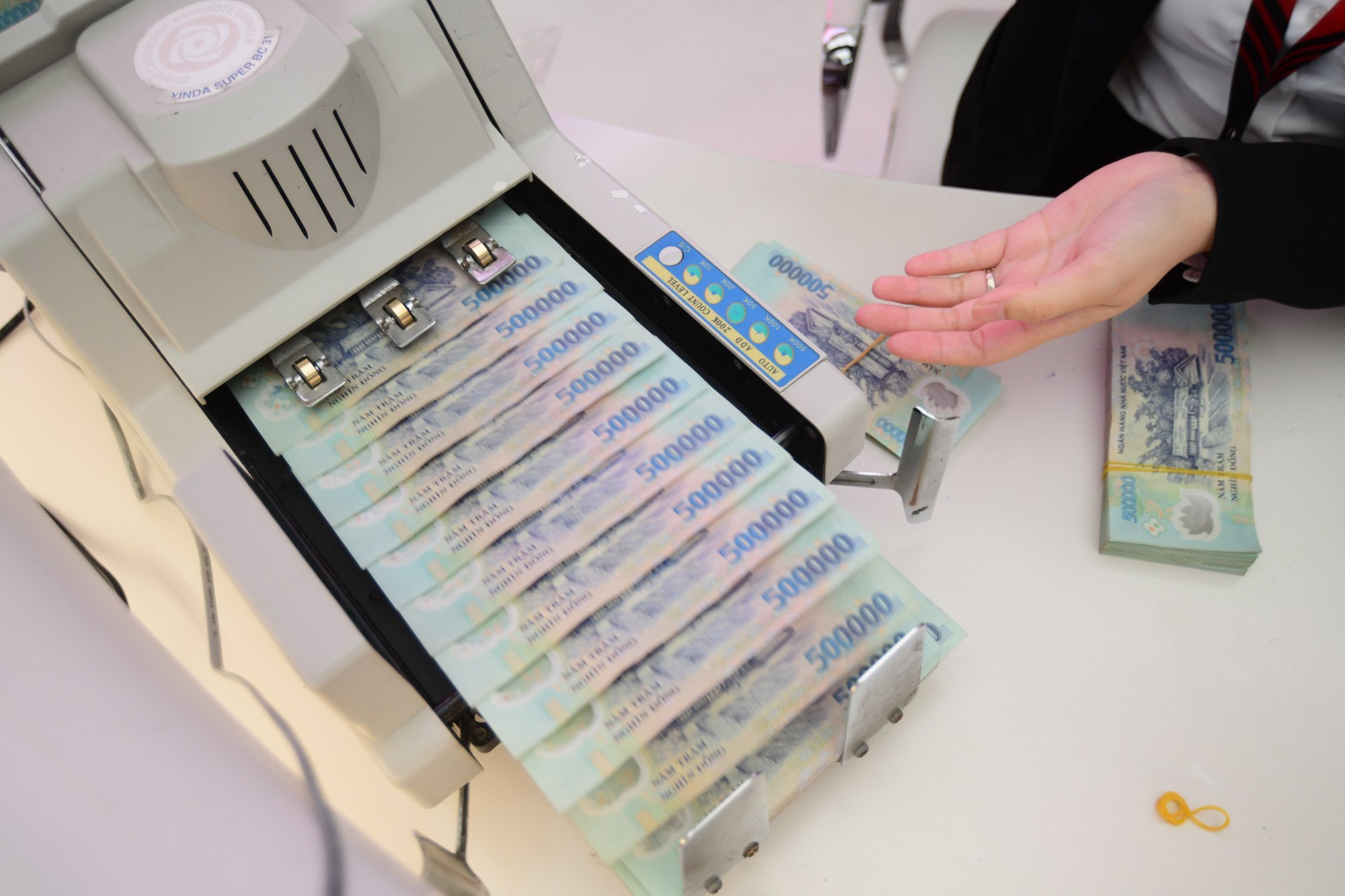
Vietnam's public debt remains within safe limits, with a debt structure that increasingly reduces the risk of borrowing from foreign sources - Photo: QUANG DINH
The government has just submitted a report to the National Assembly on the public debt situation in 2024 and projections for 2025.
Accordingly, based on the estimated public debt and foreign debt repayment of the nation in 2024, it is projected that debt indicators at the end of 2024 will remain within the ceiling and safety warning thresholds decided by the National Assembly.
Debt indicators are within safe limits and thresholds.
Specifically, the estimated public debt/GDP ratio is 36-37%, and the government debt/GDP ratio is 33-34%. The country's foreign debt relative to GDP by the end of 2024 is expected to be around 32-33% of GDP (the ceiling set by the National Assembly is 50% of GDP).
The ratio of the country's foreign debt service obligations to its exports of goods and services in 2024 (excluding short-term principal debt repayment obligations under 12 months) is projected to be around 8-9%, within the limit of 25% allowed by the National Assembly.
According to the report, these debts were borrowed primarily from domestic sources. Insurance companies, Vietnam Social Security, and investment funds and finance companies held approximately 62.5% of the total outstanding government bonds. The remainder was held by commercial banks, securities companies, investment funds, and other investors.
The foreign creditors are mainly bilateral and multilateral development partners such as Japan, South Korea, the World Bank, and the Asian Development Bank.
The proportion of debt denominated in local currency accounts for the majority of the government debt portfolio, estimated at approximately 71.3% by the end of 2023.
Foreign currency debt remains primarily in USD (approximately 12.5%), JPY (approximately 8.2%), and EUR (approximately 4.4%), with other currencies accounting for about 3.7%.
This year, based on the total borrowing limit of the central budget decided by the National Assembly, the Prime Minister has pledged to mobilize borrowed capital for the whole year of 2024 to reach 670,679 billion VND.
Of this amount, 659,934 billion VND was borrowed for central government budget balancing, and 10,745 billion VND was borrowed for on-lending.
These funds will include domestic borrowing projected at VND 639,399 billion (approximately 95% of the plan). This will primarily be through the issuance of government bonds with an 11-year maturity and an average interest rate of 3% per year, a decrease of 0.21 percentage points compared to 2023.
ODA loans and preferential loans from foreign donors are estimated at 31,280 billion VND. Of this, loans for on-lending are estimated at 10,745 billion VND. Foreign loans mainly consist of ODA loans and preferential loans from the Government.
These are long-term, low-interest loans (averaging 1.9% per year) from multilateral and bilateral donors, including the World Bank, the Asian Development Bank, the Government of Japan, the Government of South Korea, and AFD (France).
A more positive public debt structure reduces the risks of borrowing from abroad.
The government's debt repayment in 2024 will be fully implemented as committed, within the scope of the budget approved by competent authorities. The ratio of the government's direct debt obligations to budget revenue is 21-22%.
The government assesses that public debt management has been implemented in close adherence to the National Assembly's resolution.
This ensures that targets and indicators regarding public debt safety, total borrowing and repayment levels of the budget, government guarantee limits, and borrowing for on-lending of ODA loans and preferential foreign loans are within permissible limits.
Essentially, public debt management aims to meet the capital mobilization needs for development investment, while ensuring that debt targets by the end of 2024 remain within the ceiling and safety warning thresholds approved by the National Assembly, thereby guaranteeing national financial security.
The structure of government debt continued to improve positively by the end of 2024. Government-guaranteed debt continued to be tightly managed, with its proportion decreasing from 3.8% of GDP in 2021 to approximately 2-3% of GDP in 2024.
Regarding national credit ratings, as of August 2024, S&P, Fitch, and Moody's continue to maintain Vietnam's national credit rating.
Accordingly, ratings from S&P and Fitch are both at BB+, while Moody's rates it at Ba2, with a stable outlook.
In particular, government debt is stable and much lower than that of countries with similar ratings (34% compared to the BB average of 53%).
A proactive debt management strategy helps minimize the government's liquidity risk. Improved debt position, reduced reliance on external funding sources, and a decreasing proportion of foreign currency debt help mitigate exchange rate risk.
However, the Government acknowledges that the progress in negotiating and signing foreign loan agreements has been slower. Foreign borrowing costs are currently higher than the average domestic borrowing costs and pose risks related to exchange rate fluctuations. Disbursement of public investment funds from foreign sources remains low…
The reasons given include unresolved issues related to public investment and bidding, and legal obstacles that have hindered the timely implementation of loan agreements.
Source: https://tuoitre.vn/no-cong-an-toan-viet-nam-dang-vay-no-o-dau-20241013091508047.htm

![[Video] Sunset at Lap An Lagoon – Where the sun sets over the fishing nets](https://vphoto.vietnam.vn/thumb/1200x675/vietnam/resource/IMAGE/2026/05/31/1780187239592_2222.jpeg)

































![[Image] Nearly 125,000 Hanoi students completed the Literature exam for the 10th grade entrance exam.](https://vphoto.vietnam.vn/thumb/1200x675/vietnam/resource/IMAGE/2026/05/30/1780117233041_ndo_br_thiet-ke-chua-co-ten-2-png.webp)







































































Comment (0)