


The village has remained in its original state despite the wave of modernity that has swept across the land.
In the village of white clouds
Far across the western border of Quang Nam province, small groups of people occasionally venture here as if seeking paradise, a place where only clouds touch the hand, where day and night the sound of the Mo Rooy stream murmurs in the deep, winding forest, where the rhythmic pounding of pestles grinds rice to cook meals for guests, or the splashing of young men and women wading in the stream to catch fish.
Elder A Lăng Reng is like a towering tree in the village, yet he is approachable and warm, like a father figure to the more than 100 inhabitants. Both familiar and unfamiliar, Elder A Lăng Reng beckons each person into the largest communal house in the village, surrounded by the houses of the villagers clustered together on a flat piece of land, like chicks huddled around their mother.

Aur is a heavenly village nestled in isolation amidst white clouds.
Aur is a village perched precariously on a mountain range at an altitude of over 1,000 meters, located in A Vuong commune (Tay Giang district, Quang Nam province). Aur is one of the most isolated and difficult-to-reach places in the mountainous region of Quang Nam. Many first-time visitors are surprised to find a village completely cut off from modern life.
There are no markets, no health clinics, no phone signal, no national power grid, and no roads for vehicles. The only way to get to the village is a nearly 20-kilometer walking trail through fields, wading through streams that flow day and night, and crossing hills perpetually shrouded in clouds...
And, it seems, it is precisely this pristine essence that makes this unique village perhaps the only place in Quang Nam that still preserves the unique traditional cultural values of the Co Tu people. It embodies the values of truth, goodness, and beauty, and has its own definition of happiness. And, especially, the village's rules and customs have transformed this place into a beautiful land, likened to a paradise amidst the Truong Son mountain range.
A Lăng Eo, a villager from Aur, shook hands with each person on this journey up the highlands. His gentle and warm smile helped each person dispel the cold and lessen the feeling of being a stranger.
" Occasionally, tourist groups or volunteer groups come up here, and the villagers consider it a festival ," A Lăng Eo said in a warm but not-yet-perfect accent.
Like A Lăng Eo, because the village is isolated deep in the mountains and forests, contact with the outside world is quite limited, and contact with people from the lowlands is also very rare. A Lăng Eo, like many young people in the village, has absorbed the character of their ancestors from generations past in these remote mountains, becoming attuned to nature and as warm and welcoming as a long-lost relative.
In an instant, A Lăng Eo disappeared into the small houses, carrying a gourd of r'lang wine (distilled cassava or sweet potato wine mixed with honey) and two bamboo tubes of meat. A Lăng Eo and the elderly A Lăng Reng meticulously poured small cups of wine and carefully sliced pieces of meat from the bamboo tubes, offering them to everyone. “ Drink, eat, satisfy the villagers! ” A Lăng Eo and the elderly A Lăng Reng diligently served each person.
Having visited many remote villages in the highlands and border regions, I'm already familiar with the hospitality of the villagers. But in Aur, the villagers welcome guests with all the genuine kindness and selflessness that comes from their poverty.

Poor transportation infrastructure is the biggest challenge facing the villagers.
In the evening mist, the mountaintops are shrouded in light, and in the fading twilight, wisps of blue smoke rise from the wooden roofs, accompanied by the rhythmic pounding of pestles in wooden mortars and the gentle murmur of the stream, creating a scene as beautiful as a traditional ink painting. Children play around the village's communal courtyard while women carry small trays of food towards the community house.
On the tray, there might be a bowl of rice from fields grown near the village, or a grilled stream fish, a boiled chicken, or a piece of smoked pork drenched in chili. In an instant, the evening meal was served, and the strangers were overwhelmed by the abundance of food and drink, along with the welcoming greetings of the villagers. It seemed that nowhere else, in any village, had such a custom of "sharing the meal with guests."
A Lăng Eo and the elder A Lăng Reng patiently explained that the villagers have been working together, eating together, and entertaining guests together for generations. When guests arrive, the whole village will contribute, each household contributing a bowl of rice, a cup of wine, a grilled fish... whatever food and drink each household has, they will bring it to share with the guests, chat, and sing together until they are full and satisfied.
It seems that, amidst the hustle and bustle of modern civilization and the increasingly evident cultural disparities, Aur and the villagers still retain the purest aspects of their culture. Sharing the responsibility of hosting guests, in this remote village, though simple, they are warm and friendly like family, even on their first meeting.
The Aur people don't just feed guests for one meal; they feed them collectively until the guest leaves the village. If a guest stays for one meal, they feed them for one meal; if they stay for ten meals, they feed them collectively for ten meals. Elder A Lăng Reng pointed to a nearly 2-hectare rice pad far from the village, which yields about 30-40 bags of rice each year. The village has about 20 buffaloes and cows, several hundred chickens, and a few dozen pigs. These are considered common assets of the village, used for offerings, feeding guests, and sharing the profits when needed.
“ In our Aur village, we maintain close bonds, sharing joys and sorrows while eating together. For Aur, peace is the most important thing ,” said elder A Lang Reng, his eyes twinkling with a smile that held immense pride.
Preserve in isolation.
The night stretched on, filled with the aroma of r'lang rice wine, laughter, conversation, and warm affection. But hardship was undeniably present. The dim light of the solar-powered lamps was insufficient to dispel the precariousness of this idyllic village. As if understanding our feelings, old A Lăng Reng and a few other elders poured wine and slowly began to confide in us.
Old Man Reng said that Aur village is the poorest in the district, and literacy is still a foreign concept to most of the villagers, as nearly 70% are illiterate. The school for the children is quite far from the village, so the children stay there to attend school and only return to the village on weekends.
That was Aur's biggest obstacle. With 21 households, their self-sufficient lifestyle meant they lacked everything; medicine and electricity were scarce. While there wasn't a shortage of food, there wasn't much surplus to sell, and even if there was, traveling nearly 20 kilometers along a trail to sell it was a significant challenge.
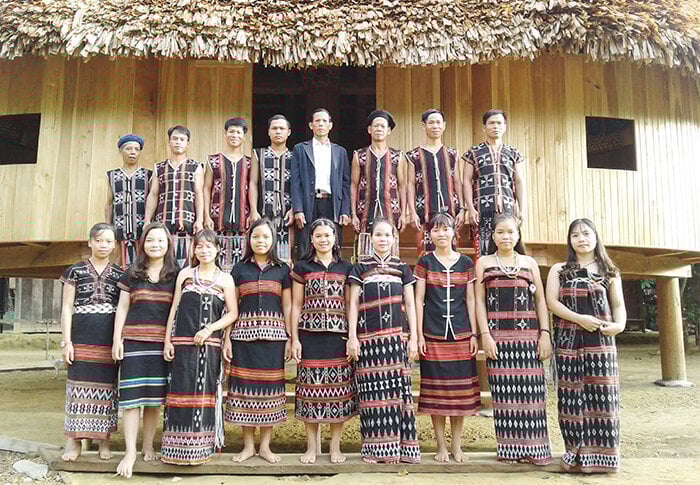
The people of Aur village have preserved the original cultural characteristics of their ethnic group.
For centuries, the Aur people have lived off and revered the forest. They toil like bees, are gentle like trees and leaves, pure like the Mơ Rooy stream, and resilient like the ancient trees of this land. The forest nourishes them with honey, cassava, ginger fields, wild vegetables, and stream fish. They live in harmony with the forest, taking just enough to eat and working enough to ensure they have food in the winter.
But, we also need electricity, phone signal to communicate with the outside world, and modern amenities like televisions so we can learn how to make a living and escape poverty, or at least improve the lives of the children! I expressed my feelings, saying that this would help the villagers live better lives, and their future would be brighter, like many other villages.
“ With modernization, will we be able to preserve Aur as it is now? ” This question, pondered in the depths of old man Reng's mind, is also the concern of many villagers. Old man Reng, like many other elderly people in the village, is understandably worried about this.
“ Although other villages have developed, many bad things have followed. The villagers are no longer the same as before. I’m very worried !”, the man named A Lăng Lép whispered as he finished the last sip of wine from his small cup.
Many conveniences can now be found in this remote corner of the mountains, replacing the quiet solitude of the past. However, the consequence of this "invasion" of civilization is, of course, a bustling, even noisy kind of "civilization"—with its jukeboxes, vehicles, smartphones, and portable speakers—which the Aur people have the right to enjoy based on their very real needs. But, will they be able to preserve the purity of Aur as it is now? And who knows, development might sometimes bring about vague losses.
Isolated amidst a region shrouded in white clouds and lacking many things, Aur is certainly not neglected but always receives attention from the local authorities. Aur has become a special focus of the local government. In any support program, the People's Committee of A Vuong commune or Tay Giang district always prioritizes allocating a larger share.
Many programs and projects have been implemented to help people "get involved," such as the 2011 project "Strengthening tourism activities in inland districts of Quang Nam province" launched by the International Labour Organization (ILO) with funding from the Government of Luxembourg, helping people to participate in sustainable tourism.
In 2023, the Tay Giang District Youth Union mobilized nearly 100 young people from 10 communes to renovate more than 7 km of road and build 4 temporary bridges from A Rec village (A Vuong commune) to Aur. However, after much consideration and concern about disrupting the village's "precious" natural space, only 2/3 of the road to Aur was opened, leaving the remaining section as it was, thus preserving the community's living space.
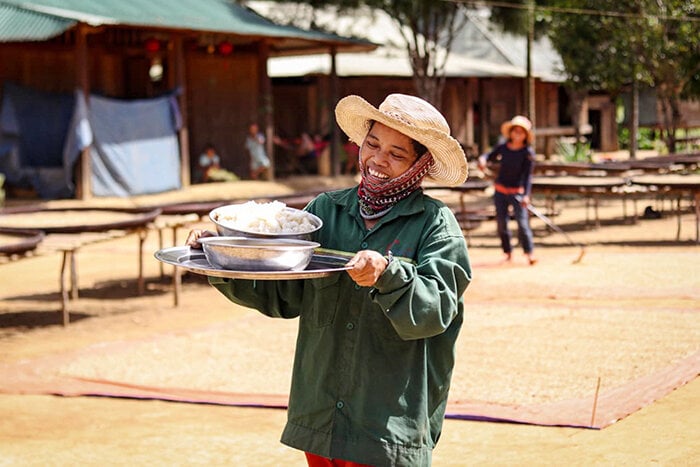
These women brought the food to share with the guests.
The isolation of the village, once nestled in the forest as if entrusting its fate, seeking refuge, and securing its survival, is now a shining example of experiential tourism. In recent years, Aur has become a popular tourist destination among backpackers. Aur's inherent qualities have proven resilient to the changes brought about by development.
Preserving Aur in its original, timeless state is a challenge for the local community. And the dilemma of both preserving Aur culture and supporting its people is also causing concern among all levels of government.
When leaving the village, Aur feared that the travelers would be hungry and thirsty along the way. Out of compassion for them, she treated them like her own children, so she cooked sticky rice with cassava and wrapped it in banana leaves or bamboo tubes. The women in the village also brewed a pot of herbal tea for the travelers to take with them. The villagers are striving to preserve for Aur the purest possible representation of their age-old culture.
Hopefully, Aur will remain strong in preserving itself amidst these obstacles, so that this unique village can retain its original form, its way of life, and its pristine beauty, regardless of the turbulent changes happening outside.
Source






























































Comment (0)