

(CLO) A volcano near Iceland's capital Reykjavik erupted late Wednesday, marking the tenth such eruption in the past three years.
However, Iceland's meteorological agency said there were no disruptions to air traffic or infrastructure in the area. And although the volcano remained active, the situation did not seriously affect daily life.
Iceland, with a population of nearly 400,000, lies on a fault line between the Eurasian and North American tectonic plates, making it a seismic hotspot. It boasts numerous geysers, hot springs, and dozens of volcanoes.
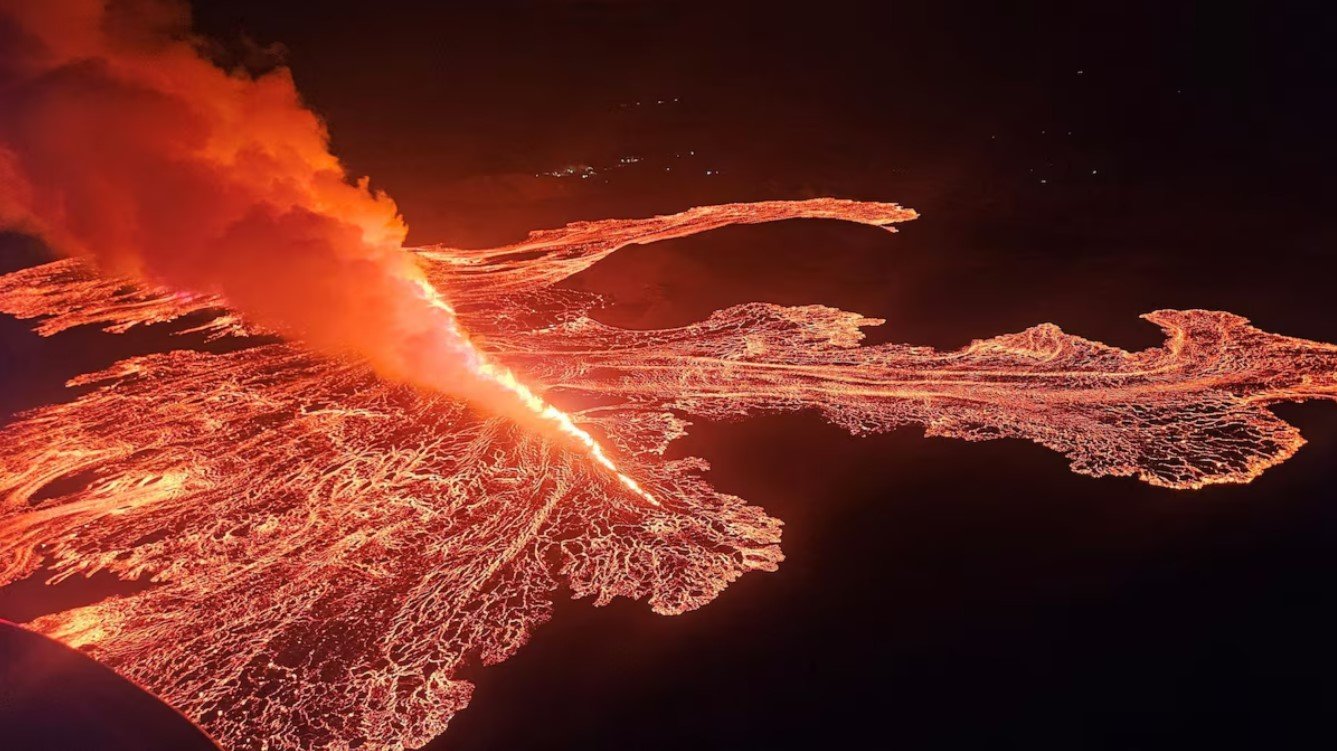
Lava flows erupting on the Reykjanes Peninsula near Grindavik, Iceland. Photo: Reuters.
Live footage shared on social media from the area revealed spectacular scenes: streams of molten lava, in vibrant yellow and orange hues, erupting into the dark night sky. These images garnered significant attention online, leaving many feeling both amazed and terrified by the power of nature.
Iceland's meteorological agency said that just 45 minutes before a giant crack appeared in the ground, opening up a crater about 3 km long, molten lava had penetrated the Earth's crust and surged to the surface.
Previously, scientists had predicted an impending volcanic eruption in the Reykjanes Peninsula, about 30 km southwest of the capital Reykjavik. They discovered that a large amount of magma was accumulating underground in the area.
The most recent eruption in this area only ended on September 6th. However, there has been no significant increase in seismic activity in recent weeks.
Reykjavik's Keflavik Airport announced on its website that flights were unaffected and no critical infrastructure was at risk from the volcanic eruption.
The nearby fishing town of Grindavik, which had around 4,000 residents before being evacuated last December, remains deserted due to the threat of lava flows. Although there are no signs that lava is flowing toward the town, about 50 homes have been evacuated, according to a statement from the civil protection agency.
The volcanoes had been dormant for 800 years; however, geological activity was reactivated in 2021. Since then, the volcanoes here have erupted with increasing frequency, with the most recent eruption expected in 2024.
Experts have warned that the Reykjanes region is likely to continue experiencing multiple volcanic eruptions for decades, possibly even centuries.
Ha Trang (according to Reuters)
Source: https://www.congluan.vn/nui-lua-o-iceland-phun-trao-lan-thu-10-trong-vong-3-nam-post322393.html

![[Photo] Prime Minister Pham Minh Chinh attends the Conference on the Implementation of Tasks for 2026 of the Industry and Trade Sector](/_next/image?url=https%3A%2F%2Fvphoto.vietnam.vn%2Fthumb%2F1200x675%2Fvietnam%2Fresource%2FIMAGE%2F2025%2F12%2F19%2F1766159500458_ndo_br_shared31-jpg.webp&w=3840&q=75)














































































Comment (0)