

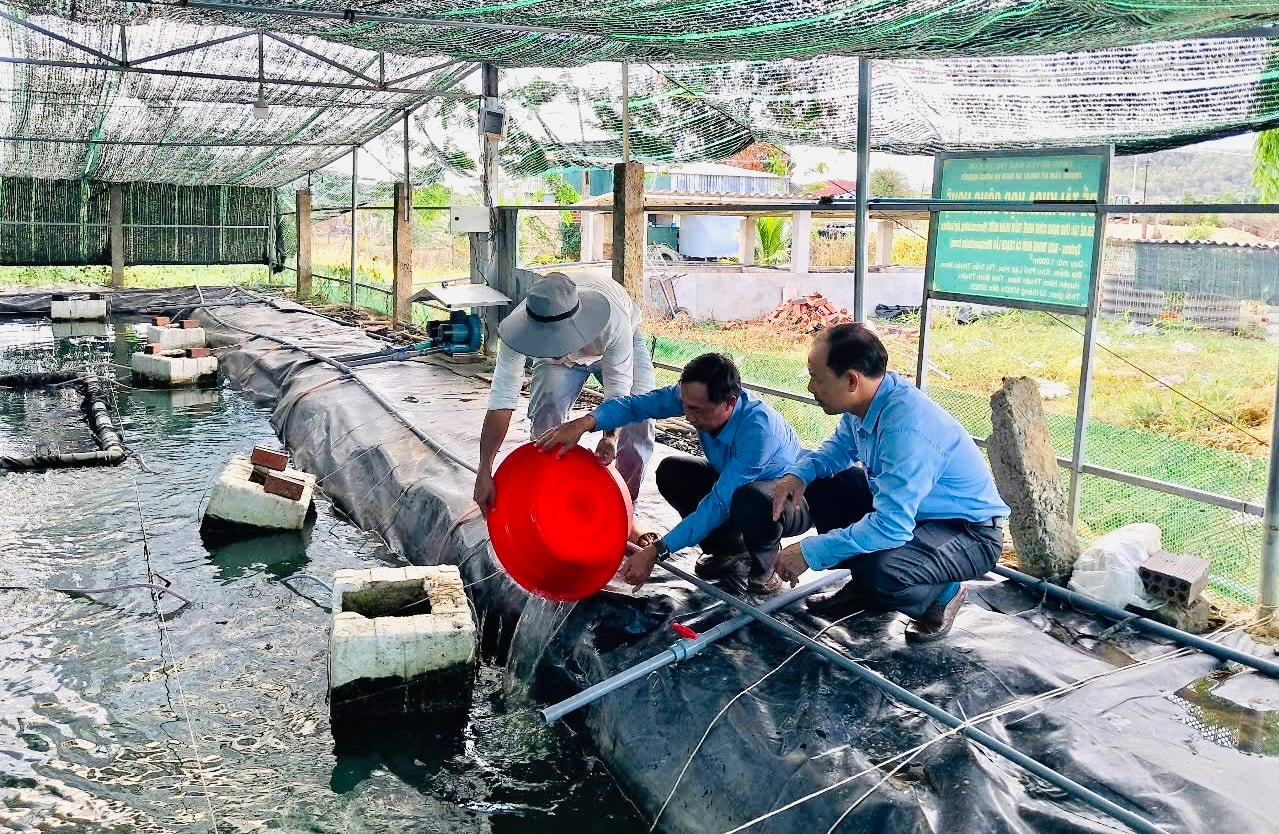
After nearly a year of raising snakehead fish using traditional methods, by the end of 2024, Mr. Tran The Dien's household in Ham Thuan Nam commune only broke even, failing to achieve profitability. The reasons were a lack of technical expertise, frequent problems with water quality and disease outbreaks, and low farming efficiency. It wasn't until the local Agricultural Technical and Service Center (now part of the Provincial Agricultural Extension Center) suggested and supported him in implementing the "Application of recirculating water technology in snakehead fish farming" model that he was able to succeed. With his inquisitive and eager-to-learn nature, Mr. Dien agreed to follow the technical staff's guidance.
Accordingly, unlike traditional pond farming, this time he switched to raising fish in ponds lined with tarpaulin. At the same time, he managed water quality using a suitable recirculating filtration system to ensure rapid growth of the snakehead fish and minimize size variation. In a 1,000 m² pond, Mr. Dien stocked 600 fingerlings. After about 8 months to 1 year, he harvested approximately 1.2 tons of marketable snakehead fish, earning a profit of over 90 million VND after deducting expenses.
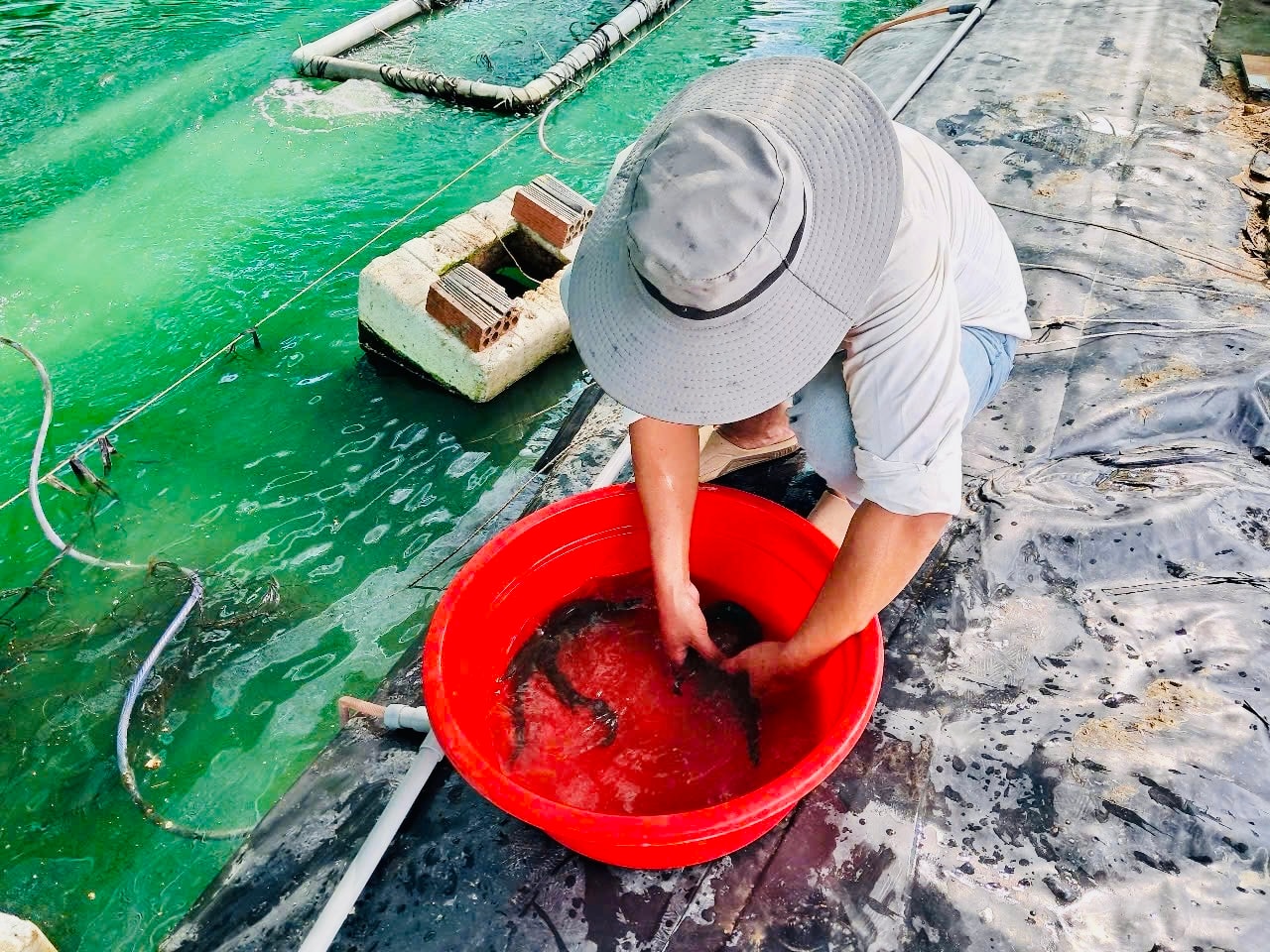
Mr. Dien further shared that during the first two months after stocking, the fish suffered losses due to unfamiliar water and environment. However, by the third month, they began to stabilize, with water changes once a month and feeding twice a day. At harvest, they weighed approximately 5 fish per kilogram, and traders purchased them at prices ranging from 160,000 to 200,000 VND per kilogram. After deducting expenses, the profit was around 80,000 VND per kilogram.
According to local agricultural officials, snakehead fish are a high-value economic species with delicious meat and are popular and well-received in the market. However, snakehead fish farming is not easy due to many factors such as water source, light, and pH level. If the techniques and technology are mastered, snakehead fish farming is quite simple. Farmers only need to feed them twice a day, early in the morning and late in the evening, with specialized feed pellets. Farmers should occasionally turn on the oxygen aerator to circulate air for optimal growth and development of the snakehead fish. In addition, the temperature in the pond must be between 26-28 degrees Celsius, and bamboo or plastic pipes should be placed in the pond to encourage the fish to gather in schools, as this species prefers to live in groups.
According to the agricultural sector, for households with limited land area and a willingness to learn new farming models, raising snakehead fish is a good and practical idea that brings high economic efficiency. They also stated that this is a successful freshwater aquaculture model. Similarly, other successful farming models in the area include mudless eel farming utilizing leftover feed combined with catfish farming; eel breeding; and commercial frog farming in tanks. This not only helps farmers access new freshwater aquatic species but also contributes to diversifying local aquaculture species, aligning with the current trend of green agriculture and circular economy. The initial success of the snakehead fish farming model using recirculating water technology opens the way for further research and development of farming models for other fish species such as spotted eel, snakehead fish, and catfish, applying recirculating water filtration technology to conserve water resources and ensure sustainability.
Source: https://baolamdong.vn/nuoi-ca-chach-lau-bang-cong-nghe-tuan-hoan-nuoc-382920.html























































































Comment (0)