

But the dirt roads, treacherous mountain passes, steep slopes, and difficult terrain dampened the will and eroded the passionate desire to conquer the Nậm Nghẹp "Gateway to Heaven." The path is as difficult as climbing to the gate to Heaven; few strangers would entrust their lives to a motorbike like an old horse precariously running along the edge of a cliff. Only the Hmong people of Nậm Nghẹp, familiar with the route, would descend the mountain to buy goods or for absolutely unavoidable personal reasons.

Over two years ago, the road to Nam Nghep began to be rebuilt. The government undertook the surveying, design, technical supervision and monitoring, and invested in materials such as cement, sand, gravel, and construction equipment. The people of Phay, Chu Pong, and Nam Nghep villages contributed thousands of man-days of labor and donated tens of thousands of square meters of forest land to expand the road.
I arrived in Nam Nghep just as the road was under construction on three sections simultaneously. The spring rain in the highlands gently scattered dust. Beside the rumbling excavators, bulldozers, rollers, and trucks, strong young men carried stones and cement, while young women in colorful Thai and Hmong dresses carried gravel and sand, leveling the cement road surface... Working on the road was like attending a lively festival. The concrete road gradually took shape, the three sections widening and lengthening, connecting like a ribbon of ivory silk winding along the hillsides amidst the endless blue-green landscape.
Once the road from the "lower world" of Ngoc Chien valley to the Nam Nghep mountain pass was completed, trucks carrying instant noodles, salt, fish sauce, steel, cement, etc., went up, while carrying hawthorn berries, cardamom, bamboo shoots, corn, upland sticky rice, stream ducks, etc., went down the mountain. Many Hmong households bought motorbikes and pickup trucks, and more people from the lowlands eagerly flocked to Nam Nghep.
On the way up to the Nậm Nghẹp Sky Gate, I occasionally saw young couples or groups of backpackers walking towards it. Sometimes, they would stop to rest or take photos when they unexpectedly caught sight of a fluffy white cloud drifting over the thatched roofs of the stilt houses, scattered across the blue valley, or be moved by a patch of hills covered in white hawthorn blossoms. The higher we climbed, the more satisfied we felt looking back, realizing how beautiful our country is, with such unique places. The poetic nature, the dreamy scenery, and the alluring mystery of the Nậm Nghẹp Sky Gate attract and captivate tourists, but partly it's the smooth, unpaved road that makes our steps longer and stronger.
***
The Hmong people in Nam Nghep celebrate Tet (Lunar New Year) early. From the 20th day of the 12th lunar month, many people travel forty kilometers by motorbike to Muong La market to shop for Tet. Those going to the market continue their work, while those at home continue draining ponds or casting nets to catch fish. In the village, the squealing of pigs continues until the 30th day of the 12th lunar month. Some families slaughter small pigs weighing a few dozen kilograms, while others slaughter larger ones weighing over a hundred kilograms, and begin making crescent-shaped rice cakes and sticky rice cakes. Starting from these days, every household seems to put on new clothes; grandparents, parents, and children clean the house, gates, and gardens. They prepare and decorate the altar for the ancestors.
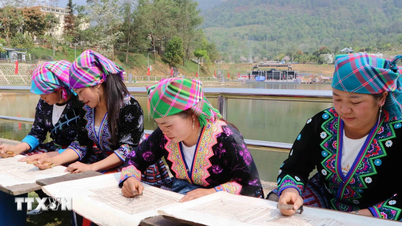
Nam Nghep now has electricity, but every household still uses a small bowl filled with lard and a wick to light their ancestral altars, inviting the spirits of their ancestors to celebrate Tet (Lunar New Year). Khang A Lenh recounts that the Mong people of Nam Nghep usually slaughter a chicken for the New Year's Eve offering. A Lenh's family chooses a strong, healthy rooster with a red comb and beautiful, vibrant feathers. They dip a handful of the head feathers in the chicken's blood, stick it onto paper, and then affix it to the weathered wooden wall of the Pơ Mu tree above the altar to invite the spirits and ancestors to celebrate Tet, bless their descendants with good health, full granaries, abundant livestock, lush trees, and plentiful fruits... After the New Year's Eve offering, the Mong people of Nam Nghep visit each other's houses to exchange New Year's greetings, with whole groups going around and drinking alcohol all night. At the same time, the boys and girls, dressed in traditional brocade clothes and wearing jingling silver ornaments, pour out onto the streets to play, pick lucky branches, their laughter, and the sound of flutes echoing throughout the village.
The Hmong people in Nam Nghep celebrate Tet (Lunar New Year). Around the fifth day of the new year, they visit distant relatives, even those as far as Tram Tau and Mu Cang Chai. Some walk twenty kilometers to Xa Ho at the foot of Ta Chi Nhu mountain to visit and exchange New Year greetings. After celebrating Tet until the 15th day of the first lunar month, they begin preparing for the Hawthorn Flower Festival.
***
In recent years, community-based tourism has developed. Down in the valley, there's the Ngoc Chien Community Tourism Cooperative and many households have invested in homestays to welcome guests. At the Nam Nghiep Sky Gate, Khang A Lenh sells wild apples and pigs, using the money to buy a pickup truck and build five small, single-story wooden houses. Western tourists call them bungalows; but A Lenh says they're just small wooden houses made of Pơ Mu wood on the hillside with large glass windows overlooking the valley, equipped with hot and cold water, bedding, a private bathroom, and a spacious veranda right on his own hillside land.
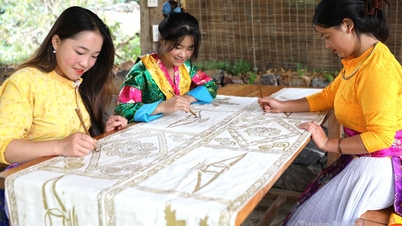
Sitting in A Lệnh's bungalow, you can "hunt for clouds," with white clouds drifting lazily over the green valley and swirling around the mountain peaks. A Lệnh also built a large stilt house to accommodate tour groups, and used an entire hillside as a pathway connecting the bungalows, planting colorful flowers along both sides of the road. A Lệnh established the Nậm Nghẹp Cooperative to develop community tourism, cultivate local ginseng, weave linen and dye it with indigo, and produce hawthorn wine... In reality, it's still in the process of "feeling the stones across the river" and is largely spontaneous, learning as you go, experimenting as you go. But the movements and creativity of the Hmong people are already showing promising signs, full of confidence and glimmering hope.
From the "staircase landing," the Nam Nghep "gateway to heaven," visitors can spread out to various places in this fairytale paradise at an altitude of over 2,000m. They can camp by the stream at "Bay Tinh Waterfall," climb Ta Tao mountain to take photos and admire the rhododendron flowers on the mountainside, or marvel at the "Lonely Apple Tree" standing silently amidst the poetic mountains and forests, and at dusk watch the crimson sunset over Yen Ngua hill...
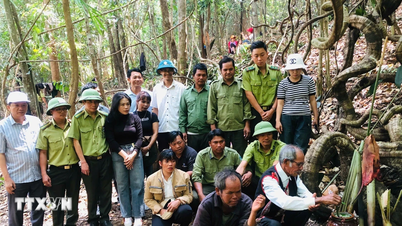
You can go on your own, but hiring Hmong men and women to guide you is even easier, and you'll get to hear ancient stories, customs, lifestyles, and fascinating Hmong culture. The most vibrant and mystical experience is the Forest Opening Festival in October each year, held next to the "Husband and Wife Rocks" on the summit of Ta Tao Mountain. At that time, the maple leaves have turned from bright yellow to vivid red and are shedding their leaves. What could be more exciting and exhilarating than walking through the dragon's claw tea forest, under the canopy of maple trees during the leaf-falling season, with leaves falling on your head and scattering on your shoulders?
The most fascinating and adventurous part is the mountain climbing journey. Besides the route through Tram Tau, there's also a route from the Nam Nghep "Heaven's Gate" to Ta Chi Nhu. This route is usually reserved for mountaineers and those who enjoy challenging explorations, requiring more than half a day's walk to reach the foot of Ta Chi Nhu mountain. Ta Chi Nhu is one of the 10 highest peaks in Vietnam, but in terms of its romantic beauty, it's probably second, or even third, among the most beautiful and enchanting.
Throughout the year, on foggy days, clouds blanket the peak of Ta Chi Nhu, while on clear days, white clouds still drift across the mountaintop, seemingly close enough to touch or embrace. Bright red rhododendrons, creamy white hawthorn blossoms, and wildflowers of all colors bloom along the mountain path. After climbing the Hai Cay slope and passing through the bamboo forest, further up, a patch of vibrant purple chi pau flowers unexpectedly appears on the mountainside. Chi pau flowers, also known colloquially as "unknown" flowers, don't bloom by chance; they usually choose the busiest climbing season to display their beauty, evoking a sense of wistful melancholy.
From the Nậm Nghẹp Gate to a fairytale paradise is just "a step away," but the journey from the mortal world to the Gate of Heaven is filled with countless hardships, excitement, and happiness.
Source: https://baovanhoa.vn/du-lich/o-noi-cong-troi-nam-nghep-205010.html


















![[Photo] Reception to welcome General Secretary and President To Lam and his wife on their State visit to the Philippines](https://vphoto.vietnam.vn/thumb/1200x675/vietnam/resource/IMAGE/2026/06/01/1780295488620_vna-potal-chieu-dai-chao-mung-tong-bi-thu-chu-tich-nuoc-to-lam-va-phu-nhan-tham-cap-nha-nuoc-toi-philippines-8798060-7855-jpg.webp)
























































Comment (0)