

Initial results of Turkey's closely watched presidential election show that support for President Recep Tayyip Erdogan has fallen below the majority needed for an absolute victory, signaling the possibility of a runoff election later this month.
With over 97% of the votes counted as of May 14, Erdogan was leading with 49.4%, according to Türkiye's state news agency Anadolu Agency. His main rival, opposition leader Kemal Kilicdaroglu, garnered 44.9% of the vote.
Thus, with neither side securing more than 50% of the vote, Erdogan and Kilicdaroglu are highly likely to face each other in the final round scheduled for May 28th, and both have stated they are ready for this runoff.
Erdogan, 69, said in a speech early on May 15 (local time) that he believed he could still surpass the 50% threshold to avoid a second round of elections, but "if the masses choose a second round, that would also be welcome."
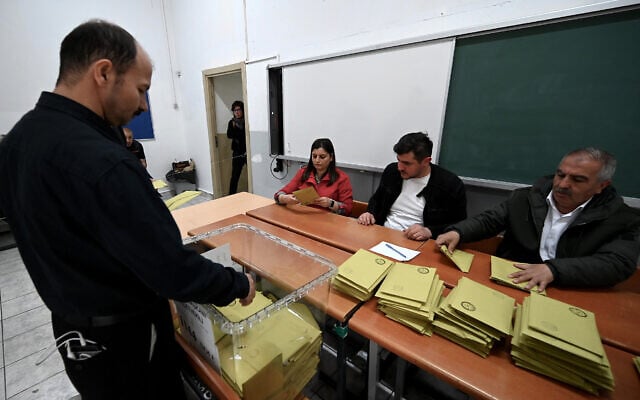
Election officials count votes at a polling station after the Turkish general election concluded in Istanbul on May 14, 2023. Photo: Times of Israel
However, the electoral landscape in the Eurasian nation became complicated when Anadolu Agency was accused of manipulating the figures. Members of Kilicdaroglu's center-left Republican People's Party (CHP) claimed the state-run news agency had shown bias in favor of Erdogan.
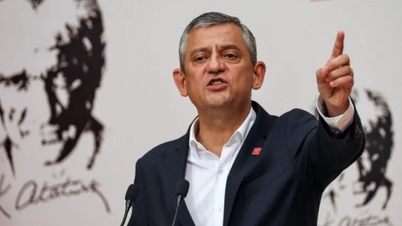
Kilicdaroglu, 74, who ran as a candidate for a coalition of six opposition parties, wrote on Twitter: "We are leading."
Meanwhile, Erdogan's Justice and Development Party (AKP) accused the opposition of "conspiring to assassinate the national will" by claiming the state news agency had distorted the results. The party called the opposition's statements "irresponsible."
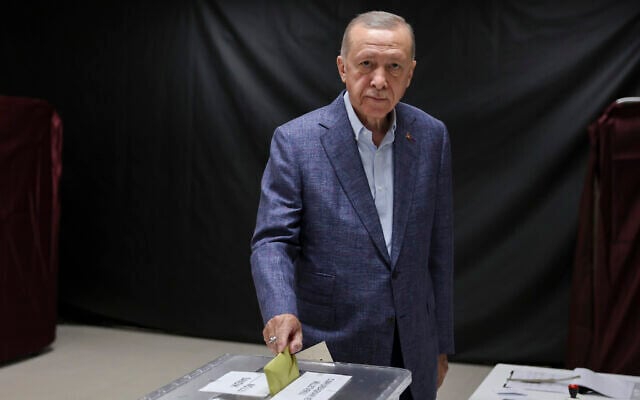
Recep Tayyip Erdogan at a polling station in Istanbul, Türkiye, on May 14, 2023. Photo: Times of Israel
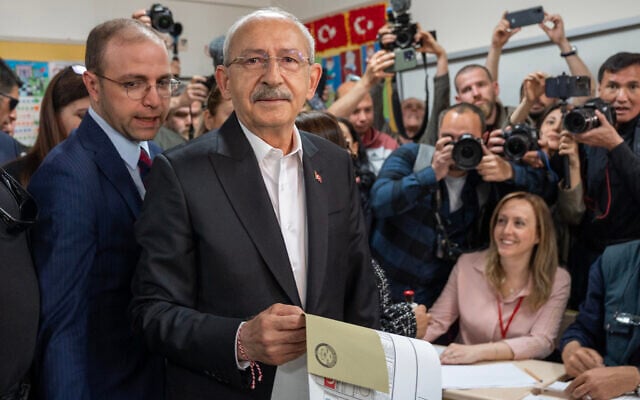
Kemal Kilicdaroglu at a polling station in Ankara, Türkiye, on May 14, 2023. Photo: Times of Israel
The presidential election will decide not only who will lead Türkiye, a NATO member state, but also whether the country will return to a more democratic and secular path; it will also dictate how the government will handle the severe cost of living crisis and manage crucial relationships with Russia, the Middle East, and the West.
The country of 85 million people – already struggling with soaring inflation – now faces two weeks of uncertainty that could rock the markets, with analysts predicting volatility in the Turkish lira and the stock market.
“The next two weeks will likely be the longest in Turkish history, and a lot will happen. I think the Istanbul stock market will collapse significantly, and there will be a lot of currency volatility,” said Hakan Akbas, Managing Director of Strategic Advisory Services .
Minh Duc (Based on Fox News, Axios, Reuters)
Source
























![[Photo] Reception to welcome General Secretary and President To Lam and his wife on their State visit to the Philippines](https://vphoto.vietnam.vn/thumb/1200x675/vietnam/resource/IMAGE/2026/06/01/1780295488620_vna-potal-chieu-dai-chao-mung-tong-bi-thu-chu-tich-nuoc-to-lam-va-phu-nhan-tham-cap-nha-nuoc-toi-philippines-8798060-7855-jpg.webp)






































































Comment (0)