

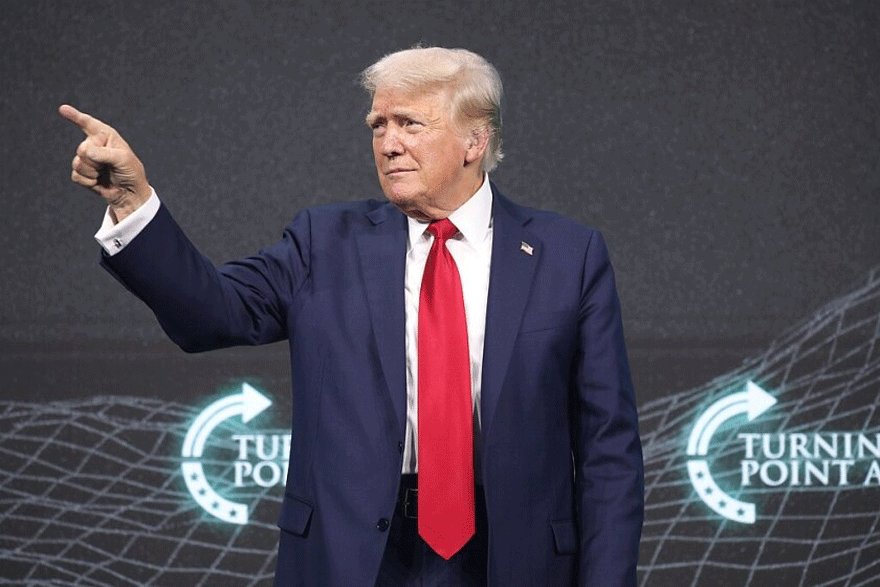
Donald Trump once again declared he would "take back the Panama Canal," while also warning of "strong measures," even though Panamanian President Mulino said he would consider agreements involving China.
According to CNN, President Donald Trump reiterated his vow to "reclaim" the Panama Canal on February 2, while also warning of "strong" action by the United States. Trump had previously made similar statements several times in the face of China's presence around this vital waterway.
According to Mr. Trump, “China is running the Panama Canal which was not given to this country”, and affirmed that Panama had “violated its commitment” (according to the 1977 US-Panama treaty), and declared “will take back the canal”, otherwise “something very big will happen”.
Trump's statement came just hours after U.S. Secretary of State Marco Rubio made his first foreign trip in his new role, meeting with Panamanian President Raúl Mulino and raising hopes of easing diplomatic tensions between the U.S. and Panama.
Following the meeting, Mulino stated that Foreign Minister Rubio "issued no warning about the possibility of the U.S. seizing control of the Panama Canal by force," and that Panama would review agreements involving Beijing and Chinese businesses…
During the meeting with Mr. Rubio, the Panamanian leader acknowledged U.S. concerns about Chinese influence over the Panama Canal and announced that he would not renew the memorandum of understanding (MoU) with the Chinese government on the Belt and Road Initiative (BRI), signed in 2017 under President Juan Carlos Varela.
Mr. Mulino stated that he would study the possibility of ending the aforementioned agreement early.
Panama will also reconsider some cooperation projects with Chinese businesses, including an agreement allowing Panama Ports Company, a subsidiary of Hong Kong-based CK Hutchison Holdings, to lease seaports near both ends of the Panama Canal. The agreement, signed in 2021, has a 25-year term and includes an automatic renewal clause.
President Mulino said he would make a final decision after the government completes its audit of the agreement with the company.
According to CNN, Hutchinson Ports is one of the world's largest port operators, overseeing 53 ports in 24 countries, including other US allies such as the UK, Australia, and Canada.
However, Trump's latest move has reignited tensions between the two countries. Mulino's commitments may not have met Donald Trump's demands, or the White House may want to continue its "maximum pressure" strategy to quickly achieve its goals.
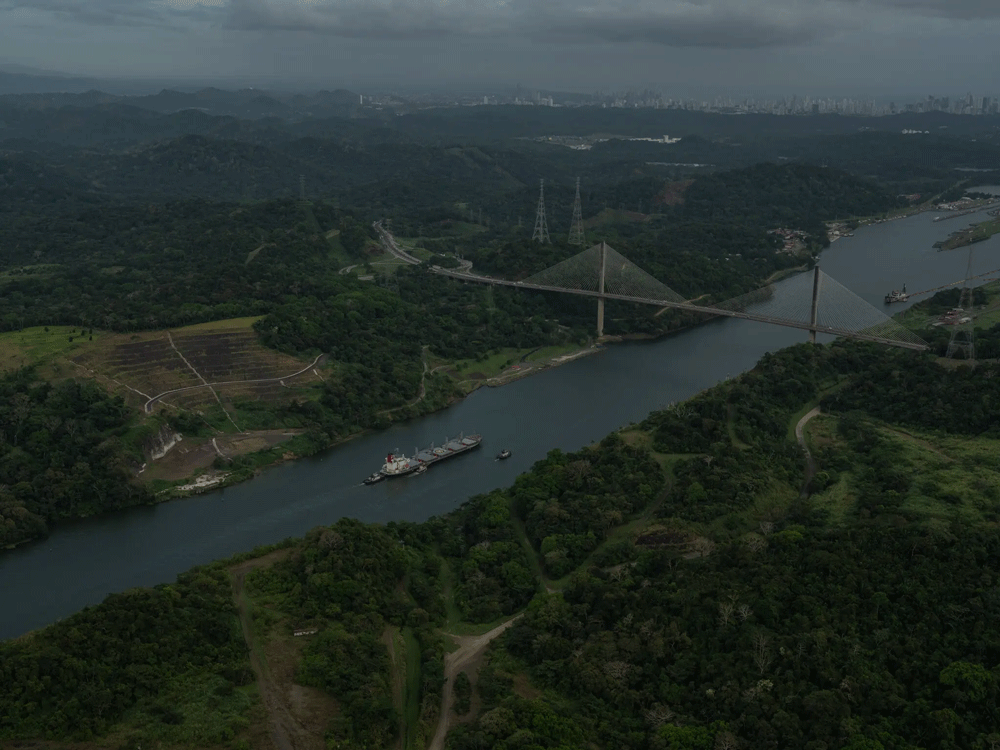
The unique position of the Panama Canal
The Panama Canal is an artificial waterway approximately 82 km long in Panama, connecting the Atlantic and Pacific Oceans and dividing North and South America. The canal cuts across the Isthmus of Panama and is a vital route for maritime trade.
This is considered a strategic gateway for maritime transport and one of the greatest engineering feats of the 20th century. Approximately 6% of global maritime trade passes through this canal, with hundreds of shipping routes connecting thousands of ports worldwide. Excluding oil tankers, over 20% of global cargo passes through this canal. The United States uses the canal the most, accounting for about 40% of container traffic.
The Panama Canal is also a "golden goose" for Panama, contributing approximately 6% to the country's GDP in 2023.
The Panama Canal, over 110 years old, has transformed the landscape of maritime transport, shortening the routes of cargo ships, eliminating the need for vessels to绕 around Cape Horn in southern Chile, South America, saving thousands of kilometers and thus reducing transportation costs.
For the United States, the benefits of the Panama Canal are enormous. Ships carrying goods from the East Coast (such as New York) to the West Coast (such as San Francisco) reduce their journey by more than half, saving tens of thousands of kilometers.
The idea of a sea route connecting the Atlantic and Pacific Oceans via Panama dates back to the 16th century, but it wasn't until early 1882 that a French consortium began construction. However, the project later failed and went bankrupt due to earthquakes, epidemics, differences in sea level, harsh climate, outdated construction techniques, and other factors.
At the beginning of the 20th century, France transferred the exploitation rights to the United States. It took the Americans another 10 years to complete the canal, which opened in August 1914. Afterward, the canal was under the management of the US government until Washington returned it to Panama in 1999 under a treaty signed by the late US President Jimmy Carter in 1977.
The treaty allows the United States to intervene militarily if the waterway's operation is disrupted by "internal conflict or a foreign power."
Recently, Trump and some Republican lawmakers have argued that cooperation agreements between Panama and China regarding the Trans-Panama Canal violate the neutrality commitment in the 1977 U.S.-Panama treaty.
Over the past decade or so, Panama has been a particular focus of China's attention due to its strategic location, as Beijing seeks to expand its influence globally, including in Latin America.
China is currently South America's second-largest trading partner, after the United States. According to the NYT, China also has several multi-billion dollar infrastructure construction contracts in Panama. Both sides have indicated they will also negotiate a free trade agreement.
However, as China's influence grows, so too does pressure from the US on Panama.
Conversely, according to the NYT, China denies having any interest in infringing on Panama's sovereignty or interfering in its affairs. Beijing says it has always respected the canal as a permanently neutral international waterway.
Source: https://vietnamnet.vn/ong-trump-de-doa-dung-bien-phap-manh-vi-the-dac-biet-cua-kenh-dao-panama-2368196.html


![[Photo] Urgently help people soon have a place to live and stabilize their lives](/_next/image?url=https%3A%2F%2Fvphoto.vietnam.vn%2Fthumb%2F1200x675%2Fvietnam%2Fresource%2FIMAGE%2F2025%2F12%2F09%2F1765248230297_c-jpg.webp&w=3840&q=75)


































![[Photo] General Secretary To Lam works with the Standing Committees of the 14th Party Congress Subcommittees](https://vphoto.vietnam.vn/thumb/402x226/vietnam/resource/IMAGE/2025/12/09/1765265023554_image.jpeg)




















Comment (0)