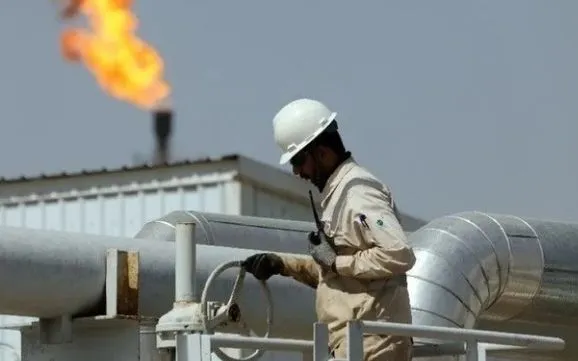
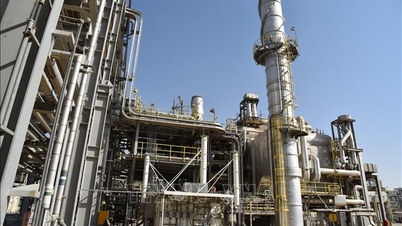
Workers at an oil extraction facility in Wasit, Iraq. (Photo: THX/VNA)
Sources close to the Organization of Petroleum Exporting Countries (OPEC) and its partners, known as OPEC+, said the group had agreed in principle to maintain stable oil production ahead of its meeting at 7 p.m. on January 4 (Vietnam time), despite escalating political tensions between Saudi Arabia and the United Arab Emirates (UAE), as well as major developments related to Venezuela.
The meeting of the eight key OPEC+ countries, the group that produces about half of the world's crude oil output, took place against the backdrop of world oil prices having fallen by more than 18% in 2025, the sharpest year-on-year decline since 2020, due to concerns about increasing oversupply.
The eight countries participating in the meeting were Saudi Arabia, Russia, UAE, Kazakhstan, Kuwait, Iraq, Algeria, and Oman. Between April and December 2025, this group raised its production target by approximately 2.9 million barrels per day, equivalent to nearly 3% of global oil demand.
However, under persistent downward price pressure, in November 2025, OPEC+ agreed to temporarily halt its production increase plan for the first quarter of 2026. According to three sources within OPEC+, the January 4th meeting is unlikely to produce any adjustments to the current policy.
Tensions between Saudi Arabia and the UAE are considered the most serious rift in decades between the two once-close allies, as long-standing differences on strategic issues have erupted publicly, particularly concerning the protracted conflict in Yemen. In the past, OPEC maintained cohesion even during periods of deep disagreement, such as the Iran-Iraq war, by prioritizing oil market stability over allowing political disputes to dominate decision-making.
However, this alliance is currently facing several serious challenges, including pressure from sanctions against Russia, internal instability in Iran, and new developments in Venezuela after the US announced the arrest of President Nicolas Maduro and interfered in the power transition process in the country with the world's largest oil reserves.
In this context, OPEC+'s continued maintenance of production levels is seen as an effort to stabilize the market, but increased geopolitical risks could still be a dominant factor influencing oil price fluctuations in the short term.
Source: https://vtv.vn/opec-giu-san-luong-giua-song-gio-dia-chinh-tri-100260104193341434.htm


![[Photo] Solemn bathing ceremony and Buddha procession in Hue](https://vphoto.vietnam.vn/thumb/1200x675/vietnam/resource/IMAGE/2026/05/31/1780228263543_1-jpg.webp)
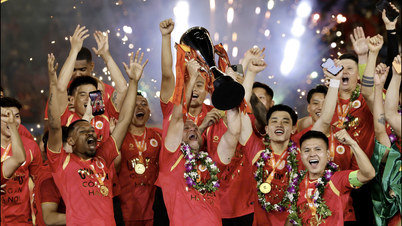
![[Image] Hanoi Police officially crowned champions of V-League 2025/2026](https://vphoto.vietnam.vn/thumb/1200x675/vietnam/resource/IMAGE/2026/05/31/1780244769054_ndo_br_039d561b692be875b13a-jpg.webp)


![[Photo] Admire the coral "masterpiece" amidst the million-year-old heritage of Dak Lak province.](https://vphoto.vietnam.vn/thumb/1200x675/vietnam/resource/IMAGE/2026/05/31/1780221235105_anh-man-hinh-2026-05-31-luc-16-53-27.png)
![[Photo] The General Secretary, President and his wife begin their state visit to the Philippines.](https://vphoto.vietnam.vn/thumb/1200x675/vietnam/resource/IMAGE/2026/05/31/1780230559452_anh-man-hinh-2026-05-31-luc-19-28-11.png)












![[Video] Sunset at Lap An Lagoon – Where the sun sets over the fishing nets](https://vphoto.vietnam.vn/thumb/340x192/vietnam/resource/IMAGE/2026/05/31/1780192137701_beach-landscape-sea-water-nature-grass-745871-pxhere-com.jpeg)



























































Comment (0)