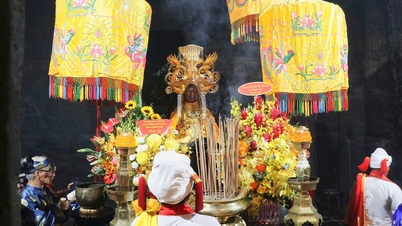
 With his military talent and bravery, General Pham Van made a significant contribution to the victory of the Lam Son Uprising, establishing the Later Le Dynasty (photo taken at the Lam Kinh Historical Site - the spiritual "capital" of the Later Le Dynasty).
Born at the end of the Tran Dynasty in Nguyen Xa village, Luong Giang district (formerly Tho Xuan district), he was one of the generals who participated in the Lung Nhai Oath at the beginning of the Lam Son Uprising and was a founding hero of the Le Dynasty. When Le Loi ascended the throne, he was granted the royal surname (the king's surname), which is why some documents refer to him as Le Van. During the early days of the Lam Son Uprising, facing countless difficulties, shortages of provisions, and being besieged at Linh Son (Chi Linh mountain)... General Pham Van never lost heart. He always stood by his commander, Le Loi, determined to defeat the invading army.
After Le Lai changed his robes and risked his life to save the king, the Ming invaders thought they had killed their commander Le Loi and retreated, lowering their guard. This gave the Lam Son rebels time to consolidate their forces, stockpile provisions, and prepare for a long period of fighting. Later, the invaders discovered this and returned to suppress the rebellion.
In the year Canh Ty (1420), a traitor named Cam Lan guided the Ming generals Ly Bin and Phuong Chinh, along with a large army, straight to Muong Thoi (believed to be a mountainous area in Thanh Hoa province, bordering Laos). At that time, Le Loi ordered Pham Van, Ly Trien, and Nguyen Ly to lead troops ahead to intercept and attack, then set up an ambush at Bo Mong. “When the enemy arrived, Pham Van and the generals took advantage of the treacherous terrain, unleashing an ambush, causing them to flee in disarray. Le Loi anticipated that the Ming army was numerous... and would not easily retreat, so he ordered Pham Van, Ly Trien, and Nguyen Ly to set up ambushes in the treacherous paths. The next day, the enemy indeed arrived, but Pham Van and the generals ambushed them... beheading more than three thousand men. Ly Bin and Phuong Chinh only managed to escape. The rebel army pursued the enemy for six days and nights before stopping, then advanced and set up camp at Ba Lam in Loi Giang” (Tho Xuan District Gazetteer).
Regarding the significance of the Bo Mong victory, according to the book "Famous Vietnamese Generals," Volume 2, "Famous Generals of Lam Son": "Although the scale of the Bo Mong battle was not large, it was one of the important battles of the Lam Son rebels in the early stage - the period of operation in the mountainous forest region of western Thanh Hoa . The victory of the Bo Mong battle prevented the Ming army from being complacent and underestimating the Lam Son rebels. From the Bo Mong battle, Pham Van's military talent began to be affirmed."
Furthermore, in the early stages of the rebellion, the Lam Son army had good relations with Laos. However, later, instigated by the Ming invaders, Laos joined forces with the Ming army to launch a surprise attack in an attempt to suppress the Lam Son rebellion.
In the year of the Tiger (1422), the Ming invaders joined forces with the Laotian army to attack the Lam Son rebels from two sides, creating a critical situation. According to historical records, at that time, King Le Loi of Binh Dinh told his generals and soldiers: "Currently, the enemy is surrounding us on all sides; our army has no escape route. This is what military strategy calls a 'death trap.' Attack quickly and you will live, delay and you will die." After saying this, Le Loi shed tears... Faced with this situation, the Lam Son generals and soldiers unanimously decided to fight to the death. Pham Van, along with generals Le Hao, Le Linh, Ly Trien, and others, bravely charged forward, breaking the encirclement, killing the enemy general Phung Quy and many soldiers... The encirclement by the Ming and Laotian forces quickly disintegrated... After the victory, Pham Van was promoted to the rank of Supreme General, becoming one of the high-ranking commanders of the Lam Son rebels.
In 1424, following Nguyen Chich's plan, King Le Loi of Binh Dinh decided to advance into Nghe An province to find a foothold. In the major battles fought by the Lam Son rebels in Nghe An, General Pham Van played a crucial role, one of which was the Battle of Tra Lan. In this battle, Pham Van and other skilled generals, with their bravery and prowess, broke through the enemy's formation, captured Chu Kiet, and beheaded Hoang Thanh... the river was filled with enemy corpses, and countless supplies and weapons were seized. The Lam Son rebels' prestige soared, and enemy collaborators in many provinces and districts were forced to surrender in fear. After this victory, Pham Van was promoted to the rank of Lieutenant.
In the spring of 1427, riding on their victories, the Lam Son rebels advanced northward. At that time, Pham Van was tasked with establishing a garrison in Dong Thanh to isolate the enemy forces inside... By the end of 1427, the Lam Son rebels fought their final decisive battle against the Ming invaders, the Battle of Xuong Giang. The book "Famous Vietnamese Generals," Volume 2, "Famous Lam Son Generals," writes: “Because of the exceptionally important nature of the battle, Le Loi and the Lam Son command decided to deploy a considerable number of additional soldiers and generals to Xuong Giang. Among the generals assigned to command this supporting force was Pham Van. At that time, thanks to his many merits in commanding the siege of Dong Quan citadel, Pham Van had been promoted to the rank of Commander. He, along with General Le Khoi, led three thousand troops straight to Xuong Giang. And in this large-scale battle, Pham Van once again distinguished himself.”
 A street in the center of Hac Thanh ward is named after General Pham Van.
The Lam Son Uprising was a complete victory, and King Le Loi of Binh Dinh ascended the throne – becoming King Le Thai To. When rewards were given for meritorious service, Pham Van was ranked first, receiving the title of Vinh Loc Dai Phu, Left Kim Ngo Guard Grand General, and the title of Thuong Tri Tu. He was later promoted to Suy Trung Tan, a meritorious official who assisted in governing and maintaining order, and then further promoted to Nhap Noi Kiem Hieu Binh Chuong Quan Quoc Trong Su, holding the power of Prime Minister.
King Lê Thái Tổ, in his decree to Phạm Vấn, highly praised his role: “Considering Phạm Vấn, he is upright and virtuous, decisive and resourceful. In the early days of raising an army to avenge grievances… he endured hardships and sacrifices, dedicating himself wholeheartedly. He conquered land and captured cities… his achievements are immense” (from the book Famous Generals of Vietnam, Volume 2, Famous Generals of Lam Sơn, quoted from Đại Việt Thông Sử).
When King Le Thai To ordered the erection of a plaque inscribed with the names of the founding fathers of the nation, Pham Van's name was listed first. He was granted the title of Huyen Thuong Hau, and later the title of Quan Hau.
In 1433, before his death, King Lê Thái Tổ issued a decree enthroning Lê Nguyên Long – who became King Lê Thái Tông. According to the king's decree, Phạm Vấn was one of the high-ranking officials granted the power of regent. Three years later, Phạm Vấn passed away, and he was posthumously awarded the title of Thái Phó (Grand Tutor) and given the posthumous name Tuyên Vũ. Over the centuries, his achievements have been recorded in historical texts and remembered by posterity. Today, in Hạc Thành ward (formerly Thanh Hóa City), a central street is named after him.
(This article references and uses content from the book "Famous Generals of Vietnam, Volume 2, Famous Generals of Lam Son", Education Publishing House, 1996; and the book "Geography of Tho Xuan District", Social Sciences Publishing House, 2005).
Khanh Loc (Source: Baothanhhoa)
Source: https://svhttdl.thanhhoa.gov.vn/van-hoa/pham-van-gianh-dat-ha-thanh-biet-may-cong-lao-1010090





































































Comment (0)