

 |
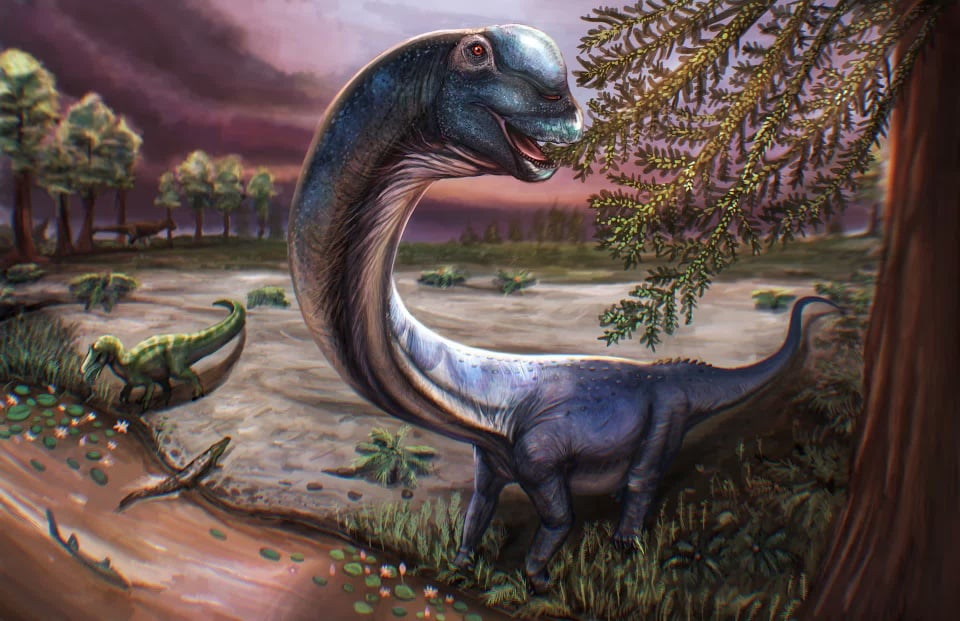
A reconstruction of the Nagatitan sauropod dinosaur, which lived during the Cretaceous period and whose fossil was unearthed in Thailand, is shown in the image released on May 14. |
Along a winding river in the hot, arid land of Thailand about 113 million years ago, a colossal creature nearly 27 meters long leisurely stretched its neck to eat leaves in the tall trees. It had no fear of predators because of its enormous size. That was Nagatitan chaiyaphumensis, the largest dinosaur ever recorded in Southeast Asia, according to Reuters.
Researchers have unearthed the fossil of Nagatitan, a group of sauropod dinosaurs known for their long necks, long tails, small heads, and four large, pillar-like legs.
The first fossils of this Cretaceous dinosaur species were discovered by a local resident in Chaiyaphum province, northeastern Thailand. Over the following years, scientists continued to unearth vertebrae, ribs, pelvis, and leg bones, including a forearm bone measuring up to 1.78 meters in length.
Based on the size of its arm and thigh bones, the research team estimated that Nagatitan weighed approximately 25-28 tons. Its head and teeth have not yet been found, but scientists believe it had a diet similar to many other sauropod species.
"Nagatitan may have been a voracious herbivore, primarily consuming plants that required little chewing, such as gymnosperms and possibly seed ferns," said Thitiwoot Sethapanichsakul, a paleontology PhD student at University College London and lead author of the study published in Scientific Reports .
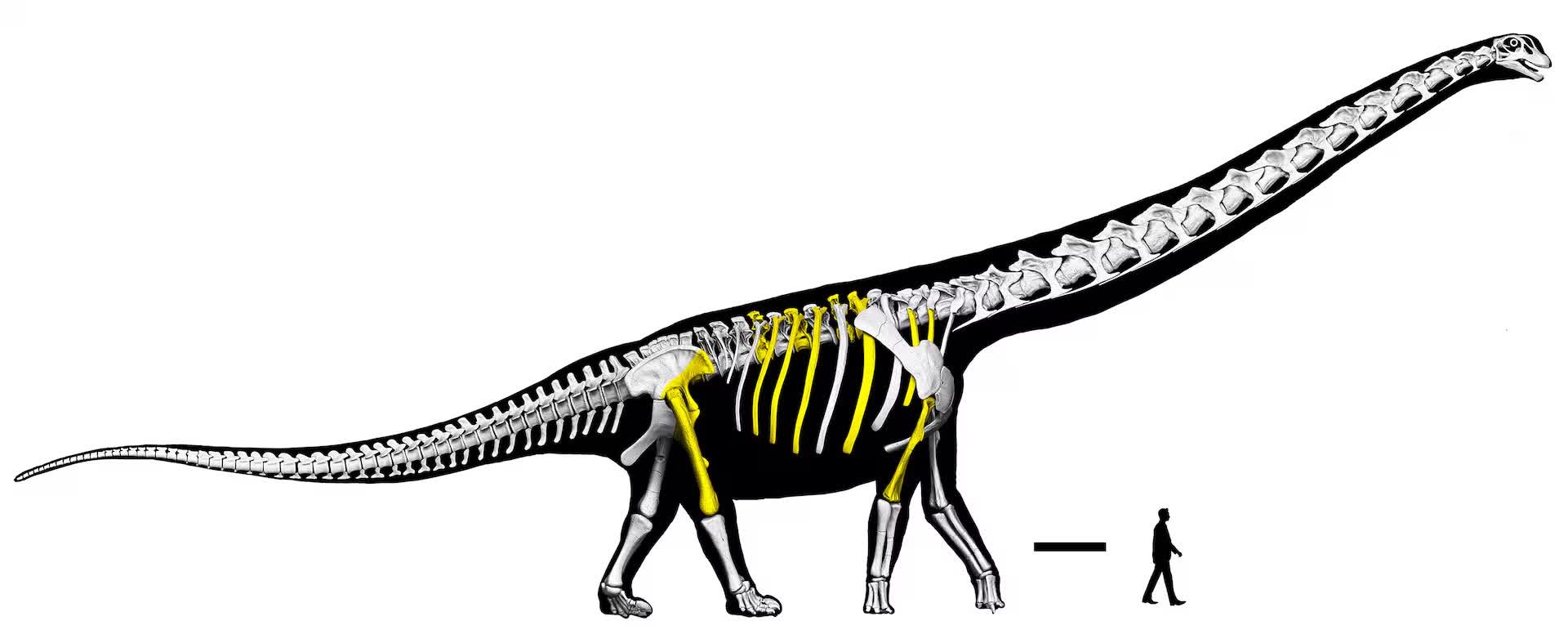 |
This image, released on May 14th, shows a reconstructed skeleton of the sauropod dinosaur Nagatitan chaiyaphumensis, which lived during the Cretaceous period. The excavated fossil remains are marked in yellow. |
According to scientists, the climate at the time was likely subtropical, with forests interspersed with grasslands and shrublands. Nagatitans lived alongside many other dinosaur species as well as pterosaurs. The rivers in the area were teeming with crocodiles and various fish species, including freshwater sharks.
Despite its enormous size, Nagatitan still pales in comparison to some South American sauropod species like Argentinosaurus or Patagotitan, which were over 30 meters long. The name Nagatitan is inspired by Naga, a serpent-like creature found in many Asian beliefs and often carved in temples in Thailand. Thailand has now recorded a total of 14 named dinosaur species.
The discovery of Nagatitan provides further data on sauropod diversity in the region. It is not only the largest sauropod but also the youngest species geologically known in Southeast Asia.
Paul Upchurch, a paleontologist at University College London, suggests that the link between enormous body size and high climatic temperatures is not yet fully understood, but high temperatures may have affected the plant sources that these giant herbivores depended on.
"Nagatitan gives us insight into the period just before global body size and temperature peaked about 10-15 million years later," he stated.
Source: https://znews.vn/phat-hien-hoa-thach-khung-long-lon-nhat-dong-nam-ao-thai-lan-post1652119.html
























































































Comment (0)